Max Bill
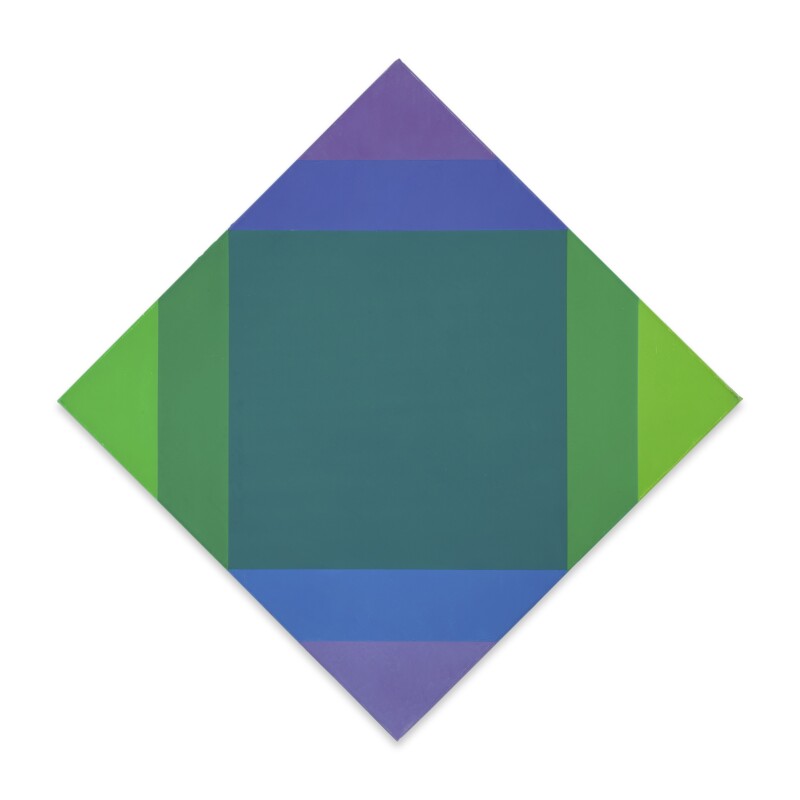
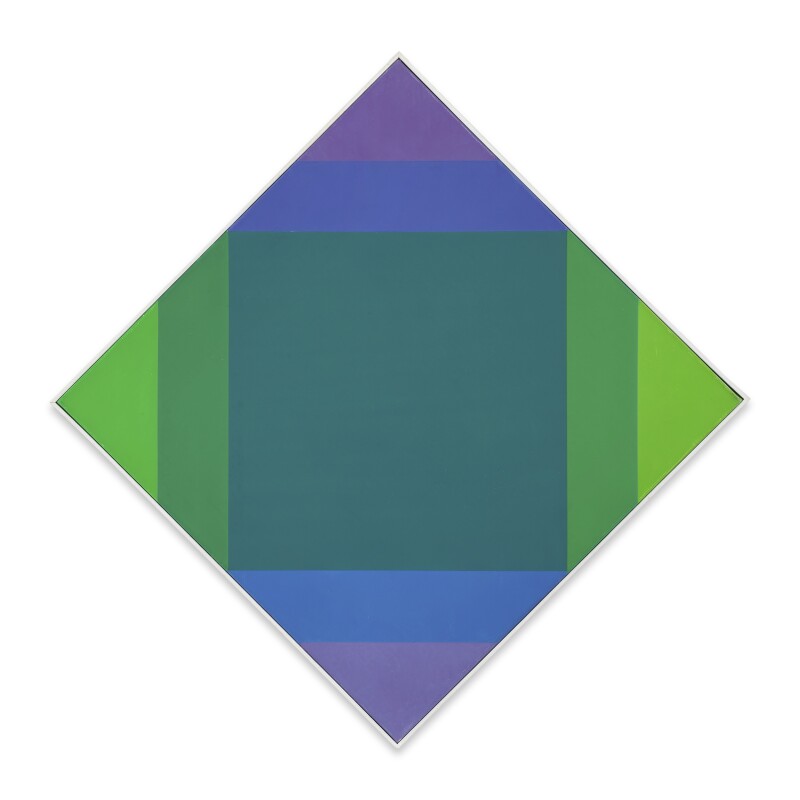
Transcoloration aus Grün
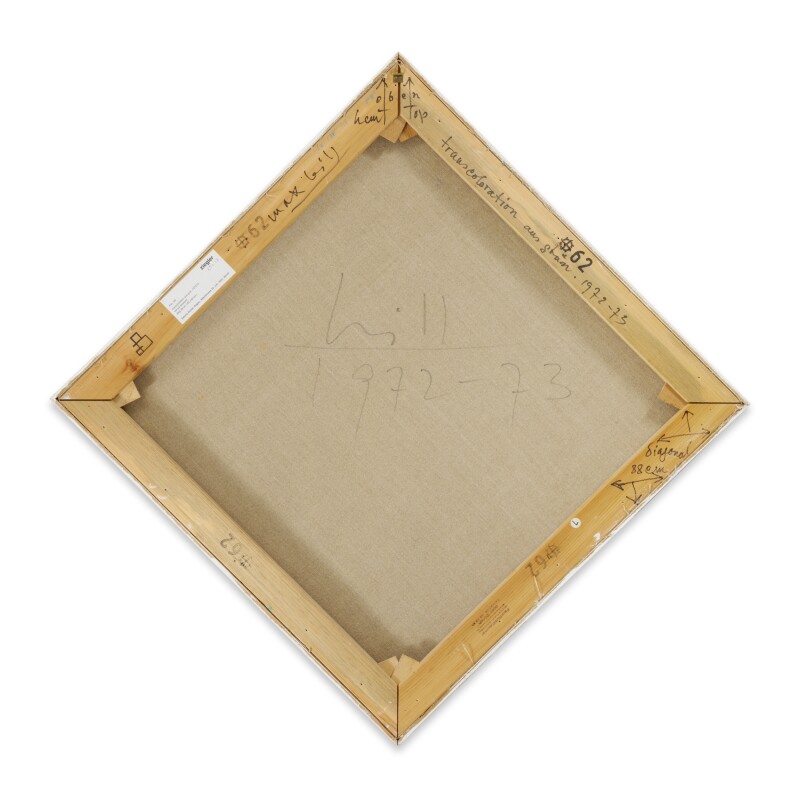
signed bill and dated 1972-73 (on the reverse); signed max bill, titled and dated 1972-73 (on the stretcher)
oil on canvas
24 by 24 in. (diagonal 35 in.)
62 by 62 cm. (diagonal 88 cm.)
Executed in 1972-73.
Price upon request
Taxes not included
VAT and other taxes are not reflected in the listed pricing. Read more
Details

signed bill and dated 1972-73 (on the reverse); signed max bill, titled and dated 1972-73 (on the stretcher)
24 by 24 in. (diagonal 35 in.)
62 by 62 cm. (diagonal 88 cm.)
Provenance
Galerie Ziegler, Zurich
Private Collection, Italy (acquired from the above)
Catalogue Note
This work is registered in the Max, Binia und Jakob Bill Stiftung, Adligenswil.
A geometric construct of vertical and horizontal lines, Max Bill’s Transcoloration aus Grün unfolds into a complex blend of intersecting lines, colours, and movement. Executed in 1972-73, the present work is a mesmerizing example of juxtaposing pure colour fields exemplary of Max Bill’s celebrated abstract oeuvre. It is a mature example of Bill’s multifarious practice. In his use of empirical calculations as a neutralising compositional device, Bill transcends personal and artistic expression to achieve a universal visual lexicon: “Art plainly calls for both feeling and reasoning… It is mankind’s ability to reason which makes it possible to coordinate emotional values in such a way that what we call art ensues. Now in every picture the basis of its composition is geometry or in other words the means of determining the mutual relationship of its component parts either on plane or in space” (Max Bill, ‘The Mathematical Approach in Contemporary Art’, in: Kristine Stiles and Peter Selz, Theories and Documents of Contemporary Art: A Sourcebook of Artists’ Writings, Berkeley 2012, pp. 92-93). An advocate of mathematically based artistic production, Bill sought to create autonomous forms that in turn visually echo the New Physics of the early Twentieth Century.
One of the main protagonists of the Concrete Art Movement, Bill was highly influential, practicing not only as an architect, painter, sculptor and graphic designer, but also as a scholar, politician and writer. He initially trained as a silversmith before studying at the Bauhaus in the late 1920s. In Dessau, Bill met some of the most respected artists of the day, studying under Josef Albers, Wassily Kandinsky, Paul Klee and Oskar Schlemmer. The ethos of the Bauhaus, simplicity of design with form and function hierarchically equal, profoundly influenced Bill. Throughout his interpretations of Constructivism, he integrated the study of both mathematics and geometry into his artistic practice.