/
private sales


Private Sale
Domingo Milella
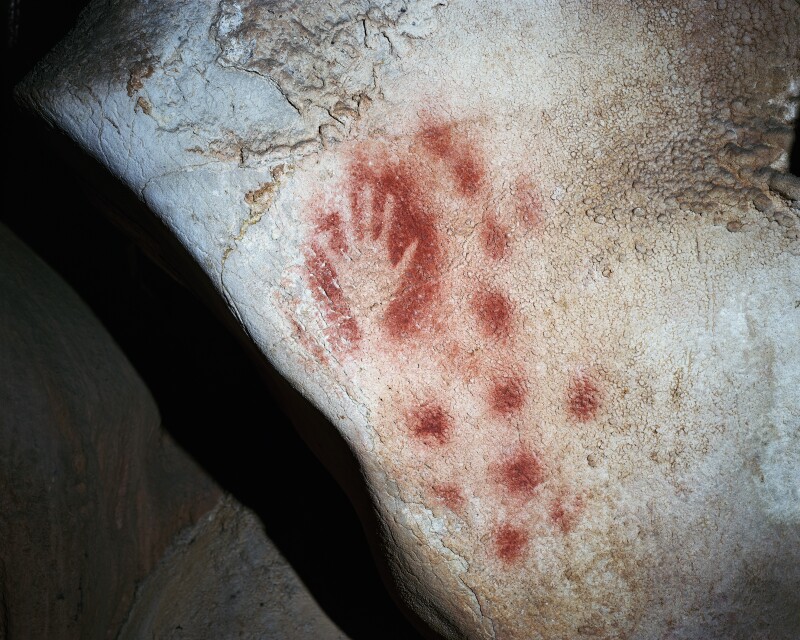
Pech Merle, Hand and Discs, France 2018
Inkjet print mounted between Plexiglass and Dibond
Print 120 x 150 cm. 47 1/4 x 59 in.
Frame 126.5 x 156.5 cm. 49 3/4 x 61 5/8 in.
Edition 2 of 5 + 2 AP
Executed in 2018.
Price upon request
Taxes not included
VAT and other taxes are not reflected in the listed pricing. Read more
Details

Print 120 x 150 cm. 47 1/4 x 59 in.
Frame 126.5 x 156.5 cm. 49 3/4 x 61 5/8 in.
Edition 2 of 5 + 2 AP
Provenance
Directly from the artist studio
Exhibition
Sotheby's Maison, Hong Kong, Domingo Milella LIMINAL, 10 June – 20 August 2026
Gravettian (approximately 30,000 to 25,000 years ago)
Hand stencils—or negative handprints—and discs, created using the same technique (blowing liquid pigment onto the surface), are characteristic motifs of the earliest phase of cave art. In the Pech Merle cave, these forms abound; they are not, strictly speaking, representations, but rather testimonies to an art that some archaeologists have termed “pericorporeal.” In this type of art, the act of painting is essential, and the true core of meaning likely lies in the sequence of gestures involved in its execution: Imagine the artist placing his or her hand (or that of another group member, such as a child) on the wall and blowing paint onto it. At that moment, the hand, covered in color, merges completely with the wall, which has been, at the same time, stained. In a third step, upon lifting the hand, its imprint remains visible, forever bound to the rocky surface. One cannot imagine a more powerful way to assimilate mind and cave.