/
khamseen 50 years of saudi visual arts
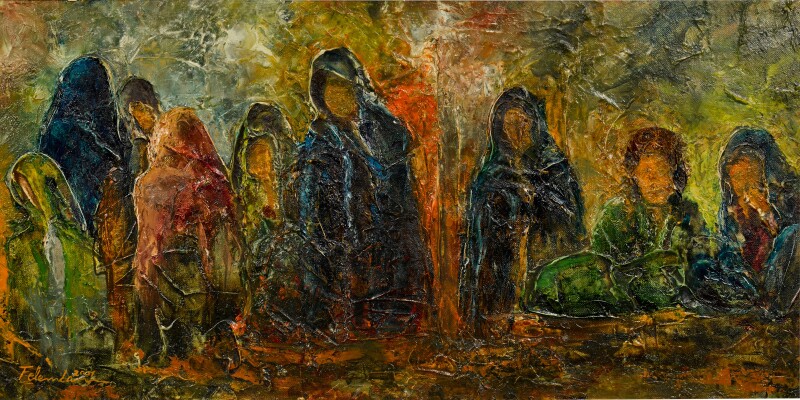
AHMED FELEMBAN (B. 1951), ARRIVAL
signed and dated Felemban 2001 in English (lower left); with stamped certificate of authenticity in Italian and Arabic (to the reverse)
oil and gesso on canvas
30 by 59.5 cm. 11 ¾ by 23 ½ in.
Framed: 42 by 71 cm. 16 ½ by 28 in.
Executed in 2001.
Price upon request
Taxes not included
VAT and other taxes are not reflected in the listed pricing. Read more
Details

signed and dated Felemban 2001 in English (lower left); with stamped certificate of authenticity in Italian and Arabic (to the reverse)
oil and gesso on canvas
30 by 59.5 cm. 11 ¾ by 23 ½ in.
Framed: 42 by 71 cm. 16 ½ by 28 in.
Executed in 2001.
Catalogue Note
Ahmed Felemban was born in Mecca in 1951. He received a scholarship in 1967 to pursue studies abroad at the Accademia delle Belle Arti in Rome, graduating in 1971. Felemban’s portrait paintings are recognised for their ability to convey the complexities of human suffering, and a characteristic of his work is the focus on subject matter over stylistic considerations. Through painting these evocative portraits that depict themes of poverty, hunger and oppression, his aim is to underscore social injustices and encourage viewers to confront and engage with these pressing topics. In the 1970’s, Felemban also experimented with acid etching on zinc plates to create abstract prints. In creating compositions that convey the depths of pain and suffering, he has employed a colour palette of dull greens, oranges and browns that impart the works with a heavy emotional atmosphere. Upon returning to the Kingdom in 1974, Felemban began his career as an arts educator, and later became an art supervisor at a secondary school. Alongside educational work, he has also maintained a prolific journalism career, writing over 400 articles and art critiques in newspapers across Saudi Arabia, Italy and Austria. Felemban has also published several books on the history of Saudi Arabian art with notable titles including ‘Art in Half a Century,’ ‘Lights Glow on Saudi Art’ (2016) and ‘Saudi Plastic Arts’ (2007). He is a member of the Italian Academy for Art and of the World Artists Association. In 2018, the Misk Art Institute celebrated him as a pioneer of Saudi Art. A testament to the expansive impact of his work, Felemban’s paintings are held in the collection of the Saudi Ministry of Foreign Affairs, the Al Mansouria Foundation, the Italian Ministry of Foreign Affairs, and the National Museum of Graphic Arts, Rome.
“[His] paintings reflect the many pains humans go through, the successive losses that include loss of fortune, loss of souls. Some of these pictures that the artist tried to paint is illness, for his characters are often pale, fraile [...] and fragile. Their body’s constitution can be seen through their clothes, which are brilliantly drawn by Felemban, marking their limits and curves in an unparalleled stroke of knives in drawing and colouring.”
Dr Sami Jreidi, “Tragedy in Visual Scenes,” in Exh. Cat., Jeddah, Hafez Gallery, Ahmed Felemban: Woes Ruminations, n.d., n.p.