/
interiors
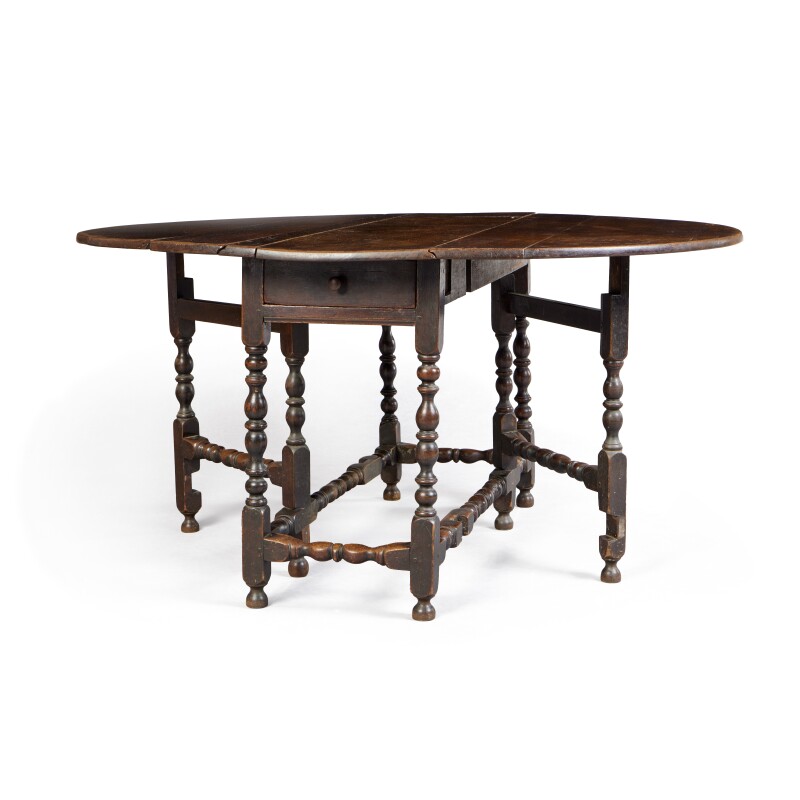
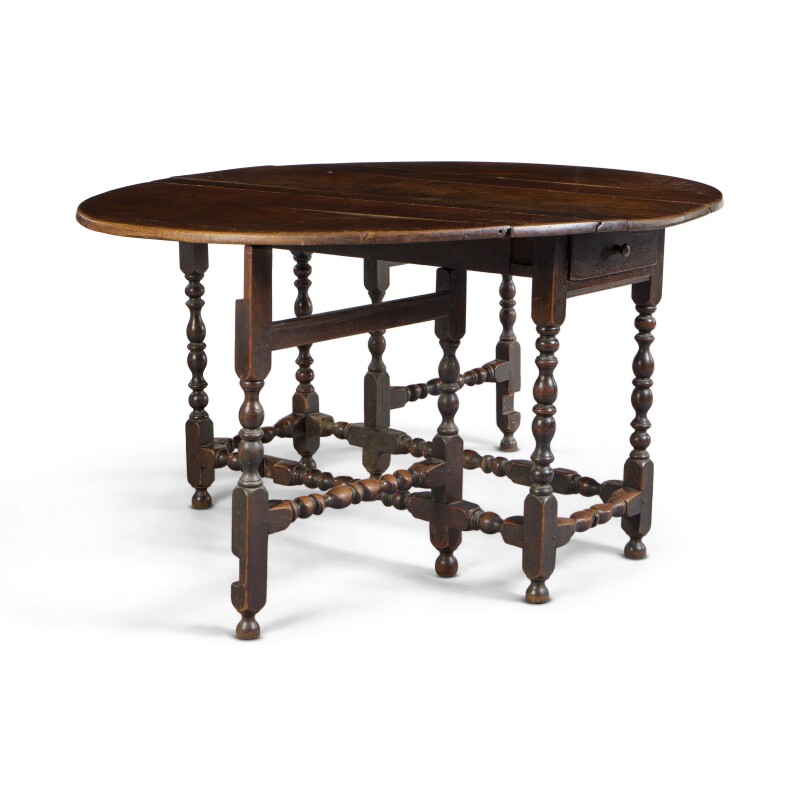

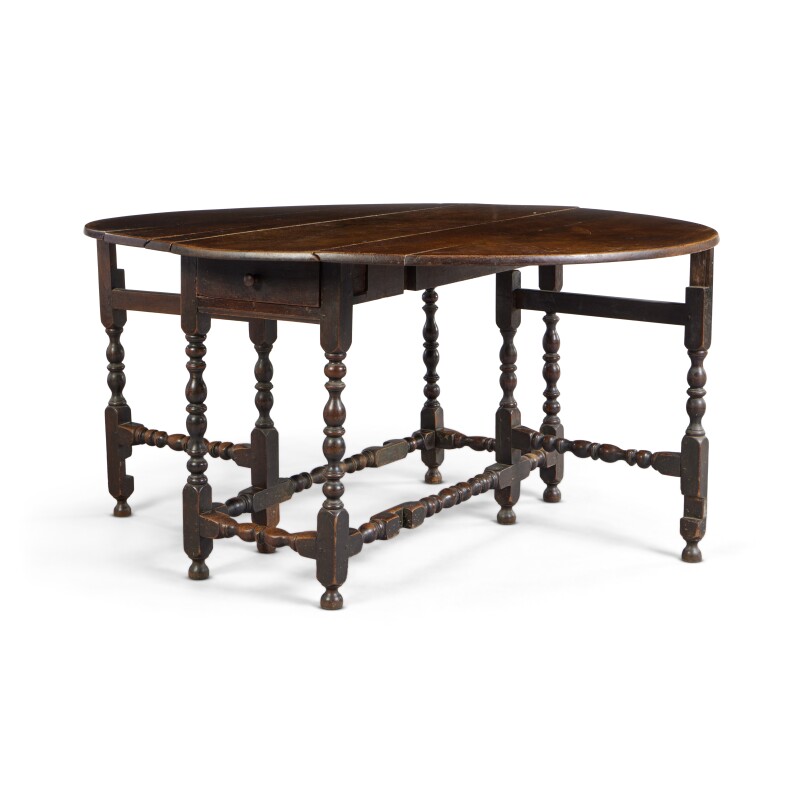
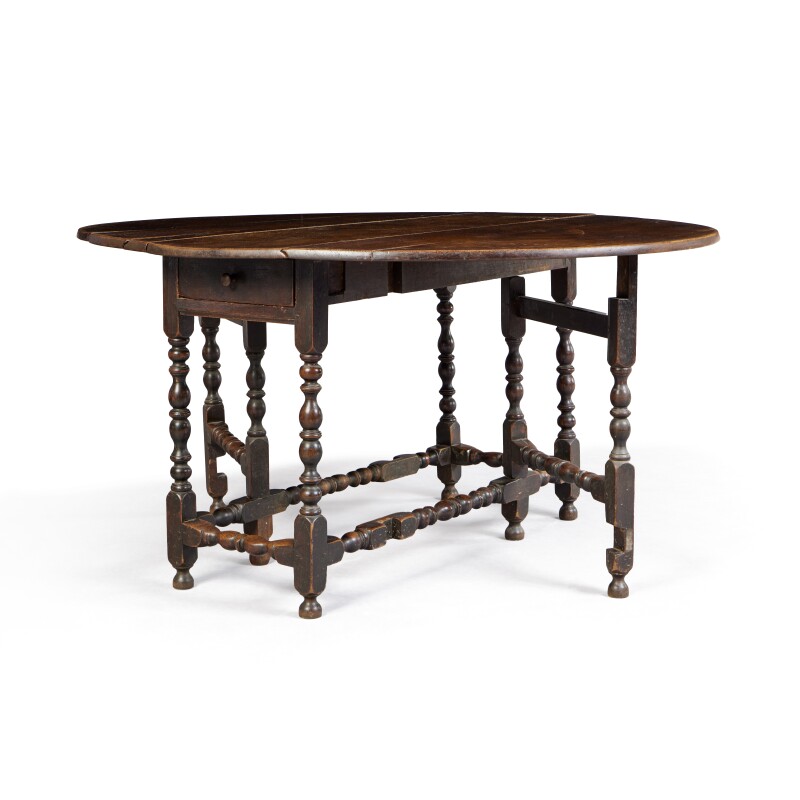
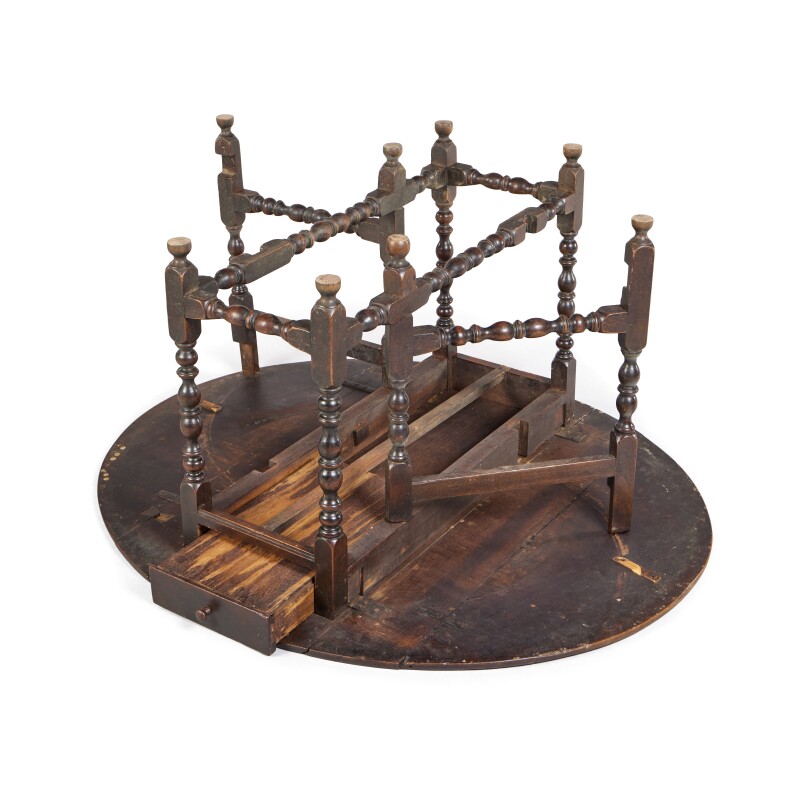
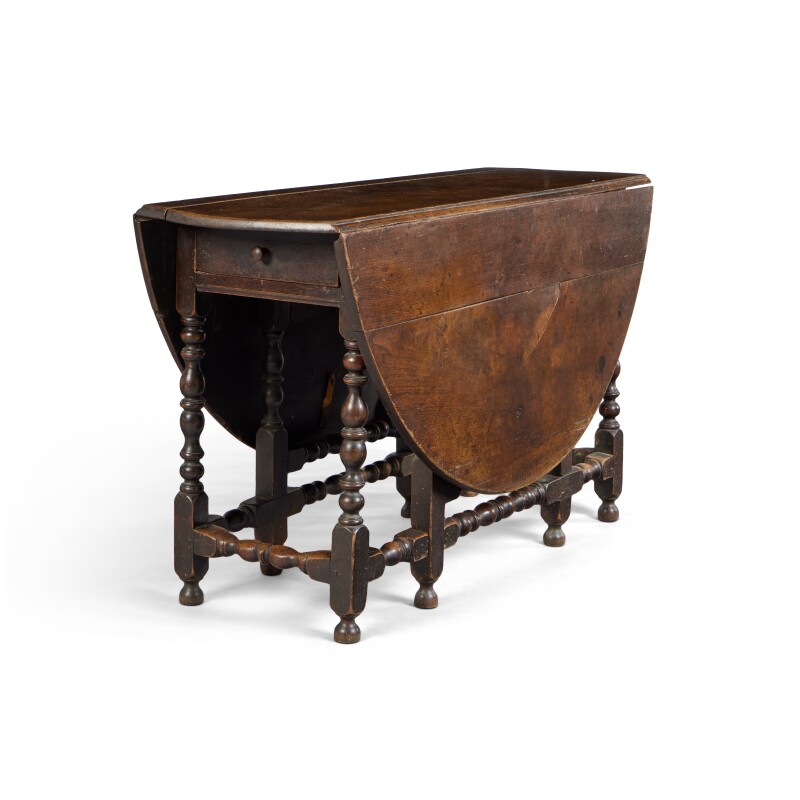
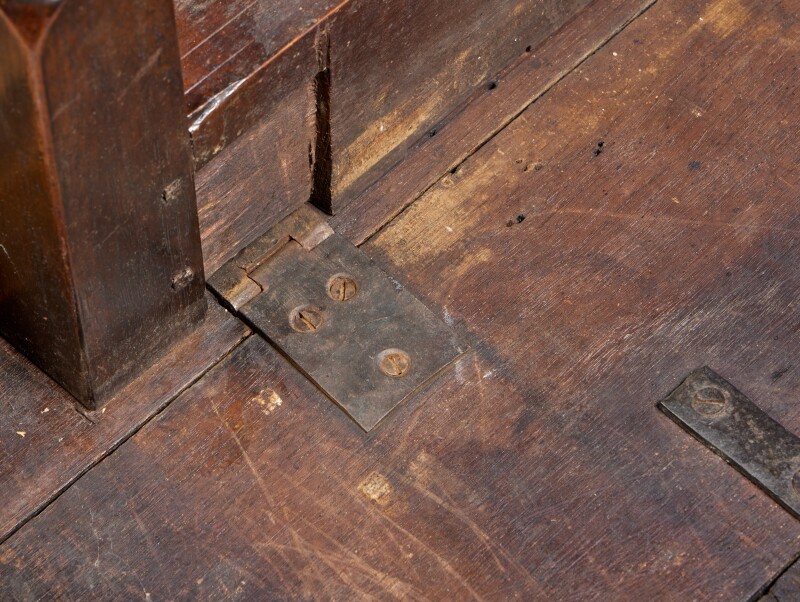
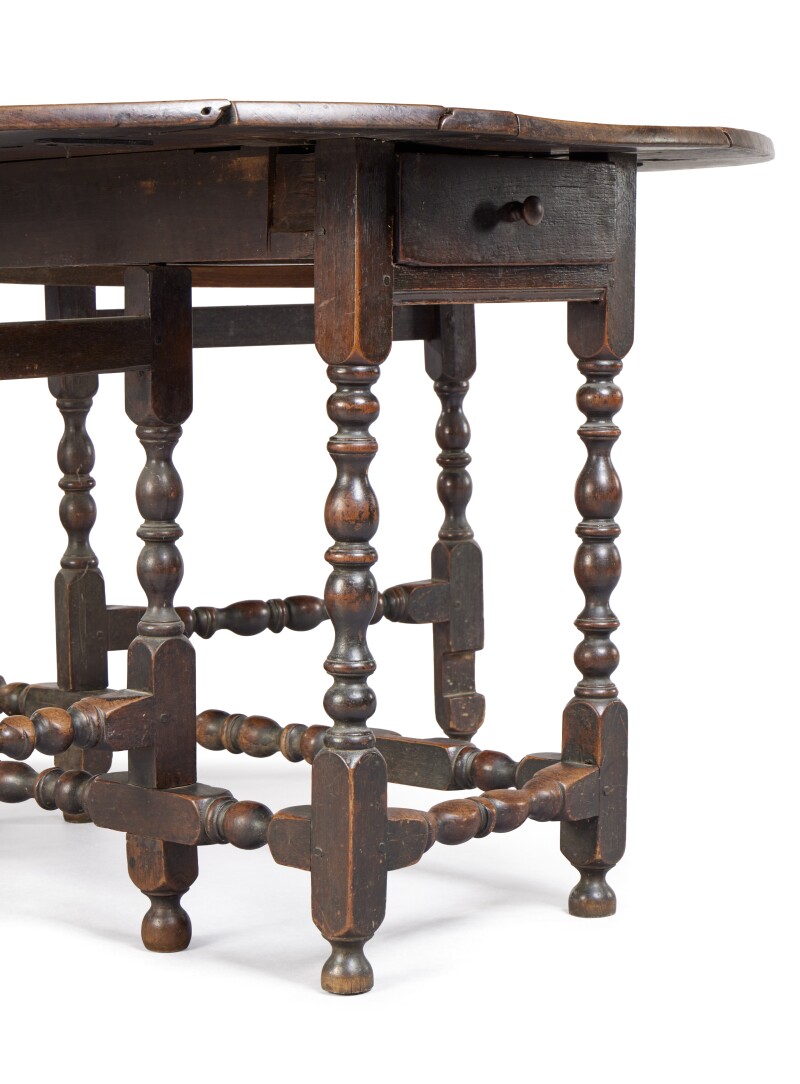
The Historically Important Abigail Wiswell Jones William and Mary Gateleg Dining Table, Boston, Massachusetts, Circa 1720
Price upon request
Taxes not included
VAT and other taxes are not reflected in the listed pricing. Read more
Details

Description
height 28¼ in. by width 56 in. by depth 47 in.
black walnut, white pine and oak.
appears to retain an old and probably original finish.
Provenance
Abigail Wiswell (1721–1814) and Rev. Thomas Jones (1721–1774), Burlington, Middlesex County, Massachusetts;
to daughter, Martha Jones (1758–1803) and Rev. John Marrett (1741–1813), Burlington, Middlesex County, Massachusetts;
to daughter, Martha Marrett (1783–1860) and Rev. Samuel Sewall (1785–1868), Burlington, Middlesex County, Massachusetts;
to son, Samuel Sewall (1819–1903) and Elizabeth Brown (1820–1909), Burlington, Middlesex County, Massachusetts;
to son, Samuel B Farrington Sewall (1846–1883) and Louisa E. Farrington (1848–1917), Burlington, Middlesex County, Massachusetts;
to daughter, Nellie Louise Sewall (1873–1959) and Edward Dana Bennett (1871–1941), Barnard, Windsor County, Vermont;
to daughter, Mary Elizabeth Bennett (1902–1977) and Stephen Henry Earl Lowther (1899–1940), Burlington,
Middlesex County, Massachusetts;
to son, Henry Erle Lowther (1932–2015) and Norma J. Ruth (1941–2013), Nashua, New Hampshire;
Sotheby’s New York, Important Americana, October 13, 2000, sale 7521, lot 263;
Leigh Keno American Antiques, New York;
Private collection;
Sotheby’s, New York, Important Americana, January 23, 2015, sale 9300, lot 850.
Catalogue Note
This remarkable table stands as a silent witness to one of the most momentous moments of American history. Made in Boston, Massachusetts during the first quarter of the eighteenth century, this outstanding table descended through nine generations of the Jones, Marrett, Sewall, Bennett and Lowther families. The table’s importance lies not only in its exceptional form and condition, but to the events it beheld on the fateful early morning of April 19, 1775.
As night fell on April 18th, Dr. Joseph Warren told Paul Revere and William Dawes that the British troops were intending to embark in boats from Boston for Cambridge and march along the road to Lexington to capture John Hancock and Samuel Adams and then continue on to Concord to capture or destroy its military stores. By 11 o’clock, Revere was riding through the countryside alarming the local militia along the way. He arrived in Lexington sometime shortly after midnight at the residence of Reverend Jonas Clarke where Adams and Hancock were staying. Upon the news, the Founding Fathers quickly departed and headed for the home of Madam Abigail Wiswell Jones and Reverend John Marrett in Woburn, Massachusetts (present-day Burlington).1
Along their journey to Woburn, Hancock realized that he had inadvertently left behind a trunk that held documents which detailed his involvement in the Massachusetts Provincial Congress and the Continental Congress in Philadelphia. He sent John Lowell, his personal secretary, back to the tavern to retrieve the trunk, his fiancé, Dorothy Quincy, and his aunt, Lydia Hancock, as well as a fine salmon that was to be their breakfast.2
In the early morning of April 19, 1775, Dorothy and Lydia arrived at Madam Jone’s home to find Samuel Adams, John Hancock and Rev Marrett sitting at this very table discussing the evening’s fraught events. As the salmon was being prepared and the table dressed, musket fire between American militiamen and British regulars could be heard coming from the Lexington green. Adam’s exclaimed “Oh! what a glorious morning is this!” However just before they were about to partake of the bountiful meal placed before them, a man rushed wildly into the house exclaiming “My wife, I fear, is by this time in eternity now ... and as to you ... you had better look out for yourselves, for the enemy will soon be at your heels.” Adams and Hancock rushed to their feet and were guided by Rev. Marrett and Madam Jones’ African American slave, Cuff Trot, to safety at the home of Amos Wyman in nearby Billerica, Massachusetts.3
This remarkable table has been a long-treasured family heirloom. After the fateful events of April 19, 1775, the table continued to reside in the Madam Jone’s house. Abigail Wiswell Jone’s inventory taken August 25, 1814 lists one “Oval Table” at $2.00 in the East Room. The house, built in 1733 for Sergt. Benjamin Johnson, was later called the Sewall house in remembrance of Rev. Samuel Sewall a later descendant and historian. Tragically, on the evening of April 23, 1897, slightly more than one hundred and twenty-two years since the house was used as a refuge for two of America’s leading Founding Fathers, it caught fire and burned to the ground.4
The May 1, 1897 account from the Woburn News stated that the family escaped unscathed and “By persistent
effort they were able to save some furniture, pictures etc. in the parlor, front hall and sitting room. All else perished.” “The chief articles of historical interest saved were: the clock bought by Rev. Thomas Jones about 1751, the table spread for Hancock and Adams, April 19, 1775, 2 chairs belonging to Mr. Jones, 5 chairs brought from the Sewall house at Marblehead, the portrait of Rev. Nathaniel Henchman and his wife, a light-stand which belonged to Mr. Jones, the desk of Joseph Sewall once State Treasurer, and a few curios collected by Rev. Samuel Sewall, and his brass candlestick.” Burlington, Massachusetts had such a reverence for the Sewall home it incorporated its image into the town seal and the Burlington Historical Committee recently erected a commemorative plaque at its location.5
This table is one of those exceedingly rare objects which was present at a momentous historical moment. Its hand-worn top and foot-worn stretchers were privy to the most intimate initial conversations relating to the dawn of American Independence. With the Revolution at its infancy, Samuel Adams and John Hancock were at their most vulnerable. Capture meant certain death to them both and yet they had the composure to sit at this table, contemplating the world before them, and preparing for their future. Little could they have imagined how pivotal their involvement in the Patriots cause was to the history of the world as we know it today.
Samuel Adams wrote, “Will the spirits of the people as yet unsubdued by tyranny, unawed by the menace of arbitrary power, submit to be governed by military force? No.” While John Hancock stated, “Some boast of being friends to government; I am a friend to righteous government, to a government founded upon the principles of reason and justice; but I glory in publicly avowing my eternal enmity to tyranny.”6
This table stands as a witness to their undying principles.
1 Samuel Sewall, The History of Woburn, Middlesex County, Mass., From the Grant of its Territory to Charlestown, in 1640, to the Year 1860, (Boston: Wiggin and Lunt, 1868), pp. 365-6.
2 Henry Schwan, “‘Box of Treason’: An interesting link to America’s independence resides in Worcester,” Telegram & Gazette, April 19, 2022. https://youtu.be/ou1kr_DitwE?si=GhsxYeUVCSyrTsGW&t=438.
3 Form C Object, Massachusetts Historical Commission, Assessor’s Number 56/84, Area H, Form Number 947. There are diffreing report of what was exactly exlaimed to Hancock and Adams. Other reports state “The British are coming! The British are coming!” was shouted. Ellen C. D. Q. Woodbury, Dorothy Quincy: Wife of John Hancock, (Washington: The Neale Publishing Company, 1901), pp. 63-9. For additional information on Cuff Trot see John E. Fogelberg, “Burlington Past and Present: Slavery Did Exist in Early Burlington”, The Daily Times and Chronicle, Tuesday, October 16, 1979. Samuel Dunster, Henry Dunster and His Descendants, (Central Falls, RI: E. L. Freeman & Co., Steam Book and Job Printers, 1876), p. 84-7, 96-7, 329. https://www.gutenberg.org/cache/epub/49742/pg49742-images.html#Page_30 https://youtu.be/v81zbDfqMgY?si=_Inr_ex6lbxJ0xZi.
4 Along with the table are listedt an assundry of other items typically used in a dining room including set of cups and sausers, glassware, waiters, and pewter platers and plates. Middlesex, Massachusetts Probate Court Record, 1814-1816, Vol. 121, pp. 1114-6.
5 Woburn News, May 1, 1897. https://www.geocaching.com/geo-cache/GCQF5K_adams-hancock-the-salmon
6 Boston Gazette, December 5, 1768. John Hancock, An Oration Delivered March Fifth, 1774, (Boston: Edes and Gill, 1774) 6.
Dimensions
Materials
Country of Origin