/
interiors
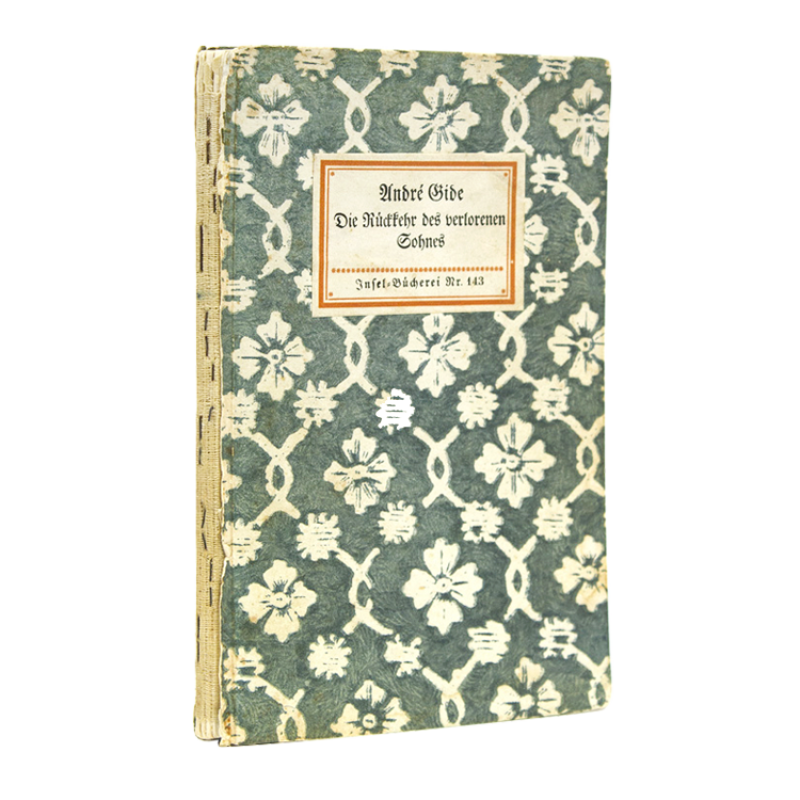
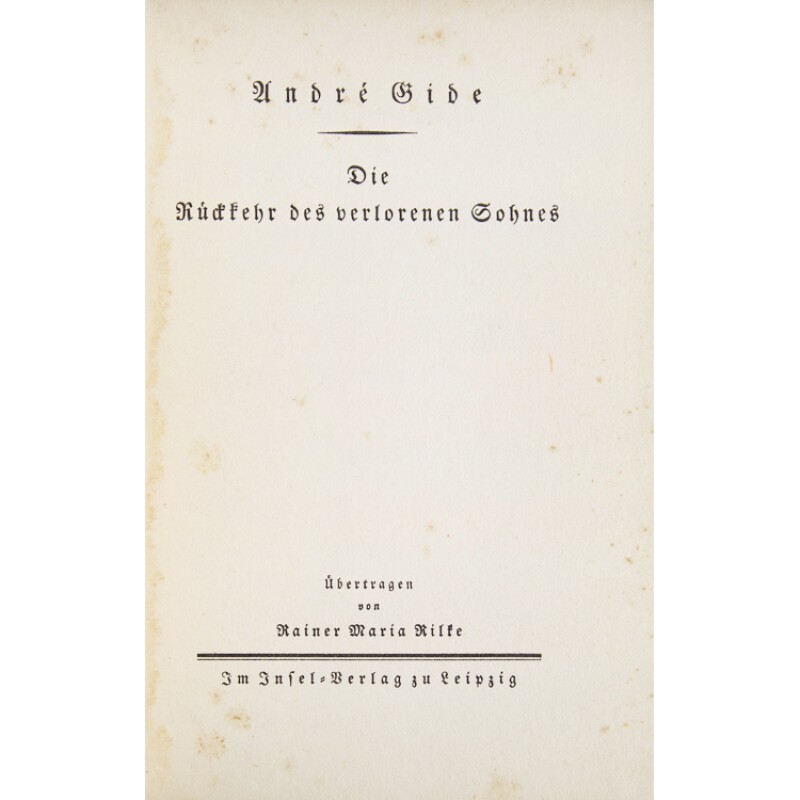
Gide, André
Die Rückkehr des verlorenen Sohnes
Insel-verlag
1914
Complimentary Shipping
Price:
International shipping available
Customs duties and taxes may apply.
Ships from: New York, United States
Taxes not included
VAT and other taxes are not reflected in the listed pricing. Read more
Authenticity guaranteed
We guarantee the authenticity of this item.
Details

Description
First edition, inscribed copy of Rilke's translation of Gide's Die Rückkehr des verlorenen Sohnes (The Return of the Prodigal Son).
- André Gide (French).
- Translated by Rainer Maria Rilke (German).
- Leipzig: Insel-verlag, [1914].
- 38, [2], [2 ad] pp.
- Small 8vo.
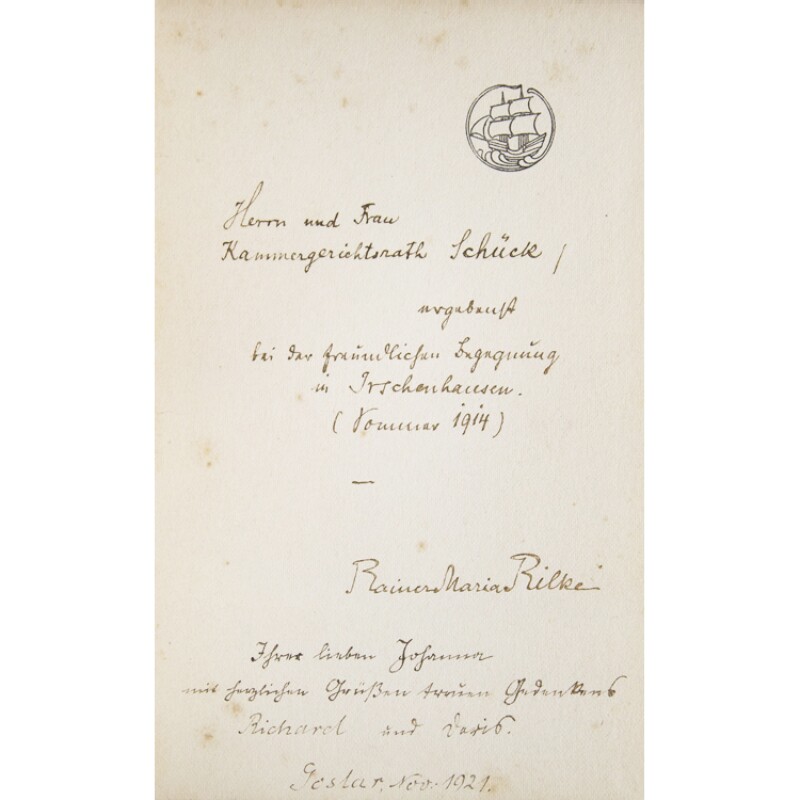
- Presentation inscription by Rilke to Dr. and Mrs. Richard Schück.
- Gift inscription "Johanna" dated 1921.
- Suzy Q. Gooden ownership inscription dated January 24, 1964.
- Original decorative paper-covered boards, title label to upper cover.
First edition of Rilke's translation, inscribed on the leaf preceding the title: "Herrn und Frau Kammergerichtsrath Schück. / ergebenst / bei der freundlichen Begegnung / in Irschenhausen. / (Sommer 1914) / Rainer Maria Rilke" [To Mr and Mrs Judge Schück, respectfully, at our friendly encounter, in Irschenhausen (Summer 1914).
Rilke spent the end of summer and early fall of 1914 in Irschenhausen, a spa town near Munich, while recovering from a minor lesion on his lung. It was on this visit that he commenced his two-year affair with the painter Lou Albert-Lasard. The inscribee Dr. Richard Schück sat on the Kammergerichts, the highest state court in Berlin. The gift inscription below Rilke's inscription is evidently from the judge and his wife.
Rilke's new German translation of Gide's short story Le retour de l'enfant prodigue, published as number 143 in the popular Insel-Bücherei series, introduced Gide to a wider German audience. Rilke had concluded Malte Laurids Brigge with his own recasting of the parable of the prodigal son, perhaps inspired by Gide's story, which he first encountered in Kurt Singer's translation in Neue Rundschau in May 1907 (see A Companion to the Works of Rilke, p 182). Gide's translation of sections of Rilke's Malte Laurids Brigge appeared in La Nouvelle Revue Francaise in 1911. Rilke had admired Gide from a distance for some time before becoming personally acquainted with him through mutual friends in 1910, after which the two maintained a lifelong friendship and correspondence. "Gide was Rilke's first important French literary influence and it was through him that Rilke met most of his French friends, above all the figure who, for him, was to represent the pinnacle of French poetry and whose work he was to translate, Paul Valéry" (Sheridan, Gide, p 242).
Provenance
Suzy Q. Gooden
Dr. and Mrs. Richard Schück
Condition Report
 Good
GoodSome spotting to title.
Backstrip lost.
Product is used.
Feature(s)
Language
Subject
Conditions of Business
Please note that the cancellation right for EU/UK purchasers applies to this item. Please read Condition 19 of the Buy Now Marketplace Conditions of Business for buyers for more information. Read more here.