Property of a Gentleman | 仕紳收藏
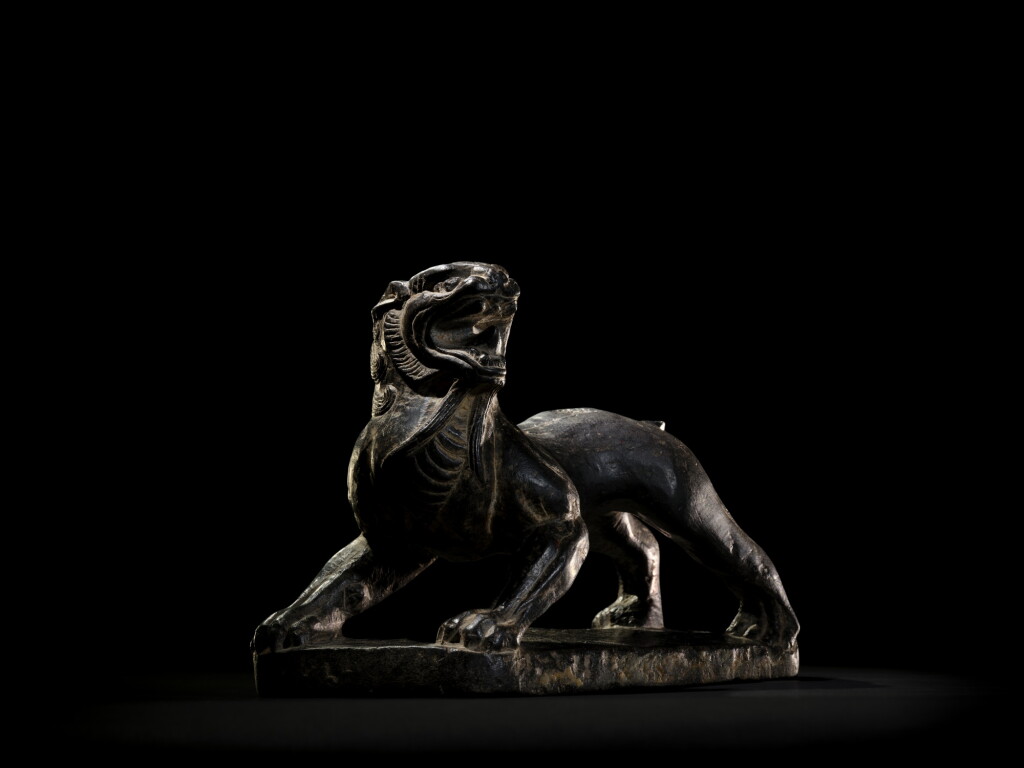
A very rare black limestone carving of a lion, Six Dynasties, 6th century | 六朝六世紀 黑石灰岩雕獅像
Auction Closed
May 5, 01:09 PM GMT
Estimate
700,000 - 1,400,000 HKD
Lot Details
Description
21.6 cm
A French private collection.
Eskenazi Limited, London, 2010.
Collection of Norman A. Kurland.
Eskenazi Limited, London, 2014.
Tang: Ceramics, Metalwork and Sculpture, Eskenazi Limited, New York, 2021, cat. no. 2.
This carved lion recalls an earlier lineage of monumental stone guardians that lined the Spirit Road to tombs from around the Eastern Han period (25–220 AD). Paired beasts stood as apotropaic sentinels at entrances, vigilant against malign forces, and smaller figures like this likely protected inner chambers. Yet unlike earlier stylised forms, this lion pulses with vitality: its body drawn taut, its stance alert, its energy immediate, caught between stillness and sudden motion.
The lion itself is not indigenous to China. Its image arrived through contact with lands to the west: India, Iran, Assyria, and the ancient Near East, and was gradually woven into the visual and symbolic fabric of Chinese art. Linked to Buddhism from India, the lion assumed profound metaphorical significance: its roar the resonant voice of the Buddha—vast, commanding—reverberating across realms and awakening sentient beings. As early as the 3rd century BC, lions crowned the pillars of Aśoka in India, projecting imperial authority and spiritual truth. After the Han fell in 220 AD, Buddhism took deeper root in China; with it came lions carved beside Buddhas in caves as guardians, or painted watchful across expansive mural cycles, steadfast and unyielding.
By the Tang dynasty, the lion expanded from sacred into decorative, its image enlivening metalwork and textiles alike. Living lions—rare, foreign, formidable—captured the court’s imagination. They arrived as tribute from distant regions, brought by Tocharians, Persians, and Arabs, each creature a symbol of exotic might and imperial reach. One such gift, presented in 635 to Emperor Taizong from Samarkand, prompted him to order the court official Yu Shinan (虞世南) to compose an ode brimming with awe:
“It glares its eyes—and lightning flashes,
It vents its voice—and thunder echoes;
It drags away the tiger,
Swallows down the bear,
Splits the rhinoceros,
Cleaves the elephant;
It crushes the mighty gaur between gum and palate,
It bends the boa snake between finger and palm…"
(虞世南《獅子賦》; tr. Edward H. Schafer, The Golden Peaches of Samarkand: A Study of T’ang Exotics, Berkeley and Los Angeles, 1963, pp. 84–85)
Carved from black limestone, this lion crouches upon an elongated base: head snapped left in full-throated roar to a distant disturbance, pronounced chest muscles thrusting forward, sinewy musculature rippling beneath smooth time-softened stone, and limbs straining the plinth’s edges, spring imminent yet held in sturdy balance. Despite its ferocity, the well-groomed parted and curling mane, forked beard, and finely striated ruff reveal human hand taming primal ferocity: subdued yet unbowed, and once stood guardian in the home of its previous keeper, Norman A. Kurland, prominent Hollywood literary agent whose discerning and scholarly eye assembled one of the finest private collections of Six Dynasties art.
來源
法國私人收藏
埃斯卡納齊,倫敦,2010年
Norman A. Kurland 收藏
埃斯卡納齊,倫敦,2014年
展覽
《唐:陶器、金屬器和雕塑》,埃斯卡納齊,紐約,2021年,編號2
此石雕獅像上承東漢陵墓神道兩側巨型石雕鎮墓獸之遺風。昔時成對神獸多作辟邪之用,鎮守墓門,抵禦邪祟;而如本品般體型較小者,則多用於守護墓室內部。然有別於早期略顯程式化之造型,本品氣韻生動:身軀緊繃,神態警覺,張力十足,凝於靜極思動之瞬。
獅本非中土所產。其形象乃隨中原與西域之交流傳入,並逐漸融入中國藝術之視覺與象徵體系。隨著印度佛教東傳,獅子被賦予更深的宗教隱喻:其吼聲象徵佛陀弘法之音,宏大威嚴,震懾四方,喚醒眾生。早於公元前三世紀,印度阿育王石柱頂端便已雕有獅像,彰顯無上皇權與宗教真理。公元220年漢室傾頹,佛教於中土扎根益深;獅子形象亦隨之廣見於石窟造像,或伴於佛側作護法之姿,或繪於宏篇壁畫之中,目光如炬,堅定不移。
至唐代,獅子形象由神聖之宗教語境延伸至宮廷藝術,廣泛見於金銀器與絲織品。獅子深受宮廷青睞。牠們多為遠方異國之貢獸,由吐火羅人、波斯人及大食人進獻,每一頭猛獸皆象徵著異域之強大力量與大唐帝國之無遠弗屆。貞觀九年(635年),康國向唐太宗進獻一獅,太宗遂命朝臣虞世南作《獅子賦》以誌其威,辭藻間盡顯敬畏之情。
本品以黑石灰岩圓雕而成,獅子蹲伏於長形底座之上:猛然扭頭向左,仰首怒吼,似在回應遠處之動靜;胸肌賁張,強健之筋骨於歷經歲月洗禮而溫潤之石面下若隱若現;四肢緊扣底座邊緣,蓄勢待發卻又穩如泰山。儘管氣焰兇猛,其打理齊整、中分捲曲之鬃毛、分叉之頷鬚以及刻劃細緻之頸毛,皆透露出人工馴化原始野性之痕跡:雖被馴服卻不失桀驁。此獅像曾為好萊塢著名文學經紀人諾曼·庫蘭之舊藏,鎮守其宅邸。庫蘭先生憑藉其敏銳之藝術觸覺與深厚之學術底蘊,集成了最頂級的六朝藝術私人收藏之一。
You May Also Like