Property of a lady | 女史收藏
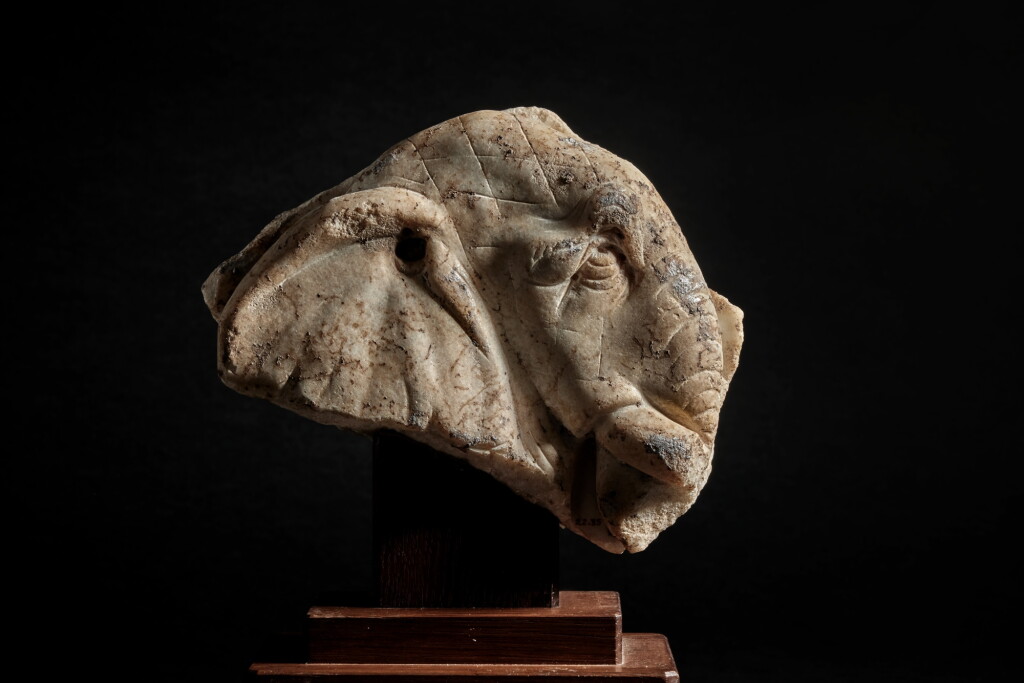
A superb marble stone fragment of an elephant head, Tang dynasty | 唐 大理石雕象首殘件
Auction Closed
May 5, 01:09 PM GMT
Estimate
2,000,000 - 4,000,000 HKD
Lot Details
Description
h. 17.1 cm
Frank Caro, successor to C.T. Loo, New York, circa 1959.
Collection of Stephen Junkunc, III (d. 1978).
Sotheby's Hong Kong, 12th September 2018, lot 2.
The elephant in Buddhist iconography can appear in varying contexts. One commonly seen in Chinese Mahayana Buddhist art is that which carries Samantabhadra (Mandarin: Puxian pusa) one of the most commonly worshipped bodhisattva in the Chinese tradition. Other appearances of the elephant in Buddhism are the self-sacrificing white elephant from the Jataka tales, and the anecdote of the six-tusked elephant king. As the present elephant's gaze looks up almost adoringly while keeping the head forward and steady for a possible rider, it would appear to be the bearer of Samantabhadra, gazing up at the holy figure seated on its back. Compare with Tang dynasty white marble elephant figures, including one unearthed in the northern regions of Xi'an and now housed in the Xi'an Institute of Cultural Relics and Archaeology, illustrated in The Glory of the Silk Road: Art form Ancient China, The Dayton Art Institute, Dayton, 2003, cat. no. 78. Another example was sold at Christie's New York, 19th March 2008, lot 392. Other examples of Tang dynasty elephant figures can be found in ceramic form. Several white-glazed examples supporting candelabra are recorded, including an elaborate caparisoned example sold in our New York rooms, 17th October 2001, lot 96, and another sold at Christie's Hong Kong, 1st June 2016, lot 3102.
Elephants created by Chinese artists were typically modeled with a T-form harness over the head, as seen in the examples cited above. The present example has a harness of diagonal crisscrosses, similar to some Gandharan depictions, such as a schist example once in the Masaki Art Museum, Osaka, attributed to the second or third century, illustrated in Sumino Irodori: Osaka Masaki Bijutsukan Sanjunentenjizuroku [Colors of Ink: Osaka Masaki Art Museum 30 Years Anniversary Exhibition], Nezu Museum, Tokyo, 1998, cat. no. 82., and sold in our New York rooms, 11th September 2012, lot 104. The Masaki elephant's harness extends over the face, perhaps a more realistic model of a practical apparatus, while the present fragment's harness lies solely on the cap of the head, betraying at once the decorative nature of Chinese elephant harnesses (recalling the T-form harnesses so often see in cloisonné, ceramic, and other media of Chinese depictions), as well as the inspiration derived from stone sculpture of neighboring cultures.
來源
弗蘭克.卡羅(盧芹齋繼任人),紐約,約1959年
史蒂芬.瓊肯三世(1978年卒)收藏
紐約蘇富比2018年9月12日,編號2
象在佛教中的形象有著多重意義。中國大乘佛教常見普賢菩薩騎象,此外《本生經》亦有記載大象捨己救人,以及六牙象王等。本像刻畫象眼往上方凝望,頗有依戀之意,象首則向前,保持騎者(即應為普賢菩薩)穩定安坐。 比較數大理石例,其一出土自西安北部,現存於西安文物考古研究所,圖載於《The Glory of the Silk Road: Art form Ancient China》,The Dayton Art Institute,代頓,2003年,編號78。另一例售於紐約佳士得2008年3月19日,編號392。此外尚可比較白釉象形燭臺數例,包括紐約蘇富比曾出售一例,象身裝飾華麗,售於2001年10月17日,編號96,另一例售於香港佳士得2016年6月1日,編號3102。
中國藝匠所塑造的大象形象,象首多飾T形束帶,可見前述例作。本像象首則飾對角十字交叉頭罩,與部份犍陀羅作例相近,包括一片岩例,現存於大阪正木美術館,斷代二或三世紀,圖見《「墨の彩」:正木美術館開館30周年記念展図録》,根津美術館,東京,1998年,編號82,售於紐約蘇富比2012年9月11日,編號104。正木美術館所藏作例刻畫頭罩覆蓋象面,或更接近實用騎具形像,而本品則僅遮蓋象首頭頂,更偏裝飾性,明顯具備漢象造型傳統,但亦可見其受了外來石雕風格影響。