Property of a Gentleman | 仕紳收藏
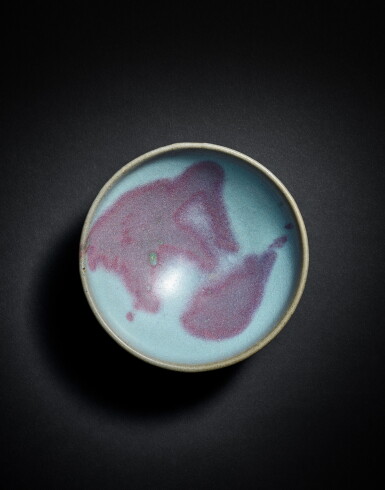
A rare Junyao purple-splashed bowl, Northern Song – Jin dynasty | 北宋至金 鈞窰藍釉紫斑小盌
Auction Closed
May 5, 01:09 PM GMT
Estimate
1,500,000 - 2,500,000 HKD
Lot Details
Description
Japanese wood box
12.6 cm
Collection of Dr and Mrs Marvin L. Gordon, San Francisco.
J.J. Lally & Co. Oriental Art, New York, September 2009.
J.J. Lally & Co. Oriental Art, The Gordon Collection: Chinese Ceramics and Works of Art, New York, 2009, cat. no. 28.
'Jun' ware, made in kilns of Henan and other provinces, ranks among the Five Great Wares of the Song dynasty (960-1279) and is one of the most famous types of Chinese ceramics. Purple-splashed 'Jun' bowls of this classic shape are remarkable for their splendid colouration, which display a range of blue and lavender tones. In this particular successful example, the copper-red pigment forms distinct colouration of purple splashes against a bright lavender-blue ground. The brilliant purple splashes on 'Jun' ware vessels were produced by the addition of copper oxides to the unfired glaze for firing in a reduction kiln, a decorative technique that appeared on 'Jun' wares from around the end of the 11th century. In the 2001 excavation of the Jun ware kiln site at Liujiamen, Shenhou, Yuzhou city, Henan, Jun ware shards with large areas of red and purple were found in strata ascribed to the late Northern Song (960-1127), see 'Henan sheng Yuzhou shi Shenhou zhen Liujiamen Junyao yizhi fajue jianbao/Excavation of Jun Kiln at Liujiamen, Yuzhou, Henan’, Wenwu/Cultural Relics, 2003, no. 11, fig. 19. In the same excavation, a shard of a small bowl with rounded sides and a slightly inverted rim, reminiscent of the current bowl, was found in the same stratum, see a line drawing illustrated ibid., p. 34, fig. 15.7.
Although on many 'Jun' pieces a splashed effect is achieved, it is likely that a brush was often used for the application of the copper-based pigment, with brush strokes evident in some cases, such as on a basin discussed in Regina Krahl, Chinese Ceramics from the Meiyintang Collection, London, 1994-2010, vol. 2, no. 674. Such copper-red designs provide a striking contrast to the thick, bright blue glaze underneath, giving each vessel decorated in this manner its unique design.
Jun ware bowls are represented in world-famous collections, such as the British Museum, London, from the collection of Sir Percival David, illustrated in Margaret Medley, The Chinese Potter, Oxford, 1976, fig. 83, and in the Palace Museum, Beijing, published in The Complete Collection of Treasures of the Palace Museum. Porcelain of the Song Dynasty (I), Hong Kong, 1996, pl. 225. Compare also two bowls in the Baur Collection, Geneva, included in John Ayers, The Baur Collection, Geneva; Chinese Ceramics, vol. 1, Geneva, 1968, nos. A31 and A32.
See also a bowl from the Schoenlicht and H.M. Knight collections, sold in our London rooms, 13th December 1955, lot 76, and in these rooms, 18th May 1982, lot 109, and now in the Matsuoka Museum of Art, Tokyo, included in the Museum’s exhibition Tōyō tōji meihin zuroku [Illustrated Catalogue of Famous Pieces of Oriental Pottery and Porcelain], Tokyo, 1991, pl. 52. Another vessel of this type, its surface almost completely covered in purple splashes, formerly in the collections of Richard Bennett and George Eumorfopoulos, and illustrated in R.L. Hobson, The George Eumorfopoulos Collection of Chinese, Corean and Persian Pottery and Porcelain, London, 1925-8, pl. XXVII, fig. B 83, was sold in our London rooms, 8th November 2006, lot 55. Two bowls from the Edward T. Chow collection, amongst the best extant examples, were sold in our London rooms, 16th December 1980, lots 264 and 265, and again in these rooms, the former on 19th May 1987, lot 209, and later in the T.T. Tsui collection; the latter on 7th June 2000, lot 93. Compare also a Junyao bowl sold in our London rooms, 11th November 2015, lot 68, and two sold in our New York rooms, 15th September 2010, lots 303 and 308, and included in the exhibition Junyao, Eskenazi, London, 2013, cat. nos. 7 and 8.
來源
Marvin L. Gordon 醫生伉儷收藏,三藩市
藍理捷,紐約,2009年9月
展覽
《The Gordon Collection: Chinese Ceramics and Works of Art》,藍理捷,紐約,2009年,編號28
宋五代名窰之一鈞瓷,造於河南一帶,為中國陶瓷史之名器,其中以小盌最廣得喜愛,也最具代表性。此件藍釉紫斑小盌,釉彩明豔澄淨,特屬難得。此小盌天藍鈞釉上施銅紅,二者相互交融,尤為悅目。銅紅釉還原燒後,得亮麗紫斑,如此裝飾技法首見於十一世紀末。2001年,河南禹州神垕劉家門鈞窰遺址,北宋晚期地層發掘出鈞釉瓷片,飾有大片紅、紫斑,見〈河南省禹州市神垕鎮劉家門鈞窰遺址發掘簡報〉,《文物》,2003年,11號,圖19。同地層出土一件小盌殘片,圓腹,口沿微歛,類同此件拍品,線描圖錄於同一文獻,頁34,圖15.7。
鈞瓷紫斑,應多以筆沾銅紅釉施之,部分作例可見筆觸,如康蕊君撰文討論一件盆器,《玫茵堂中國陶瓷》,倫敦,1994-2010年,卷2,編號674。銅紅紫斑與天藍釉,相映對比,紫斑隨意不拘,更得各別鈞瓷皆獨特無二。
世界數大收藏均可見鈞瓷小盌,如大衛德爵士珍藏一例,現存倫敦大英博物館,刊於Margaret Medley,《The Chinese Potter》,牛津,1976年,圖83,北京故宮也有一器,錄於《故宮博物院藏文物珍品全集.兩宋瓷器(上)》,香港,1996年,圖版225。比較日內瓦鮑爾收藏二盌,載於 John Ayers,《The Baur Collection, Geneva; Chinese Ceramics》,卷1,日內瓦,1968年,編號A31、A32。
鈞瓷柔美低歛,深得日本藏家傾愛,Schoenlicht 及 H.M. Knight 遞藏一小盌,曾於1955年12月13日售於倫敦蘇富比,編號76,再度於1982年5月18日售於香港蘇富比,編號109,現藏東京松岡美術館,展出於《東洋陶磁名品圖錄》,東京,1991年,圖版52。另一件小盌,釉面均佈紫斑,曾為 Richard Bennett 及 George Eumorfopoulos 遞藏,刊於 R.L. Hobson,《The George Eumorfopoulos Collection of Chinese, Corean and Persian Pottery and Porcelain》,倫敦,1925-8年,圖版XXVII,圖B83,2006年11月8日售於倫敦蘇富比,編號55。仇焱之舊藏二件小盌,精緻至極,堪稱傳世品中佳例,1980年12月16日售於倫敦蘇富比,編號264、265,1987年5月19日再度售於香港蘇富比,編號209,後入徐展堂珍藏,後者於2000年6月7日售出,編號93。並比較倫敦蘇富比2015年11月11日售出一例,編號68,還有紐約蘇富比2010年9月15日,編號303、308二件小盌,錄於《鈞窰》,Eskenazi,倫敦,2013年,編號7、8。
You May Also Like