
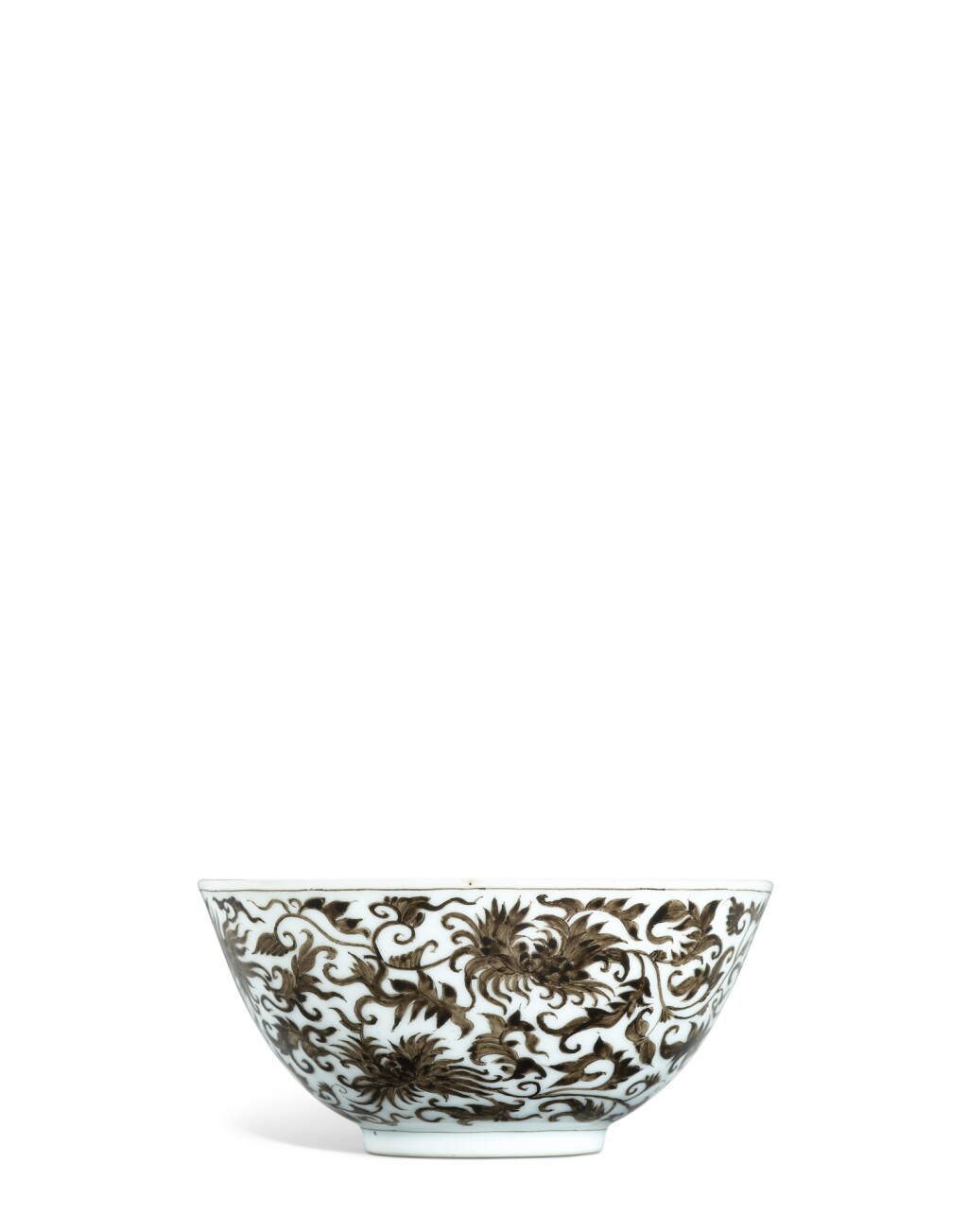
Property of a Gentleman | 仕紳收藏
A fine and very rare small falangcai grisaille-decorated ‘chrysanthemum’ wine cup, Mark and period of Yongzheng|清雍正 琺瑯彩赭墨纏枝菊紋茶圓 《大清雍正年製》款
Premium Lot
Auction Closed
May 5, 01:09 PM GMT
Estimate
5,800,000 - 8,800,000 HKD
Lot Details
Description
wood stand
8.8 cm
A Hong Kong private collection.
Christie's Hong Kong, 31st May 2017, lot 3024.
An enduring symbol of autumn, blooming by the full moon while the myriad flowers fade, the chrysanthemum represents one of the most enduring metaphors for longevity in the Chinese canon— here masterfully depicted in the typically refined style of the Yongzheng Emperor (r. 1723–1735). Known as the ‘hermit among flowers,’ full of quiet nobility that fails to conform to the whims of the world, the chrysanthem perfectly embodies the brief reign of Shizong and the exceptional artistic treasures produced under his care, made to exacting standards in minute numbers to the Emperor’s personal taste.
The present cup is particularly remarkable in its traceable imperial history. On the ninth day of the eighth month of the tenth Yongzheng year (1732), an order emerged from the Summer Palace, conveyed by the eunuch Cangzhou, to the Imperial Enamel Workshop declaring:
Search the Yonghegong (Palace of Harmony and Peace) for any small thin-bodied white porcelain bowls, dishes, tea cups, or wine cups, and bring some for use in painting enamels.
By Imperial Command.
By the eleventh day, these imperial wishes had been fulfilled. The artisan official of the Yonghegong, Folun, had presented ‘four thin-bodied white porcelain wine cups; and two thin-bodied white porcelain tea cups’ to the Workshop and, by the first day of the following month:
The four thin-bodied white porcelain wine cups, painted with ink chrysanthemums in enamel, were handed over by Treasurer Changbao and head steward Samuha to eunuch Cangzhou, and presented to the Emperor.
Completed.
Underlying the transformation of these imperial cups from white canvases to floral ink paintings, was the personal tastes, technical admiration and scholarly views of the Yongzheng Emperor. Shortly after the white cups’ retrieval from the Yonghegong and prior to their enamelled return to court, a note delivered to the Enamel Workshop adds further colour to the history of this remarkable cup:
On the fourteenth day of the eighth month, Baitang’a and Li Liushi delivered a dispatch from the Summer Palace, reporting that Treasurer Changbao, head steward Li Jiuming, and Samuha conveyed the imperial order:
Among the works presented for the Mid-Autumn Festival, the enamel dishes, bowls, tea cups, and wine cups were all very well made. Henceforth, produce more pieces painted in ink style; the lacquered works are also good. The black glass boxes closely resemble foreign lacquer.
By Imperial Command.
Whether the present cup was among the wares already previewed by the Emperor by his proclamation on the fourteenth (the day before Mid-Autumn festival) or produced later in the month as a result of this admiration for the ‘ink style,’ these historical sources point to the direct hand of the Emperor in the cup’s production and show its sumptuous chrysanthemum design to be more than mere decoration; instead representing a tangible link to imperial celebrations and the Emperor’s admiration for the beauty of the Mid-Autumn.
Today only four examples of the present design appear to be extant and very likely represent the full extent of the design’s production, directly corresponding to the ‘four wine cups’ in the imperial order of 1732. Beyond the present cup, the three attested companions are as follows: one sold in these rooms, 20th November 1984, lot 438, and passing to the Goldschmidt Collection, from which it was sold again in these rooms, 13th November 1990, lot 24; and the other two extensively restored, preserved as a pair and sold in these rooms, 28th November 1978, lot 343, to the collector Brian McElney (1932–2023), included in Chinese Antiquities from the Brian S. McElney Collection, Hong Kong Museum of Art, Hong Kong, 1987, cat. no. 102, and bequeathed in turn to the Museum of East Asian Art, Bath (accession no. BATEA: 207), where they remain today.
The close involvement of the Yongzheng Emperor in the production of this cup should not be surprising. While European-style enamelling on porcelain had first been produced during the reign of his father, the Kangxi Emperor (r. 1662–1722), it was during Shizong’s reign that the practice became firmly established as a mainstay of imperial design, as different colours and effects came to be perfected by his imperial artisans. According to Fung Ming-chu’s count, with the perfection of nine further enamels under the watch of Prince Yi, by 1728, the Imperial Workshops of Beijing were capable of producing just twenty-one distinct enamel colours, and refined and perfected these through the watchful eye of the Emperor and experimental pieces like the present; see Porcelain with painted enamels of Qing Yongzheng period (1723–1735), Palace Museum, Taipei, 2013, pp 10–13.
Surviving examples of falangcai (‘enamel colour’) porcelain are among the finest and most coveted products of the High Qing period, of which the vast majority remain preserved in the Taipei Palace Museum. While more commonly attested in a polychrome palette of enamels akin to the famille-rose wares of Jingdezhen, a small subsection of Yongzheng enamel wares were produced in spellbinding single-colour palettes, in which the enamel is applied in various thicknesses and shades in imitation of the finest ink paintings of the period, usually following drafts produced by court painters themselves. Compare a pair of dishes of Yongzheng mark and period, preserved in the Taipei Palace Museum, decorated with prunus branches in a related grisaille palette, included ibid., cat. no. 41; a corresponding pair of bowls, cat. no. 56; and two pairs of bowls decorated with bamboo and rocks, cat. nos 54 and 55. These Taipei pieces, unlike the present, bear four-character reign marks in blue enamel, which imply that the porcelain was fired unmarked at Jingdezhen expressly for enamelling in Beijing. The present bowl, in contrast, bears a six-character underglaze-blue mark applied at the point of firing at Jingdezhen, where it was evidently deemed already perfect for imperial use in its plain white-glazed form. For another example of monochrome pieces from the Yongzheng stores re-enamelled with serene ink-style designs on imperial command, compare a pair of yellow-glazed dishes of six-character underglaze-blue marks enamelled with grisaille landscapes and poems, ibid. cat. no. 89.
Also compare a small number of related grisaille-enamelled wares bearing underglaze-blue six-character Yongzheng reign marks arranged in three columns, likely somewhat later in date than the present and less closely regulated by the Yongzheng court, including: a pair of grisaille landscape bowls formerly in the T.Y. Chao collection with a six-character mark in three columns, sold five times in these rooms, including most recently, 7th April 2015, lot 101; and a pair of wine-cups, sold at Christie’s Hong Kong, 2nd December 2015, lot 3102.
Known to the Qing court by his Chinese name Lang Shining, Giuseppe Castiglione (1688–1766) was, without a doubt, one of the most important artists of the High Qing period. Born in Milan in 1688, Castiglione travelled to China in 1715 as a member of a Jesuit mission and served as a leading court painter of the Kangxi, Yongzheng and Qianlong Emperors. While the manner of Castiglione’s involvement in imperial porcelain decoration remains a matter of scholarly debate, the fluid style, attention to form and subtle control of enamel pigments displayed in this rococoesque design are all indicative of the hand of a master with European training, if not Castiglione himself.
來源
香港私人收藏
香港佳士得2017年5月31日,編號3024
御苑秋芳
雍正皇帝與菊紋赭墨琺瑯彩茶圓
菊花,是秋日經久不衰的象徵,在百花凋零之際伴滿月盛放,在中國文化傳統中寓長壽之意,此器紋飾巧妙描繪了雍正皇帝對精緻典雅風格的追求。菊花素有「花中隱士」之稱,其靜默孤高的氣質不隨時世流轉而移,恰如其分地體現了清世宗雖短暫卻卓越的統治時期,以及在其親自督導下誕生的非凡藝術珍品。這些作品嚴格遵循皇帝的個人品味,製作精良,存世稀罕。
此器尤為珍貴之處,在於其可溯源的宮廷歷史。據清宮內務府造辦處檔案記載(圖1):
雍正十年八月初九日,據圓明園來帖內稱本日太監滄洲傳旨:著向雍和宮查有脫胎填白磁小盌、碟、茶圓、酒圓拿些來畫琺瑯用,欽此。
八月十一日雍和宮匠人房官佛倫送來脫胎填白磁酒圓四件。
脫胎填白磁茶圓二件記此,於九月初一日將脫胎填白磁酒圓四件(上畫琺瑯墨菊花),
司庫常保首領蕯木哈交太監滄洲 呈 進訖。
這些御製器物從素白胎轉化為花卉墨彩畫作的背後,蘊含著雍正皇帝個人的審美趣味、對工藝的推崇以及文人化的視野。就在這批白瓷器從雍和宮取回不久,尚未經琺瑯彩繪返歸宮廷之際,一道送至琺瑯作的旨意更為此非凡器物的歷史添寫了生動注腳:
十四日據(交琺瑯作栢唐阿李六十):
圓明園來帖,内稱本日司庫常保首領李久明薩木哈奉上諭,中秋節呈進活計之內法瑯盤、盌、茶圓、酒圓俱燒造的甚好,嗣後將画水墨的多燒造些… 欽此。
無論本器是否屬於皇帝在十四日(中秋節前一日)詔令中已預覽的器物,或是因鍾情「墨樣風格」而在當月後期製作,這些歷史記載均指向皇帝親自參與了器物的製作過程,並揭示其華麗的菊花圖案不僅是裝飾,更具體體現了與宮廷慶典的直接聯繫,以及皇帝對中秋之美的深深傾慕。
現今存世可見同紋樣之茶圓僅四例,極可能為此式樣的全部製作數量,正與雍正十年御旨中「四隻」之數相符。除本器外,其餘三件可考者如下:其一曾售於香港蘇富比1984年11月20日,編號438,後入戈爾德施密特(Goldschmidt Collection)珍藏,複於1990年11月13日由本行再度釋出,編號24;另兩例曾經大面積修復,成對保存,售於香港蘇富比1978年11月28日,編號343,由收藏家麥雅理收藏(1932–2023年),後收錄於1987年香港藝術館《麥雅理收藏中國古物》展覽,編號102,最終遺贈予英國巴斯東亞藝術博物館(館藏編號 BATEA: 207),保存至今。
雍正皇帝對本器製作的深度參與並不令人意外。雖然瓷器上的西洋琺瑯彩繪最初創燒于其父康熙帝年間,但直至清世宗雍正朝,隨著宮廷匠人逐步完善了多種釉彩與呈色效果,琺瑯彩工藝才真正確立為宮廷設計的主流。據馮明珠統計,在怡親王監管下,隨著九種新增琺瑯釉彩的完善,至1728年,北京內廷作坊已能燒製出多達二十一種 琺瑯彩,並在皇帝本人的嚴格監督下,通過如本品一般的實驗性器物,不斷精煉並完善這些工藝;參見《金成旭映:清雍正琺瑯彩瓷》,台北故宮博物院,2013年,頁8至9。
存世的琺瑯彩瓷器堪稱清盛期最為精妙珍罕之品,其中絕大部分現藏於中國台北故宮博物院。儘管多數常見者皆為仿效景德鎮粉彩的多色琺瑯品種,雍正朝琺瑯器中仍有一小部分以迷人單色繪製,其琺瑯料通過濃淡厚薄的變化,摹仿當時最精妙的墨彩畫意,通常依宮廷畫師所作畫稿而成。可比較一對清雍正年製帶款梅枝紋盤,藏於台北故宮博物院,以相近的墨彩調繪製,收錄於前述著作,圖錄編號41;與之對應的一對盌,圖錄編號56;以及兩對竹石紋盌,圖錄編號54與55。
這些台北故宮藏品與本品不同,均署藍料四字年款,表明它們是在景德鎮燒成無款白瓷後,特為北京琺瑯彩繪而燒製。相比之下,本品則帶有青花六字款,於景德鎮燒製時已施加,可見其純白釉面在當時已被視為符合御用標準。另可參考一例:原屬雍正朝單色釉器,後依旨以淡雅墨彩紋樣重施琺瑯,見一對青花六字款黃釉盤,後加繪墨彩山水詩文,同前述著作,圖錄編號89。
亦可參考少數同類墨彩琺瑯器,其帶青花六字三行雍正年款,年代可能略晚於本品,且受雍正宮廷監管相對寬鬆,包括:一對墨彩山水盌,曾為趙從衍舊藏,署六字三行款,於香港蘇富比五度釋出,最近一次為2015年4月7日,編號101;以及一對酒圓,售於香港佳士得,2015年12月2日,編號3102。
郎世寧無疑是清朝鼎盛時期最重要的藝術家之一。他 1688 年生於米蘭,1715 年隨耶穌會使團抵華,歷仕康熙、雍正、乾隆三朝,長期擔任宮廷畫師。儘管學界對郎世寧是否直接參與御窰瓷器彩繪仍有爭議,但這件器物所展現的洛可可式紋樣,其流暢的筆觸、精準的造型以及對琺瑯彩料細膩的掌控,無不顯示出受過歐洲訓練的大師手筆,即便未必出自郎世寧本人之手,也極具其風格特徵。
You May Also Like


