Benjamin Franklin | The “universal Smoke Doctor”
Auction Closed
June 24, 09:04 PM GMT
Estimate
80,000 - 120,000 USD
Lot Details
Description
Benjamin Franklin
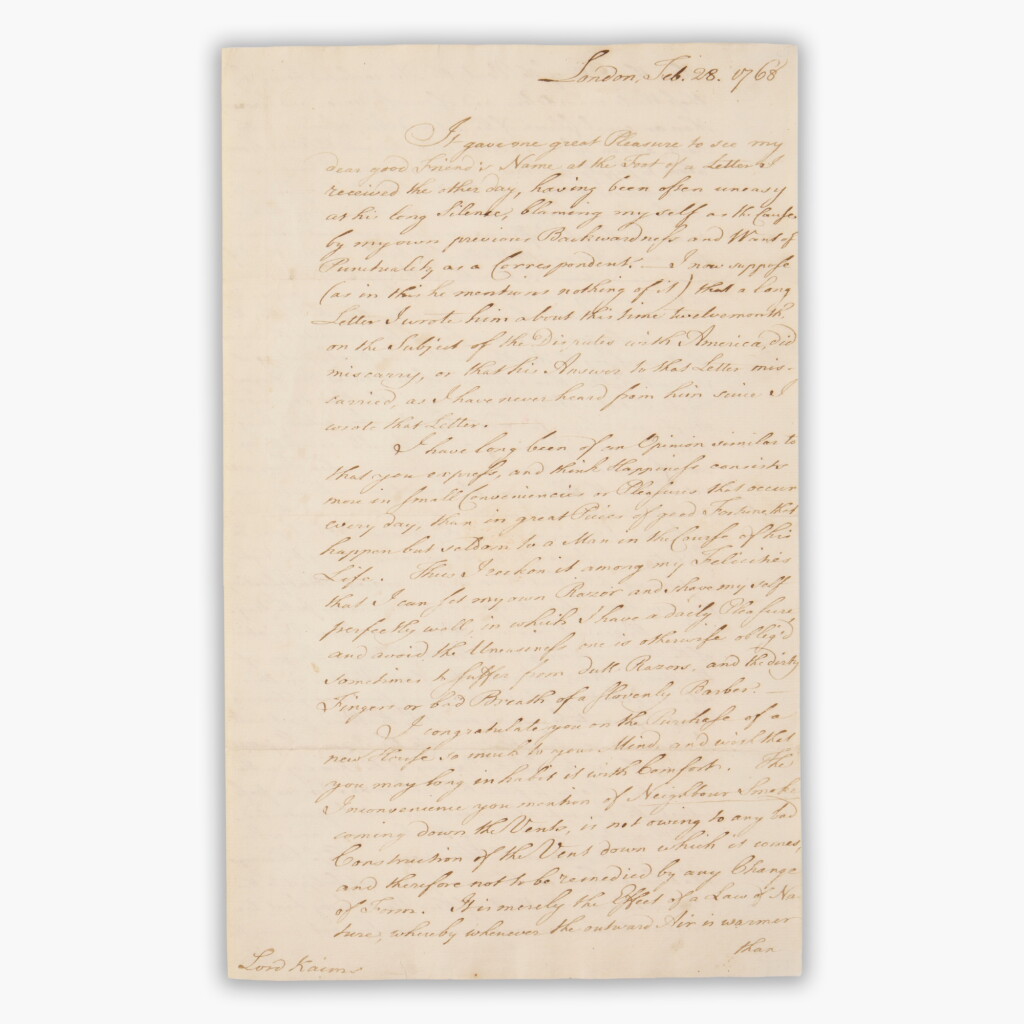
Autograph letter signed (“BFranklin”) to Henry Home, Lord Kames (“Lord Kaims,” at foot of first page), 3 pages (320 x 197 mm) on a disjunct bifolium of laid paper (watermarked Pro Patria with Maid of Dort, countermarked crowned GR), London, 28 February 1768, on the venting of chimneys and the happiness derived from “small Conveniencies or Pleasures that occur every day,” with a six-line autograph postscript; a few tiny pinholes to top horizontal fold of second leaf. Accompanied by a neat clerical “Copy of part of a Letter from Dr. Franklin. To Sir Alexander Dick— London, January. 21. 1762” (superscription at head of first page), 3 ½ pages (302 x 183 mm) on a disjunct bifolium of laid paper (watermarked arms of the United Kingdom, countermarked crowned GR), docketed on final page “Copy Letter from Dr. Franklin about his Chimney Machines. 21 January 1762”; inner margins and some folds skillfully reinforced, final page lightly soiled. And with an address panel directed “To The Rt. Honble. Lord Kames Edinburgh,” with red wax seal largely intact; soiled and repaired. (This address panel perhaps covered the transcription of Franklin’s letter to Dick, since the Papers describes the present letter to Kames as bearing the autograph address and franking signature, “To The Right honble. Lord Kaims, at Edinburgh B Free Franklin”; this was perhaps retained by a member of the Family Trust at the time of the 1995 sale.) Half green morocco folding-case gilt, two chemises.
One of Franklin’s first and most famous inventions was the Franklin stove, also called a “circulating stove” or “Pennsylvania fireplace.” Invented by Franklin in 1742, and significantly improved by David Rittenhouse, the Franklin stove was intended to produce more heat and less smoke than an ordinary open fireplace. The notoriety of the invention led Lord Kames to consult Franklin, in a letter of 18 February 1868, about an issue with his new house in Edinburgh: “I begin to perceive in my decline of life that happiness, comfort at least, depends more upon what a Philosopher would call slight conveniences than a young man in the ardour of his studies is apt to imagine. I have bought a house in this Town which luckily is absolutely free of smoke except what is commonly called neighbour smoke; that is the smoke issuing from one vent sometimes goes down a neighbouring vent and issues into the Room when there is no fire in it. I apply to you for a remedy as to an universal Smoke Doctor; and if I had a remedy, mine would be the most compleat house in Edinburgh” (Papers 15:50–51).
Franklin here responds fully to his friend, apologizing for his laxity in writing and voicing his concurrence with Kames’s perception of “slight conveniences”: “I have long been of an Opinion similar to that you express, and think Happiness consists more in small Conveniencies or Pleasures that occur every day, than in great Pieces of good Fortune that happen but seldom to a Man in the Course of his Life. Thus I reckon it among my Felicities that I can set my own Razor and shave my self perfectly well, in which I have a daily Pleasure, and avoid the Uneasiness one is otherwise oblig’d sometimes to suffer from dull Razors, and the dirty Fingers or bad Breath of a slovenly Barber.”
But Kames had consulted Franklin on a practical, not philosophical, matter, and the greater part of Franklin’s answer is devoted to a meticulously detailed commentary on the issue of “neighbor smoke,” its cause and its remedy. “I congratulate you on the Purchase of a new House so much to your Mind, and wish that you may long inhabit it with Comfort. The Inconvenience you mention of Neighbour Smoke coming down the Vents, is not owing to any bad Construction of the Vent down which it comes, and therefore not to be remedied by any Change of Form. It is merely the Effect of a Law of Nature, whereby whenever the outward Air is warmer than the Walls of the Vent, the Air included being by those Walls made colder, and of course denser and heavier, than an equal Column of the outward Air, descends into the Room, and in descending draws other Air into the Vent from above to supply its Place; which being in its Turn cooled and condensed by the cooler Walls of the Vent, descends also, and so a Current downwards is continued during the Continuance of such Difference in Temperament between the outward Air and the Walls of the Vent. When this Difference is destroy’d, by the outward Air growing cooler and the Walls growing warmer, the Current downward ceases; and when the outward Air becomes still colder than the Walls, the Current changes and moves from below upwards, the warmer Walls rarifying the Air they include, and thereby making it so much lighter than a Column of the outward Air of equal Height, that it is oblig’d to give way to the other’s superior Weight, and rise; is succeeded by colder Air, which, being warmed and rarified in its turn, rises also, and so the upward Current is continued. In Summer when Fires are not made in the Chimneys, the Current generally sets downward from nine or ten in the Morning during all the Heat of the Day till five or six in the Afternoon, then begins to hesitate, and afterwards to set upwards during the Night, continuing till about Nine in the Morning, then hesitating for some time before it again sets downwards for the Day. This is the general Course, with some occasional Variation of the Hours according to the Length of Days or Changes of Weather. Now, when the Air of any Vent is in this descending State, if the Smoke issuing from a neighbouring Vent happens to be carried over it by the Wind, part will be drawn in and brought down into the Room. The proper Remedy then is, to close the Opening of the Chimney in the Room, by a Board so fitted that little or no Air can pass, whereby the Currents above-mentioned will be prevented. This Board to remain during the Summer, and when Fires are not made in the Chimney. Those Chimneys that have Fires in them daily, are not subject to this Inconvenience, the Walls of their Vents being kept too warm to occasion any downward Current during the Hours between the going out of one Fire and the kindling of another. And indeed in Summer, those Vents that happen to go up close joined with the Kitchen Vent, are generally kept so warm by that, as to be free from the downward Current, and therefore free from what you call Neighbour Smoke.”
Kames, in his letter, had also asked Franklin if he should adopt “your Philadelphia Grate, as it promises to save Coal, and to diffuse an equal heat through the Room,” but Franklin here advises that, under the circumstances, this is an unnecessary addition: “The Philadelphia Grate which you mention, is a very good Thing, if you could get one that is rightly made, and an ingenious Workman to fix it properly. Those generally made and used here are much hurt by fancied Improvements in their Construction, and I cannot recommend them. As Fuel with you is cheap and plenty, a Saving in that Article is scarce an Object. The Sliding Plates (of which I sent a Model to Sir Alexander Dick) are in my Opinion the most convenient for your purpose, as they keep a Room sufficiently warm, are simple Machines, easily fix’d, and their Management easily conceiv’d and understood by Servants.”
Franklin described these sliding plates, based on his “more than 20 Years Experience of my own Contrivances and those of others, for the Warming of Rooms,” in a letter of 21 January 1762 to Sir Alexander Dick (Papers 10:13–16). A contemporary transcription of this letter to Dick accompanies the present missive to Kames, although its origins are uncertain. It is most likely that after receiving Franklin’s answers to his questions about chimneys, Lord Kames applied to his fellow Dunediner for the information.
Franklin concludes by promising himself the happiness of accepting Kames’s invitation to be entertained at “one of the finest places [in Scotland] with an inchanting Winter Garden”; Franklin fulfilled this promise in 1771. In a postscript, he describes “a late Paper of mine, written to palliate a little the late offensive Behaviour of the Boston People relating to the use of the Manufactures of this Country.” This was “Causes of the American Discontents before 1768,” which was printed in The London Chronicle, 5–7 January 1768.
“Henry Home, Lord Kames (1696–1782), Scottish judge, son of George Home, a country gentleman of Kames, Berwickshire, was indentured at the age of sixteen to an Edinburgh writer to the signet. He studied assiduously in his spare time and was admitted to the Scottish bar at twenty-eight. His published collection of legal decisions four years later brought him to professional attention; he prospered, and was appointed an ordinary lord of Session in 1752, whereupon he assumed the personal, non-hereditary title of Lord Kames. In 1763 he became one of the lords of the Justiciary Court, where he sat until a few days before his death. He had a wide variety of interests including the promotion of fisheries and manufacture and improvement in agriculture. He wrote voluminously on law, antiquities, ethics and natural religion, and criticism. His Introduction to the Art of Thinking (Edinburgh, 1761) and Sketches of the History of Man (1774) included versions of [Franklin’s] 'Parable against Persecution.' As a judge he was severe in criminal cases, but personally he was jovial and vivacious, with a ready, though coarse, humor” (note in Papers, ed. Labaree, 9:5).
REFERENCES
Papers of Benjamin Franklin, ed. Willcox, 15:60–62
PROVENANCE
Deposited in the Scottish Record Office by a Family Trust of Kames’s Descendants — Sold by the Trust (Christie’s London, 29 June 1995, lot 512) — Bonhams New York, 11 June 2008, lot 2384 (undesignated consignor)
You May Also Like
![Darwin and Wallace | On the Tendency of Species to form Varieties ... [1858–1859], in: Journal of the Proceedings of the Linnean Society, Vol. III, No. 9., 1859, Darwin announces the theory of natural selection](https://sothebys-md.brightspotcdn.com/dims4/default/0ae5d5e/2147483647/strip/true/crop/2000x2000+0+0/resize/150x150!/quality/90/?url=http%3A%2F%2Fsothebys-brightspot.s3.amazonaws.com%2Fmedia-desk%2Fwebnative%2Fimages%2F18%2F98%2Fd0ba6d9f4fada55611b512c2635f%2Fn12451-bkh45-t1-01.jpg)



![Kepler, Johannes | Harmonices Mundi Libri V, Linz, 1619, first edition, [bound with:] Prodomus dissertationum cosmographicum …, Frankfurt, 1621–1622](https://sothebys-md.brightspotcdn.com/dims4/default/d54d010/2147483647/strip/true/crop/2000x2000+0+0/resize/150x150!/quality/90/?url=http%3A%2F%2Fsothebys-brightspot.s3.amazonaws.com%2Fmedia-desk%2Fwebnative%2Fimages%2F63%2F0b%2Fa27794664ee78085e15afe3c5535%2Fn12451-58tmv-t1-05.jpg)
![Archimedes | De iis quae vehuntur in aqua libri duo, a Frederico Commandino... [Bound with:] Federico Commandino. Liber de centro gravitatis solidorvm, Bologna, 1565](https://sothebys-md.brightspotcdn.com/dims4/default/38d76db/2147483647/strip/true/crop/2000x2000+0+0/resize/150x150!/quality/90/?url=http%3A%2F%2Fsothebys-brightspot.s3.amazonaws.com%2Fmedia-desk%2Fwebnative%2Fimages%2Fe3%2Fa8%2Fdf66fdd24c5ebc499d2a9dc83cd4%2Fn12451-bkh3x-t2-01.jpg)