Property of an Important Pelé Collector
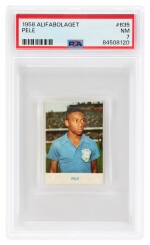
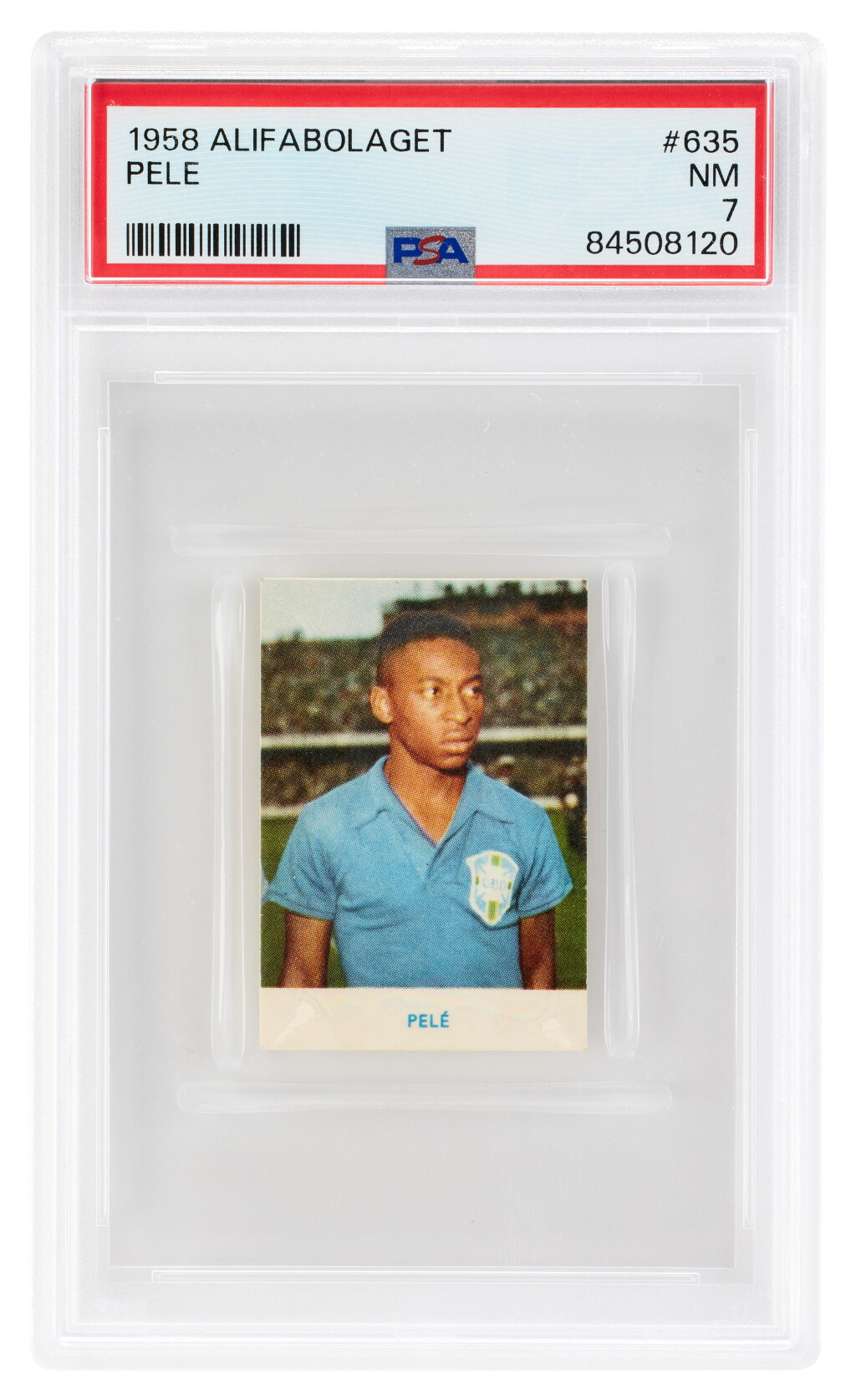
Pelé Alifabolaget #635 - PSA 7 | Rookie Card
No reserve
Lot Closed
July 16, 07:11 PM GMT
Estimate
80,000 - 100,000 USD
We may charge or debit your saved payment method subject to the terms set out in our Conditions of Business for Buyers.
Read more.Lot Details
Description
Cardboard, Plastic
Offered is a PSA NM 7 example of the 1958 Alifabolaget #635 Pelé rookie card — universally regarded as the definitive rookie card in the history of football and among the most important trading cards in the entire collecting hobby.
The card has a Certification Number of 84508120.
Little is known about the Swedish trading card company Alifabolaget except that they began printing cards in 1948 and manufactured arguably the most popular soccer card ever made ten years later. The cards, affectionately known among Swedish youth as "Alfa-bilder," were distributed as inserts accompanying Alfa lemon lozenges — a modest confectionery product whose place in sporting history rests entirely on the seventeen-year-old Brazilian whose face appeared on card number 635. Only a small number of these fragile trading cards are known to exist today. A 1977 flood at Alifabolaget's headquarters in Angelholm destroyed the company's remaining stock, contributing significantly to the extreme scarcity of high-grade surviving examples. There are no PSA 10s on record.
The reverse of the card, printed in Swedish, explains that Pelé was the youngest player at the tournament at seventeen, congratulates him for winning the World Cup against Sweden, and notes that the star has received many professional offers to play for other teams but plans to remain with Santos. That text, written in the immediate aftermath of the tournament, in the very country that had just been defeated by the boy on the card's front, is itself a document of history — composed before the world had any conception of the sixty-four-year career of global iconography it was describing in a single modest paragraph.
The timing of this card's production is rather stunning. It was printed in 1958 when a seventeen-year-old phenom led his Brazilian national team to World Cup glory over host nation Sweden — an event that was effectively Pelé's introduction to the global audience that holds him in the highest reverence to this day. The youngster's brilliance on the sport's brightest stage inspired a vast array of European clubs to desperately seek his services, leading the Brazilian government to take the countermeasure of declaring Pelé an official national treasure in order to prevent his transfer from the country.
The 1958 World Cup was the stage on which Pelé announced himself to the world. He entered the tournament as a substitute, barely known outside of Santos. He finished it with six goals in four matches, a hat-trick in the semi-final against France, and two goals in the final itself — becoming both the youngest scorer and the youngest winner in World Cup history, records that stand to this day. When the final whistle sounded at the Rasunda Stadium in Stockholm, a seventeen-year-old collapsed in tears on the pitch. The card offered here was printed in that same year, in that same country, as that moment's most immediate physical artifact.
The Grade
A PSA 7 represents a highly desirable example of this card, particularly given the extreme challenges of the set's survival history. The 1958 Alifabolaget set was printed on thin card stock, distributed loosely with sweets, and handled by children across Sweden. Combined with the 1977 flood that eliminated Alifabolaget's remaining inventory, the result is a population of surviving examples at every grade level that is extraordinarily thin. A PSA 7 places this example firmly within the upper tier of all known copies, representing a meaningful and accessible entry point into one of the most significant cards in the history of the hobby. At the time of cataloging, according to the PSA Population Report, only six examples of this card have been graded PSA 8, with twenty graded higher across the card's entire recorded history. The card offered here ranks among the finest known examples in existence.
Going Deeper — Pelé
Often considered the greatest footballer of all time, Pelé joined Santos FC as a fifteen-year-old in 1956 and quickly developed into one of the league's most prolific scorers. By sixteen he was a regular scorer at the Brazilian club level. He gained global recognition at the 1958 World Cup, where he scored six goals across four matches, was named to the World Cup All-Star Team, and became the youngest player ever to appear in and score in a World Cup Final.
He went on to help Brazil win the Jules Rimet trophy again in 1962 and 1970. His three World Cup victories remain the most of any player in the history of football. At Santos across nineteen seasons, he scored 643 goals for the club — a record that stood as the most goals for a single club for over forty years until surpassed by Lionel Messi in 2020.
Upon joining the New York Cosmos in 1975, Pelé brought an entirely new level of visibility to football in the United States. He led the Cosmos to the 1977 NASL Championship and set multiple attendance records, including a crowd of 77,691 for the Cosmos' 1977 playoff match against the Fort Lauderdale Strikers. The youth participation boom that followed laid the foundation for the 1994 World Cup, the launch of MLS in 1996, and the return of the World Cup to North America in 2026.
He was named joint FIFA Player of the Century alongside Diego Maradona. He passed away on 29 December 2022 at the age of eighty-two. Sotheby's is proud to present this example of the definitive card of the definitive player in the history of the world's most popular sport.
You May Also Like


