Studio of Jan Brueghel the Younger and of Hendrick van Balen
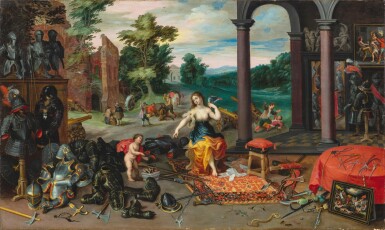
Allegory of Touch
Lot Closed
June 10, 01:16 PM GMT
Estimate
30,000 - 50,000 EUR
We may charge or debit your saved payment method subject to the terms set out in our Conditions of Business for Buyers.
Read more.Lot Details
Description
Studio of Jan Brueghel the Younger and of Hendrick van Balen
Antwerp 1601 - 1678 and Antwerp 1623 - 1661
Allegory of Touch
Oil on panel
53,4 x 89,2 cm ; 21 by 35⅛ in.
By descent in the same private collection since at least 1850.
This fascinating Allegory of Touch, still in fine condition, revisits an iconographic model devised by Jan Brueghel the Elder for his series The Five Senses, created in collaboration with Peter Paul Rubens and now in the Museo del Prado in Madrid (The Sense of Touch; Museo del Prado; inv. P001398). This series of paintings depicting the five senses is an excellent example of the art that was being produced in Antwerp in the early seventeenth century and was thence widely disseminated. Peter Paul Rubens and Jan Brueghel the Elder successfully collaborated to produce a series remarkable for its high quality and undeniable aesthetic appeal: it was reflected and circulated, with many variations, in works by numerous artists and their workshops throughout northern Europe.
The present work has long been interpreted – incorrectly – either as an allegory of fire, because it illustrates a number of objects created with the help of fire, or as an allegory of discord. In reality, it is without doubt an allegory of touch, featuring many of the elements in the original work by Rubens and Brueghel.
The depiction of the scene is characterized by its precise detail and the variety of figures, animals and objects it contains. Venus and Cupid are placed in the centre of the ‘graveyard of weapons’, with Venus holding a bird in her left hand and indicating the brazier to Cupid with her right hand. Various symbolic elements are used to illustrate the sense of touch, such as animals (scorpions, lizards, snakes), objects (armour, battle-axes, swords, a bow and arrows) as well as the visual metaphor of Vulcan’s forge. It is interesting to observe that the work by Jan van Kessel, Venus at Vulcan’s Forge, in the Hermitage State Museum in St Petersburg (Inv. ГЭ-1709), displays significant similarities to the painting by Jan Bruegel the Younger and Hendrick van Balen. Architectural elements such as carvings in high relief, columns and ruins complete this representation of the allegory of touch.
Another almost identical version of this work is in the Musée Calvet in Avignon (Inv. 827.5.24). This is considered to be by Hendrick van Balen (for the figures) and Jan Brueghel the Younger (for the landscape and still life elements) – see Klaus Ertz, Jan Brueghel d.J. (1601-1678), Freren, 1984, no. 227; and Bettina Werche, Hendrick van Balen (1575-1632): Ein Antwerper Kabinettbildmaler der Rubenszeit, Turnhout, 2004, vol. I no. A 184 p. 211; ill. vol. II p. 450. The Avignon painting seems to be of slightly higher quality than the present version, which was probably produced by the workshop; however, the main figures are sufficiently fine to suggest that as far as they are concerned Van Balen himself may have had a hand in their execution.
You May Also Like