Property from a Belgian Private Collection
Léonard Defrance
Market Scenes
Auction Closed
June 9, 01:57 PM GMT
Estimate
80,000 - 120,000 EUR
Lot Details
Description
Property from a Belgian Private Collection
Léonard Defrance
Liège 1735 - 1805
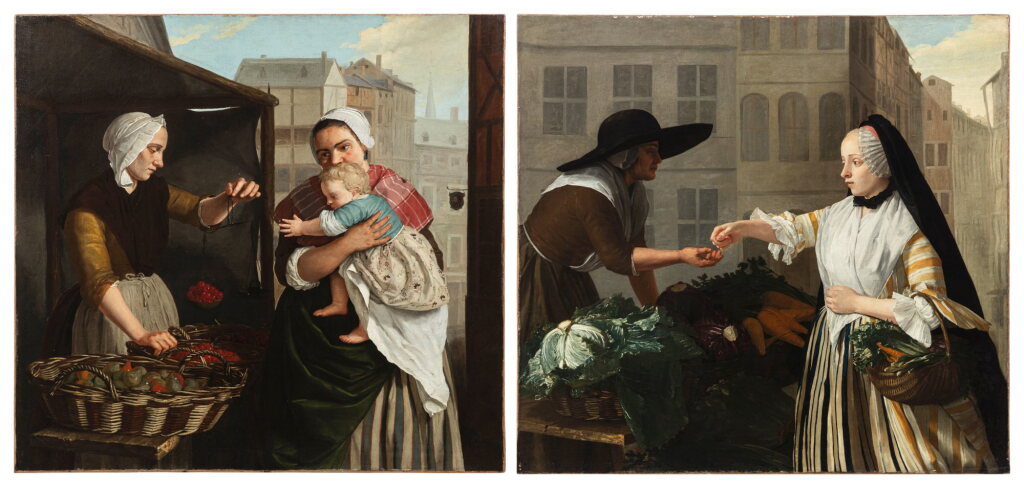
Market Scenes:
Weighing fruits
The Vegetable Sellers
A pair, both oil on canvas
(I) 114,5 x 122 cm ; 45⅛ by 48 in. ; (II) 114,2 x 122 cm ; 45 by 48 in.
(2)
Private Collection, England (as per P.-Y. Kairis);
With Jacques Leegenhoek, 2001.
P.-Y. Kairis, 'Defrance avant Defrance : pour une reconsidération de sa première période liégeoise', in Mélanges Jean-Patrick Duchesne, Art & Fact, Revue des historiens de l’art, des archéologues et des musicologues de l’Université de Liège, no. 38/2019-20, p. 61, repr. fig. 6 (titled Scène de marché avec un étal de légumes).
Born in Liège in 1735, Léonard Defrance enjoyed considerable success in Paris in the 1780s and 1790s. He trained with the painter Jean-Baptiste-Pierre Coclers and spent the early years of his career in Rome, where he studied under Laurent Pécheux at the Académie de France, as well as in Toulouse and Liège. Often regarded as a worthy emulator and follower of Adriaen van Ostade (1610–1685) and of David Teniers the Younger (1610–690), whom he studied during a trip to Holland in 1773, Léonard Defrance was adept at capturing and illustrating subjects that enchanted his contemporaries with their attention to detail and humour. Because of his progressive political opinions, he was forced to flee Liège and the regime of the prince-bishop César-Constantin-François de Hoensbroeck: in 1784, he moved to Paris, where his views surely made him all the more popular with Parisians during a time of intellectual ferment. Defrance exhibited at the Paris Salons in 1786 and 1787 as well as in the Revolutionary Salons of 1791 and 1793. The French Revolution inspired an equivalent revolution in Liège and Léonard Defrance became a member of the Liège Assembly from 1792 to 1794 and of the City Council in 1800.
These two pendants, distinguished by their fresh imagination and surprisingly modern qualities, can be dated to Léonard Defrance’s first period in Liège, between 1763 and 1773, a little known phase of his life whose achievements have largely been neglected.
Returning after a period of ten years spent in Italy and France, the artist re-established himself in the city of his birth. He then concentrated his efforts mainly on portraits and decorative painting; he disparaged history painting, for which he said he felt ‘a kind of antipathy […], especially in the way it had to be represented in this country, with the painting of miracles and setting people, angels and human children’s heads with two, four or six wings up in the sky, upon clouds’. He added: ‘My practical mind rejected all these things that defy reason’ (Mémoires, cited by P.-Y. Kairis, op. cit., p. 57).
Rediscovered in the late 1980s, these two compositions are a testament to Defrance’s strong attraction to reality, affirming his rejection of history painting. Drawing his subjects from ordinary life, setting them in the urban context of the marketplace in Liège, the artist has here demonstrated his concern for accuracy in the depiction of clothing, as well as displaying an almost photographic realism in his rendering of the still lifes with fruit and vegetables.
The two canvases were painted with a broad, free brushstroke, very far from the one he would use later in his career, which showed the influence of the much more finely wrought Dutch genre painting. Almost square in their format, they were most likely intended as overdoors, like many others Defrance produced in his first period in Liège. One shows a young bourgeois woman, smartly attired, buying vegetables from a stallholder in the market square in Liège. The other shows a nurse carrying a young child, who is eagerly holding out a hand towards cherries being weighed by a stallholder.
According to tradition, the young woman in the first painting is Defrance’s wife, Marie-Anne Joassin, whom he married on 16 April 1765; while the baby in the second composition is apparently their firstborn child, Marie-Agnès. This intriguing hypothesis seems to be confirmed by the existence of a portrait that clearly depicts the same young woman and very probably the same infant, likewise traditionally thought to be a portrait of Defrance ‘s wife and their child (Dehousse, Pacco, Pauchen, Léonard Defrance - L’œuvre peint, Liège, 1985, p. 109, no. 73, ill.).
You May Also Like