
Property from a European Private Collection
Lancelot-Théodore Turpin de Crissé
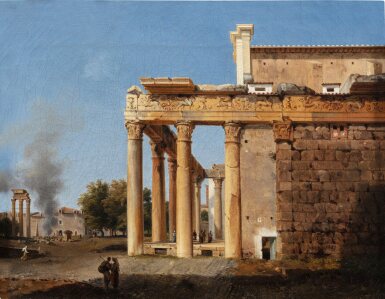
Rome, The Temple of Antoninus and Faustina
Auction Closed
June 9, 01:57 PM GMT
Estimate
26,000 - 35,000 EUR
Lot Details
Description
Property from a European Private Collection
Lancelot-Théodore Turpin de Crissé
Paris 1782 - 1859
Rome, The Temple of Antoninus and Faustina
Oil on canvas
Signed with monogram and dated lower right T.T. (surmonted by a Count's crown) / 1808 1827
19 x 24,2 cm ; 7½ by 9½ in.
With Talabardon & Gautier, Paris;
Where acquired by the present owner.
The famous Temple of Antoninus and Faustina, built in the Roman forum in 141m CE, was converted in the seventh century into the church of San Lorenzo in Miranda. The walls and Corinthian colonnade of the temple have survived, with behind them the Baroque façade of the church, added in the seventeenth century.
The present canvas dates to Turpin de Crissé’s first trip to Italy in 1807–1808. Entranced by the beauty of the monuments, the archaeological sites and the landscapes, which would inspire some of his finest work, he visited the country five times.
To depict the Temple of Antoninus and Faustina, Turpin de Crissé chose an unusual point of view, probably inspired by a drawing by Louis-François Cassas. Positioning himself at the side of the temple, which is seen at close range, he emphasizes the roughness of the raw stones on the side wall and shows a perspective view of the colonnade. The Corinthian capitals and the marble frieze, with its griffins and candelabra, are rendered with the meticulous precision typical of his style. The composition receives its dynamic quality from the shadow and light effects, the contrast between horizontals and verticals, and the diagonal that connects the three columns in the foreground to those of the Temple of Castor and Pollux in the distance. Illuminated by the morning sun and subtly tinged with pink, the temple stands out against the deep blue sky.
There is a large painting with an identical composition, also dated 1808, in the Fine Arts Museum, Boston (inv. 20.852). The two works differ in only a few ways. The tiny figures – which emphasize the temple’s monumental scale – are more numerous in the Boston painting, in which oxen can be seen on the right near a cart, a reminder that a cattle market was held in the forum until the Napoleonic period.
An early inventory indicates that the Boston canvas was painted in Rome ‘d’après nature’, in other words from sketches and studies made in situ, since Turpin de Crissé painted his large compositions in his studio, after making drawings on site. The present small painting bears two dates, 1808 and 1827. Is it possible that it was started in Rome and completed in the studio before the execution of the Boston painting? In that case it would be the final preparatory study, reworked by Turpin de Crissé in 1827. An alternative hypothesis to consider might be that it is a ricordo painted in 1808, after the Boston painting, and retouched nineteen years later.
An aristocrat with a complex and multi-faceted personality, Turpin de Crissé was a painter, traveller, collector and donator: he bequeathed his large collection of paintings and objets d’art to Angers, the town he had adopted as his own. Close to Empress Joséphine, he was her chamberlain from 1810 until she died in 1814.
He was passionate about his work as a painter, specifically as a landscape artist. On his many travels to Italy, Switzerland, England and Germany, he produced quantities of drawings and sketches, which provided him with inspiration for large compositions.
His interest in archaeology, antiquity and notable monuments shines out of his work. His classical compositions, his delicate use of paint and his smooth, meticulous brushstroke make him comparable to the great landscape painters of the previous generation, such as Jean-Joseph-Xavier Bidauld. However, while he did not shy away from historical of mythological subjects, he liked to animate sites of antiquity with contemporary figures and as the years went by he was increasingly attracted to the picturesque qualities of modern life. It was his interest in variations of light at different times of days and in different seasons, as well as his exploration of the effects of reflections, transparency and the play of light and shadow, that secured his place in the great history of nineteenth century landscape painting.


