
A French Private Collection
Jacob van Hulsdonck
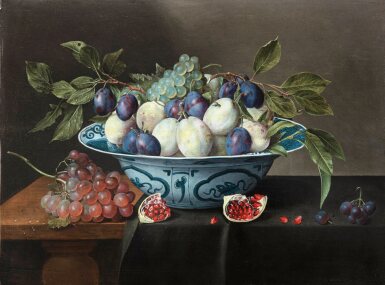
Still life with Plums in a Wanli Porcelain Bowl
Auction Closed
June 9, 01:57 PM GMT
Estimate
70,000 - 100,000 EUR
Lot Details
Description
A French Private Collection
Jacob van Hulsdonck
Antwerp 1582 - 1647
Still life with Plums in a Wanli Porcelain Bowl
Oil on panel
Signed lower left on the ledge HULSDONCK FE; the reverse branded with the mark of the Antwerp panel makers guild
42,5 x 56,4 cm ; 16¾ by 22¼ in.
We are grateful to Dr. Fred G. Meijer, who endorsed the authentication of this painting based on photographs.
Collection of Dr. G Decapmaker, Brussels;
His sale after death, Palais des Beaux-Arts, Brussels, 11-12 May 1966, lot 27;
With Kunsthandel P. de Boer, Amsterdam, 1966-1967;
With Brod Gallery, London, in 1967;
Probably English Private Collection, 1967-2015;
Anonymous sale, Christie's, London, 10 July 2015, lot 109;
Where acquired by the present owner.
Jacob van Hulsdonck was largely inspired by the works of Jan Brueghel the Elder (1568–1625) in Antwerp and by Ambrosius Bosschaert the Elder (1573–1621) in Middelburg. However, he developed a very distinct style in both his brushstroke and his compositions. In 1608, on his return to Antwerp, he became a master of the Guild of St Luke. This painting perfectly reflects the codes that characterize Hulsdonck’s work: placed on a wooden table, an ample Wang-Li bowl filled with plums, mirabelles and grapes occupies the central space. A second bunch of grapes lies on the table alongside two quarters of a pomegranate; a few seeds have fallen onto the cloth, their crimson red standing out against the dark fabric. Since only one of Hulsdonck’s known works is dated, it is difficult to establish a precise chronology. However, the fairly low viewpoint of this composition suggests a somewhat late date. The viewer cannot fail to be captivated by the technical challenge that such a fastidious imitation of reality presents.
This focus on the pleasures of the senses, expressed both in the evident freshness of the fruit and the painter’s virtuosity, is underpinned by the idea of the transient nature of the material world. The motif of the musca depicta – ‘the painted fly’ – was recurrent in painting from the Italian Renaissance onwards, especially in religious subjects. Flies can be seen on the skulls associated with St Mary Magdalene and St Jerome as well as on those that sometimes lie at the foot of the Cross: they invite the viewer to contemplate the dangers of excess in the physical world, becoming moralizing symbols. Present in Netherlandish still lifes from the fifteenth and sixteenth centuries, these small insects embody the idea of the Memento Mori.
Traditionally representing the transition from life to death, and especially the suffering and resurrection of Christ in Christian iconography, the pomegranate can also be interpreted metaphysically. The few drops of water sprinkled on the table reinforce this sense of fragility and draw the eye towards Hulsdonck’s signature, on the lower left of the panel. These motifs are found in other works by the artist, such as Wild Strawberries and a Carnation in a Wan-Li Bowl (National Gallery of Art, Washington, inv. 2013.1.1) and Still Life with Lemons, Oranges, and a Pomegranate (J. Paul Getty Museum, Los Angeles, inv. 86.PB.538).


