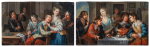
Christ before Pilate
Estimate
30,000 - 50,000 EUR
Lot Details
Description
Antoine Caron and Workshop
Beauvais 1521 - 1599 Paris
Christ before Pilate
Oil on panel
91 x 99,7 cm ; 35⅞ by 39¼ in.
Belgian Private Collection.
M. Gianeselli, 'Antoine Caron et le caronisme : aux sources de la préciosité ?', in Littérature précieuse et Beaux-Arts, influences croisées, actes du colloque, directed by N. Sainte Fare Garnot, Salles-la-Source 2025, p. 95, fig. 35 (as Antoine Caron (Circle of)).
This painting, recently published with an attribution to the circle of Antoine Caron by Matteo Gianneselli, who knew it only through a photograph, now deserves to be re-evaluated as a work by Caron himself, or by those members of his workshop who were closest to him.
While the urban landscape in the background seems to have been painted in a more summary fashion than in other more famous works by Caron, the fine treatment of some of the figures in the foreground, especially the figure of Christ, is entirely consistent with Caron’s style. The faces of the protagonists on the right and left of the composition, with their pale complexions and eyes lost in shadow, are also typical. Additionally, the presence of pentimenti in Pilate’s turban, in the position of Christ’s hands and in the left leg of the soldier behind him, testify fully to the work’s originality.
The architectural background seems to have been inspired, at least to some extent, by an engraving by Lucas van Leyden of the same subject, whose perspective, with its dominant emphasis on the left side of the composition, seems close to the present work (fig. 1).
The square format, unusual for the period, might suggest that the painting was not an isolated work but formed part of a cycle, very probably on the theme of the Passion.
A drawing by Antoine Caron in the Musée du Louvre (inv. 25141), whose subject is also an episode from the last hours of Christ’s life, the Flagellation, is likewise in a square format. In his monograph of the artist’s work, Frédéric Hueber (Antoine Caron peintre de ville, peintre de cour 1521-1599, Rennes, 2018, p. 286 cat. no. 20) has advanced the tempting hypothesis that this sheet could have been a preparatory drawing by Caron used as a model by the Paris painter Gervais Jouen (or Jouan) for a Passion series commissioned by Nicolas de Neufville de Villeroy in 1588, for the private chapel of the Château de Villeroy-Mennecy. Jouen was therefore probably working under Antoine Caron, replicating in oil his master’s drawings. Although the present work bears a coat of arms, so far unidentified but not those of Nicolas de Neufville, might there be a link to this prestigious commission?
You May Also Like