Collection of the Rochechouart de Mortemart Family
Attributed to Lancelot-Théodore Turpin de Crissé
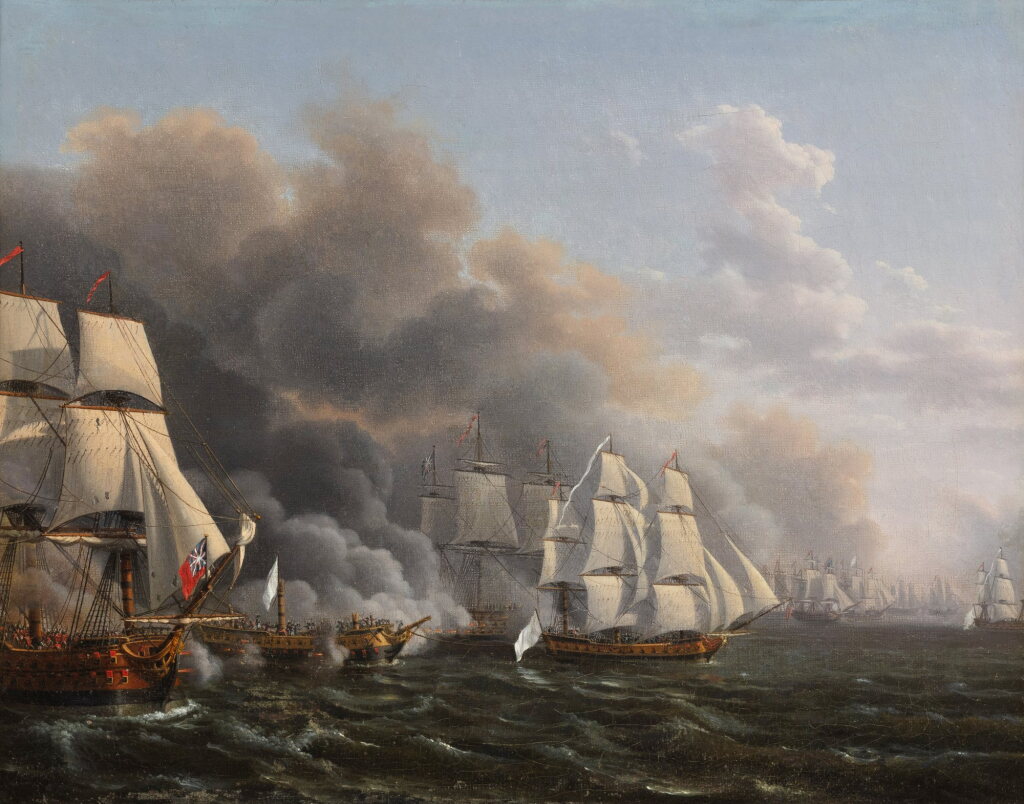
The frigate Le Richemond, commanded by the Vicomte de Mortemart, towing the dismasted Glorieux and surrounded by Admiral Rodney’s fleet during the action of 12 April 1782
Auction Closed
June 9, 01:57 PM GMT
Estimate
8,000 - 12,000 EUR
Lot Details
Description
Collection of the Rochechouart de Mortemart Family
Attributed to Lancelot-Théodore Turpin de Crissé
Paris 1782 - 1859
The frigate Le Richemond, commanded by the Vicomte de Mortemart, towing the dismasted Glorieux and surrounded by Admiral Rodney’s fleet during the action of 12 April 1782
Oil on canvas
32 x 41 cm ; 12⅝ by 16⅛ in.
Collection of the Rochechouart de Mortemart Family since the 19th Century;
Thence by descent.
The Battle of the Saintes took place off the coast of the island of Dominica between 9 and 12 April 1782. The French fleet, commanded by the Comte de Grasse, was attacked by Admiral Rodney’s fleet. After three days of manoeuvres, the broken French line forced the French to accept their defeat. The Glorieux, a vessel with seventy-four cannons which had taken part in the American War of Independence, was one of the ships boarded by Rodney’s fleet, together with the Ville de Paris, the Hector and the Ardent. The artist here depicts the desperate ploy by Victurnien-Henri-Elzéar de Rochechouart, Vicomte de Mortemart (1756–1783), who tried to tow the Glorieux, which had lost its mast and was helpless, away from the hands of the English surrounding them on every side. There are many accounts of the Vicomte’s bravery:
‘The Vicomte de Mortemart, captain of the frigate the Richemond, having been infinitely helpful on that day, 12 April, with his daring and noble ruse to tow the Glorieux, stubbornly holding on to it under enemy fire, only abandoned the attempt after repeated orders from M. de Trogoff, captain of the Glorieux, who could see that the frigate would be surrounded.’ (L.-E. Chevalier, Histoire de la marine française pendant la Guerre d’Indépendance américaine, 1877, book X, p. 320).
As far as we know at this time, Lancelot Turpin de Crissé never produced any marine paintings. But family tradition has always regarded the work as being by his hand. It is therefore probable that the work was commissioned directly from Turpin de Crissé by the Rochechouart de Mortemart family, and that on this occasion he stepped outside his usual genre.
You May Also Like