Fernand Khnopff
Study for Memories
Auction Closed
June 9, 01:57 PM GMT
Estimate
50,000 - 70,000 EUR
Lot Details
Description
Fernand Khnopff
Grembergen 1858 - 1921 Brussels
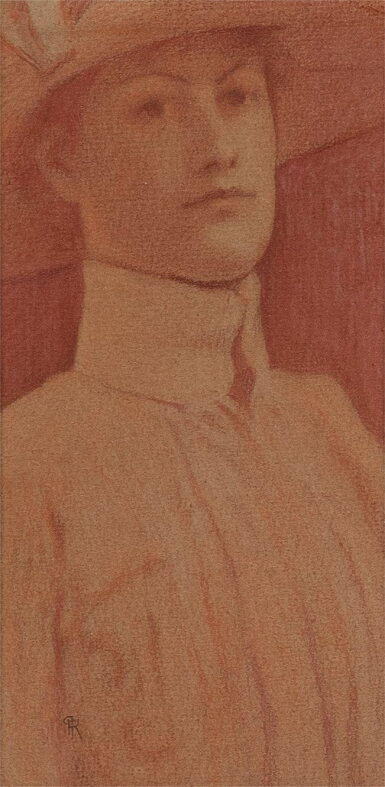
Study for Memories
Redchalk on paper
Signed with monogram lower left FK
207 x 112 mm
The work is listed in the archives of Gisèle Ollinger-Zinque under no. 115 TER.
Anonymous sale, Sotheby's, Amsterdam, 24 April 1989, lot 13;
Private Collection, Bruges;
With Zoute Art Galerie, Knokke-Heist;
Where acquired by the family of the present owner, in 1990.
Tokyo, Bunkamura Museum; Himeji, City Art Museum; Nagoya, City Art Museum and Yamanashi, Department Art Museum, Fernand Khnopff, June-November 1990, no. 15;
Brussels, Royal Museums of Fine Arts of Belgium, Fernand Khnopff, January-May 2004, no. 55.
M. Draguet, Khnopff ou l'ambigu poétique, Paris 1995, p. 240, fig. 245;
M. Draguet, Fernand Khnopff, Brussels 2018, p. 44, fig. 26.
In 1889, Fernand Khnopff made a monumental pastel with the title Memories, which would be regarded as his masterpiece. The work was displayed at the Exposition Universelle in Paris in May 1889 and won a silver medal. It depicts seven female figures about to play a tennis match, with the green tones of the Belgian countryside extending behind them. While their poses are very varied, the faces seem to be endlessly repeated: it is the face of his sister Marguerite, who was his muse and his model. Khnopff used a series of photographs as models for drawings, which he set against the background as if in a collage, throwing no shadows. This sanguine is one of the preparatory studies in pastel, a close-up view that corresponds to the face of the woman in the centre, wearing a yellow dress and wide-brimmed hat. In the drawing, Marguerite looks directly at the viewer, but in the final work she seems to be gazing into the distance.
These women seem to be inhabiting two worlds: the reality of their imminent sporting activity, indicated by the tennis rackets, becomes confused with their dreamlike state. They all seem as though locked within an interior world, in which ‘the power of memory trumps the principal of reality’ (M. Draguet, Fernand Khnopff, Brussels, 2018, p. 45). A Symbolist painter, anticipating the Pittura Metafisica later represented by Giorgio de Chirico, Khnopff’s works depict the kingdoms of the mind, emotions and memories. In the view of L. Dumont-Wilden, the Belgian writer and critic, ‘Khnopff concentrates his efforts, if not on representing ideas, at least on expressing through symbols feelings and emotions of a purely intellectual order’ (Fernand Khnopff, Brussels, 1907, pp. 9–10).
You May Also Like