
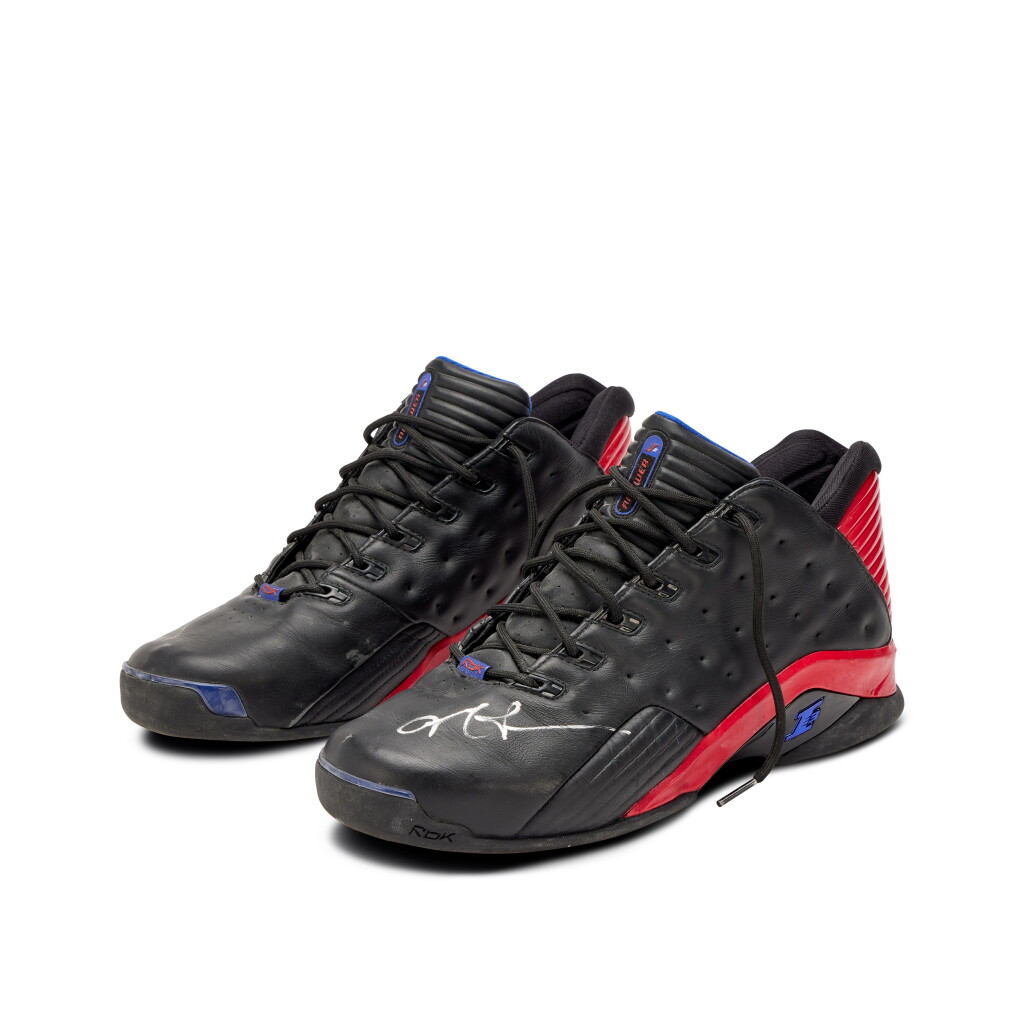
Allen Iverson Philadelphia 76ers 2003-2004 Dual-Signed Sneakers | Left Shoe Photomatch | 40 Points | Double-Double
Lot Closed
July 20, 11:53 PM GMT
Estimate
6,000 - 8,000 USD
We may charge or debit your saved payment method subject to the terms set out in our Conditions of Business for Buyers.
Read more.Lot Details
Description
REEBOK, REEBOK ANSWER VII, SIZE 10.5
Rubber, Leather, Cotton, Synthetic
2004
Former Seattle SuperSonics Ball Boy
Offered in this lot is a pair of Reebok Answer VIIs, signed by Allen Iverson. The left sneaker has been photomatched by SIA as being worn by Iverson during a regular season contest against the Seattle SuperSonics at KeyArena on February 19, 2004. Iverson delivered a dominant performance in the 76ers' 112-101 victory, recording 40 points, 11 assists, 2 rebounds, and 5 steals across 47 minutes of play. The right shoe was deemed a negative match.
The sneakers are accompanied by a letter from James Spence regarding the signatures, and come direct from Jesse Sluyter, a former ballboy for the Seattle SuperSonics.
Going Deeper | Allen Iverson
Allen Iverson joined a Philadelphia 76er team whose fans had not had much to cheer about for half a decade. After spending much of the 1980s competing in the NBA Playoffs, the team opened the 90s with two straight second round exits at the hand of Michael Jordan’s Chicago Bulls before missing the Playoffs entirely in 1992 with a record of 35-47. After trading All Star forward Charles Barkley, the team languished near the bottom of the NBA for four straight seasons; they never bested 30 games in this span and in 1995-96 they fell below 20 wins for only the second time in franchise history at the time. Attendance followed suit, with the 76ers ranking 28th out of 29 teams in attendance in 1995-96, besting only the Los Angeles Clippers. The 76ers needed a spark to reignite their storied franchise. As luck would have it, the 1996 NBA Draft had their answer.
The 1996 NBA Draft class ranks for many basketball fans among the best in league history. Names like Allen Iverson, Kobe Bryant, Steve Nash, Ray Allen, and Stephon Marbury among others were all up for grabs, and the 76ers entered the NBA Draft Lottery with a strong chance at the first overall pick; they had the second best odds, and two other lottery contenders, the Canadian expansion Vancouver Grizzlies and Toronto Raptors, were barred from the first overall pick due to their expansion agreements. As Deputy Commissioner Russ Granik counted down and announced the 4th overall pick had been awarded to the Charlotte Hornets, it became clear that Philadelphia would have their pick of this incredible draft class: they had won the first overall pick.
Although there was some consideration of the other players available, in the end the pick was relatively clear. The 76ers needed a guard and they needed a box office draw: Allen Iverson fit the bill.
Iverson had just finished leading the Georgetown Hoyas to the Elite 8 in the 1996 NCAA Tournament and was leaving Georgetown with the school record for career scoring average at 23 points per game and with two straight Big East Defensive Player of the Year nods. He represented an exciting new chapter for the 76ers, and fans did not have to wait long to see the young guard’s superstar potential.
Iverson’s rookie season was a personal triumph. While the 76ers only improved their record by four games, Iverson made it clear that their use of the first pick on him was an inspired choice. He scored 30 points in his debut, which puts him in a tie for the sixth most points of all time for a rookie in their debut. This would be the first of an incredible 20 games for the rookie scoring 30 or more, punctuated by a 50 point outburst against the Cleveland Cavaliers in April and perhaps the most famous crossover of all time, when he crossed up Michael Jordan in a 37 point game in March. Iverson finished his season with five 40+ point games, the most for a Philadelphia 76er rookie since Wilt Chamberlain, and Rookie of the Year honors. The future looked bright for AI and the 76ers.
Iverson and the 76ers finally broke through to the NBA Playoffs in the 1998-99 season, ending a seven year playoff drought, their longest in history. After another playoff berth in 2000, the height of the Iverson era in Philadelphia came in the 2000-01 season, when Iverson won MVP and led the 76ers to the NBA Finals. This playoff run was punctuated by extraordinary moments, such as his duel in the Eastern Conference Semifinals against the Toronto Raptors, which saw Carter register a 50 point game in game three while Iverson turned in multiple 50 point performances in the seven game epic, another seven game series against the Milwaukee Bucks in the Conference Finals that saw Iverson score 40 or more in the final two games, and then his famous crossover against Tyron Lue in the final minute overtime of Game 1 of the NBA Finals, which helped the 76ers secure their last NBA Finals game win to date and handed the Lakers their only loss of the 2001 NBA Playoffs. Despite losing in the championship round, Iverson had brought the 76ers all the way back to NBA relevance: from 28th of 29 teams in attendance the year before he was drafted, he had brought them to fifth. The Season after the NBA Finals, they were third.
Iverson continued to leave his mark on the NBA. He was named an All-Star for nine straight seasons after his Finals run, however not all were with the 76ers. In December 2006, Iverson met with the front office to express concerns over the direction of the franchise, and by the end of the month he had been traded to the Denver Nuggets, his last game in Philadelphia coming against the Chicago Bulls. Paired up with Carmelo Anthony, the pair managed 51 wins in their lone full season together, the 2007-08 season. The following season he was traded again, this time to the Detroit Pistons, and despite being named an All Star became frustrated by the end of the season after being asked to fill a reserve position after coming back from injury. Opening night of the 2009-10 season saw him in his third different uniform in two seasons, that of the Memphis Grizzlies. However, here too he was asked to fill a reserve role, which Iverson was not happy with. He and the team agreed to part ways and Iverson was waived. He became a free agent on November 18, and after no one signed him for a week announced his retirement on November 25.
This seemed like the end of Iverson’s NBA story, however he would get a final chance to play in the NBA, fittingly with the team that had drafted him 13 years before. On December 2, 2009, Iverson returned to the 76ers, playing 25 more games with the franchise. In his first game back, he kissed the 76ers logo at center court, acknowledging that he was in some ways back home. His last game with the 76ers and in the NBA came on February 20, 2010 against the same team his first stint ended against, the Chicago Bulls.
Iverson retired from basketball on October 30, 2013. He had gone to Turkey to play with Beşiktaş J.K. after the 2010 offseason saw him remain a free agent, and was then offered a D-League contract in January of 2013 but declined. While he had lost his desire to play, his affinity for the city where in his words he “became a man” was as strong as ever: Iverson told the assembled crowd, which included Julius Erving and his college coach John Thompson, that he would be a 76er “until I die.” He told the press that he had given “everything I had to basketball,” and the fans knew it. In November, the 76ers announced that they would retire his number three on March 1, 2014, and the ceremony was attended by almost 21,000 people.
Iverson continues to be an ambassador for the game, regularly appearing with various outlets to discuss his career and the NBA. In 2016, Iverson was inducted into the Naismith Basketball Hall of Fame alongside two contemporaries, Shaquille O’Neal and Yao Ming. In 2021, he was named to the 75th Anniversary Team and attended the ceremony at the 2022 All Star Game in Cleveland. Giannis Antetokounmpo, also named to the team and defending NBA Champion, sought Iverson out and told him that he had begun playing basketball because of him. Such was the impact of this extraordinary talent who was never afraid to be himself. Iverson once said “I don’t want to be Michael Jordan. I don’t want to be Magic. I don’t want to be Bird, or Isiah [Thomas]. I don’t want to be any of those guys…When my career is over, I want to look in the mirror and say I did it my way.” He can rest assured that there never will be, and that he always did.
You May Also Like


