
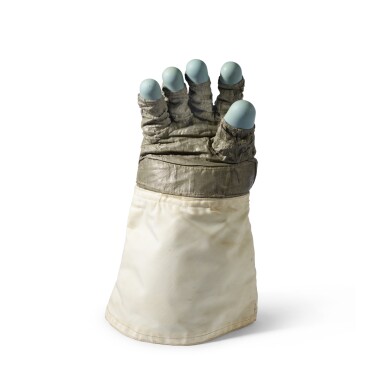
A7-L Glove
Apollo-Era Extravehicular Glove made for Gordon Cooper
Auction Closed
July 15, 04:56 PM GMT
Estimate
10,000 - 20,000 USD
Lot Details
Description
A-7L EXTRAVEHICULAR GLOVE.
MADE FOR GORDON COOPER. Manufactured by ILC Industries FOR NASA, July 1969.
Right A-7L Extra-Vehicular glove, measuring approximately 13 x 9 inches. Chromel-R fabric with thermal insulation and silicone fingertips. Inside label reads "ITEM GLOVE ASSY., EV / PART NO. A7L-203-025-10/CEI NO. 2001A/SIZE: COOPER/ SERIAL NO. 094, DATE 7/69/ CONTRACT NO. NAS9-6100 (NASA)/CODE IDENT. 74897/ILC INDUSTRIES, INC." above a COOPER nametag. The tag is struck through with faded red ink, suggesting that while this was made for Cooper, it may not have been distributed.
AN A7-L GLOVE MADE FOR GORDON COOPER, LIKELY USED IN TRAINING.
The International Latex Corporation's aerospace division, referred to on this glove's tag as ILC Industries and later known as ILC Dover, has been the designer and producer of the space suit pressure garment for NASA since the beginning of the Apollo program. They developed the first highly mobile space suit, the A7L, which made it possible for the astronauts to walk on the Moon; in fact, every American astronaut to go into space since the Apollo program did so in an ILC Dover suit. Each full suit took about 5,000 hours to complete, and cost approximately $1,000,000 to produce. The suits were tailor-made for the astronauts, and underwent rigorous testing and painstaking study to get just right.
A masterclass in engineering, the present lot demonstrates ingenuity in planning for human survival in space. Each glove was constructed with an outer layer of Chromel-R fabric , which provided thermal insulation to protect the astronauts in extremely hot or cold environments. However, sensitivity was needed in order to manipulate instruments. The blue silicone fingertips provided that functionality. This glove dates to July 1969, when the technology had been developed with the historic lunar landing in mind.
Gordon Cooper was part of the first group of astronauts chosen by NASA as part of the “Mercury Seven.” Hi piloted the final Mercury mission, Mercury-Atlas-9, a 34-hour mission that made him the first American to spend an entire day in space and considered by many to be the most successful. He set another record when he spent almost 8-days in space during Gemini V. He and crewmate Pete Conrad proved that astronauts could survive in space for the duration necessary for a round trip to the Moon.
The present glove would have been used by him after he served as backup commander of Apollo 10. He was training for Apollo 13 when he was bumped from rotation by the returning Mercury Seven astronaut Alan Shepard, who only recently had been approved for flight after having surgery to cure the Ménière's disease that had grounded him after his Mercury flight. Cooper grew frustrated and retired on July 31, 1970. His training suit, including this glove, would likely have gone back to ILC for evaluation, and eventually sold as surplus when they closed their Dover, DE plant and held what was essentially a “yard sale” in the mid-1970s.
News & Notes. Volume 37, No. 3 Washington, D.C.: NASA, 2020; Young, Amanda, Spacesuits: The Smithsonian National Air and Space Museum Collection p. 86.

