
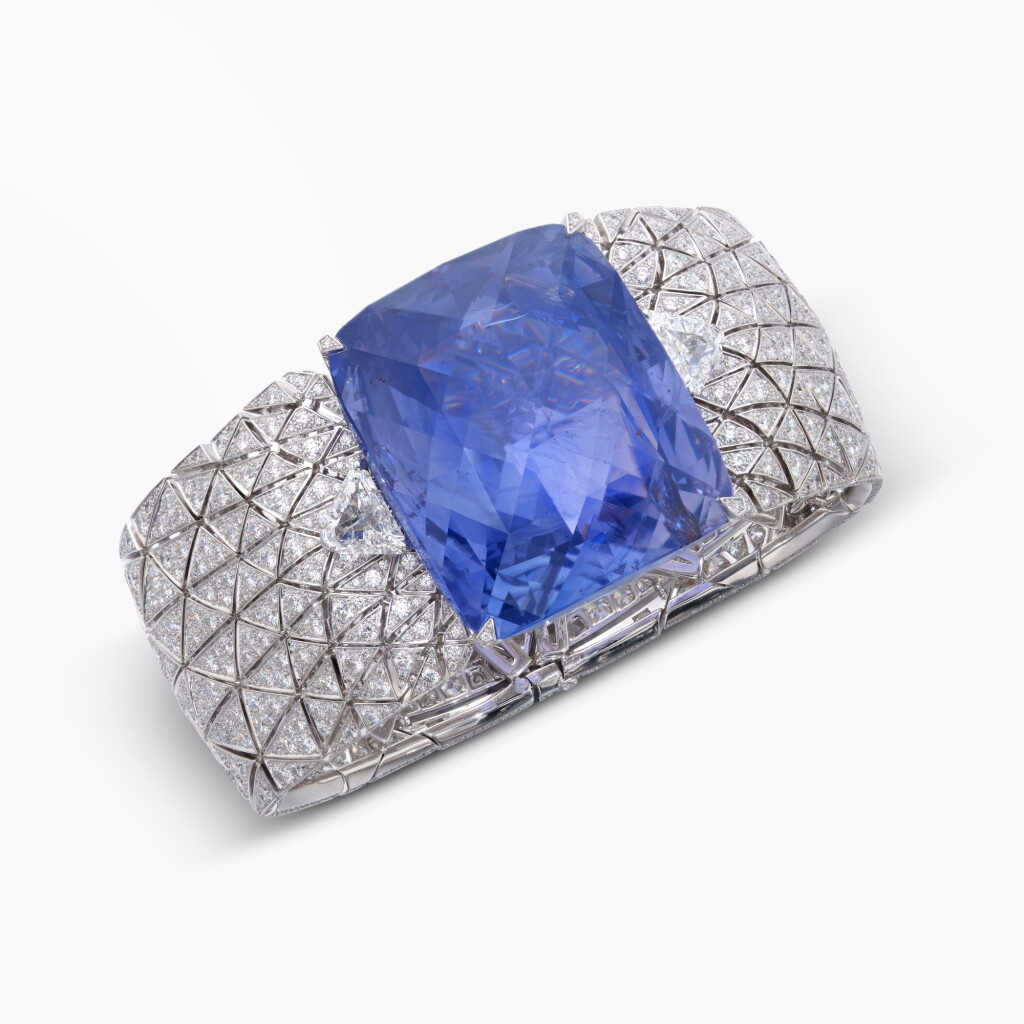
The Romanov Sapphire, Formerly Part of the Imperial Russian Crown Jewels
Cartier
Highly Impressive and Historically Significant Sapphire, Rock Crystal and Diamond Bracelet 卡地亞 | 極為重要歷史珍藏 197.80克拉 天然「斯里蘭卡」未經加熱藍寶石 配 白水晶 及 鑽石 手鏈
Auction Closed
November 11, 06:10 PM GMT
Estimate
850,000 - 1,700,000 CHF
Lot Details
Description
Centring the cushion-shaped Romanov sapphire weighing 197.80 carats, to a bracelet of geometric design set with brilliant-cut diamonds and accented by modified shield step-cut diamonds, with an interchangeable engraved rock crystal centre embellished with triangular diamonds, signed Cartier, numbered, maker’s marks for Cartier, French and Swiss assay marks for platinum, case and two pouches stamped Cartier; the Romanov sapphire 19th century, bracelet circa 2015.
Approximate inner circumference: 170mm
SSEF report no. 151294, 9 January 2026: sapphire 197.80 carats (declared weight), Ceylon, no heat, Appendix Letter
Gübelin report no. 25120037, 10 December 2025: sapphire 197.80 carats (declared weight), Ceylon, no heat, Appendix Letter
Gübelin report no. 15030013, 4 March 2015: sapphire 197.80 carats, Ceylon, no indications of heating
SSEF report no. 75120, 30 June 2014: sapphire 197.79 carats, Ceylon, no heat, Appendix Letter
Two information bundles by Cartier pertaining to the Romanov sapphire and the bracelet respectively, including a copy of the original design of the bracelet
Cartier information booklet pertaining to the Romanov sapphire
GIA report no. 2155951443, 24 February 2014: diamond 1.25 carats, D Colour, Internally Flawless
GIA report no. 1152686832, 25 November 2013: diamond 1.25 carats, D Colour, Internally Flawless
GIA report no. 2137499988, 11 June 2012: diamond 1.02 carats, E Colour, VS2 Clarity
GIA report no. 1135499967, 18 June 2012: diamond 1.03 carats, F Colour, SI1 Clarity
Accompanied by a French edition of the Fersman Catalogue of the Russian Crown Jewels (Four pamphlets, Les Joyaux du Trésor de Russie, detailing the collection of the Romanov Royal jewels, Aleksandr Evgenevich Fersman, editor. Les Joyaux du Trésor de Russie. Premiere (-quatrieme & derniere) livraison. Moscow: Commissariat national des finances, 1924-1926)
The Russian Crown Jewels
Ganna Walska (1887-1984), acquired from Cartier in 1927
The Important Jewelry Collection of Madame Ganna Walska, Sotheby’s Parke Bernet New York, 1 April 1971, Lot 75
Magnificent Jewels, Sotheby's Geneva, 18 November 1992, Lot 497
Remounted by Cartier in 2015
Private Collection
The Crystallisation of time, NACT, Tokyo, 2019.
Stefano Papi and Alexandra Rhodes, Famous Jewelry Collectors, London, 1999, pg 170 - 171
The Imperial Russian Crown Jewels: The Romanov Sapphire
This exceptional historical sapphire originated in the legendary collection of the Romanov family. The fabled collection of the Russian Tsars was arguably the most opulent and valuable Royal collection ever assembled, second only to the legendary treasures of the Mughal Emperors. Many important diamonds and gemstones in the collection were acquired by the Empresses Elizabeth and Catherine The Great in the 18th century. The exact date when this exceptional sapphire entered the Russian Crown Jewels is not recorded, but its highly unusual facetting style indicates a Mughal-era origin. The catalogue of the Russian Crown Jewels drawn up after the Revolution in 1924-1926, the so-called Fersman catalogue, shows how this sapphire, then set in a contemporary diamond border by Fabergé, formed a pair of brooches or clasps together with a second sapphire whose weight was recorded as 249.25 metric carats. The Russian Crown Jewels which were all mined in far-away locales and often retained their traditional, historical cutting styles, but were set in contemporary European settings, embodied Russia's position as the bridge between East and West.
The Romanovs wore the Russian Crown Jewels with great splendour. Countless portraits and early photographs show how the Russian Empresses and Grand-Duchesses generously piled on extravagant quantities of the largest and finest diamonds, pearls, emeralds and sapphires. Nowhere did the Romanov flair for adornment come to more dramatic expression than at costume balls in the recreating the splendour of old Moscow, such the 1903 Winter Palace Ball. The entire court attended these balls attired in splendid 17th century Moscovite dress with vast quantities of jewels sewn onto the exquisite costumes. The Dowager Empress Maria Feodorovna, born Princess Dagmar of Denmark (1847-1928) wore this sapphire together with its pair, on the front panel of her skirt, at precisely such a ball in 1883. The image of the Dowager Empress in historicising Moscovite costume wearing these extraordinarily large sapphires of old Mughal cutting-style together with numerous other jewels of the same superlative dimensions and quality, is a perfect summary of the splendour of the Tsarist court.
After the Russian Revolution, the new Soviet government had the Russian Crown Jewels inventoried in a lavishly illustrated catalogue composed of four volumes featuring life-size plates. The commission working on the catalogue, The People's Commissariat of Finances, was lead by a man called Alexander Fersman hence the catalogue being known as the Fersman catalogue. It was issued in four languages: Russian, English, French and German. The Soviets divided the collection in three categories: the most historically valuable pieces which they preserved and today form the Moscow State Diamond Fund, a second portion contained jewels of a certain historical value to be sold abroad and which was offered at Christie’s London in 1927 through intermediaries, while a third portion comprised gemstones with no historical or artistic merit further than their intrinsic value. This last portion, including the Romanov sapphire, was sold off anonymously.
Following the sale of the Russian Crown Jewels by the Soviets in the 1920s, the sapphire was acquired by the socialite and dilettante soprano Ganna Walska in 1927. Ganna Walska originally purchased the sapphire at Cartier set as the central pendant on a sautoir. Two years later in 1929, she had the sapphire remounted on another sautoir necklace together with a carved Moghul emerald weighing 256.60 carats which she had acquired four years earlier. Together these two stones embodied the exotic, bold and colourful far-Eastern aesthetic which the daring and exuberant Ms Walska adored. That same sautoir was altered many times over the ensuing years. By the time the sapphire featured in Ms Walska’s fabled estate sale at Sotheby’s Parke Bernet in 1971, it was the centre piece of a shorter necklace composed of tumbled sapphire beads likely created in the 1940s. The sapphire re-appeared at auction at Sotheby’s Geneva in 1992 when it was set on an emerald and sapphire bead torsade necklace. In 2015, Cartier created the present bracelet around the Romanov sapphire, a design echoing the art deco style in vogue when Cartier first mounted the sapphire for Ganna Walska. The bracelet, with interchangeable rock crystal centre, highlights both the historical Romanov sapphire as well as Cartier’s unique artistic legacy anchored in the art deco period.
Ganna Walska (1887-1984)
Ganna Walska was a larger-than-life socialite and self-proclaimed coloratura soprano who over the course of her adventurous and colourful life collected six husbands and a sumptuous array of jewels. During the 1920s, Ms Walska received constant press-coverage for her countless marriages, exorbitant divorce settlements, comically unsuccessful efforts on the lyrical stage and of course her extravagantly lavish life style adorned with the most fabulous gemstones. Much in the spirit of the Ballets Russes that marked her generation, Ms Walska loved strong colours, dramatic effects and Eastern-inspired aesthetics. Her jewellery collection featured many bold, large gemstones in daring settings often of oriental inspiration.
Ganna Walska was born as Hanna Puacz in 1887 in Brest, now Belarus, then part of the Russian Empire. At the age of seventeen she had embarked on her first marriage to Baron Arcadie d’Eingorn and was living in St Petersburg. By 1916, she appeared in New York and was married to Dr. Joseph Fraenkel who passed away in 1920. Her next husband, Alexander Smith Cochran (1874-1929) dubbed ‘the richest bachelor in New York’, had a fortune that allowed his wife to indulge in her appetite for exceptional jewels. This marriage lasted only two years, but left her with a substantial divorce settlement. By 1922, she married Harold McCormick (1872-1941), the millionaire son of the Chicago Reaper King, the chairman of the International Harvester Company, and a patron Chicago Opera Company. McCormick advanced her singing ambitions by allowing her to take classes with the best vocal coaches of the day and arranging for her to be cast in lead roles in major opera productions. Most dramatically, he even purchased the Théâtre des Champs Élysées in Paris for his wife. By all accounts, Ganna Walska’s vocal abilities were decidedly mediocre and the scathing press she received inspired a plotline in Orson Welles’ legendary 1941 film ‘Citizen Kane’ where the lead character, an American tycoon, builds an opera house for his hopelessly untalented young wife.
During her marriage to McCormick, Ganna Walska acquired many highly important jewels and gemstones including the 96.62 carat Fancy Vivid Yellow Walska Briolette Diamond, a 21.15 carat heart-shaped diamond ring, a sapphire weighing 39.00 carats and a 20 carat step-cut emerald. More than gemstones, Ms Walska loved daring jewellery designs, for instance she purchased one of the first carved coral chimera bangles from Van Cleef & Arpels in the 1920s. Never satisfied with her jewels, she constantly had her pieces redesigned as is evident of the many iterations of the necklace featuring the historic Romanov sapphire.
After divorcing McCormick in 1931, Ms Walska abandoned her lyric ambitions for good. Her reputation for high profile and highly mediatised marriages and divorces was such that she even promoted a perfume, scandalously titled ‘Divorçons’ or ‘Let’s Get Divorced’. As the 1930s wore on, she increasingly started to live a more withdrawn life. Two further marriages followed, first to the British inventor Harry Grindell Matthews (1880-1941) and lastly to the American explorer and scholar of Buddhism Theos Bernard (1908-1947). Twenty years her junior, Bernard introduced Ms Walska to yoga and Buddhist teachings. He encouraged her to purchase a large estate in Montecito, California to house a community of Tibetan monks. Though, the community could not be established, this estate renamed Lotusland became the passion-project that consumed the second half of Ganna Walska’s life. She found great joy in designing the grounds, planting it with rare species from across the globe. Lotusland is subdivided into several meticulously designed gardens, each designed around a central theme. Following Ms Walska’s death, Lotusland opened to the public as a Botanical Garden featuring over 3,500 different species of plants, forming the lasting, living and breathing legacy of a woman of extraordinary willpower and great artistic sensibilities.