Property of a European Princely Family
Van Cleef & Arpels
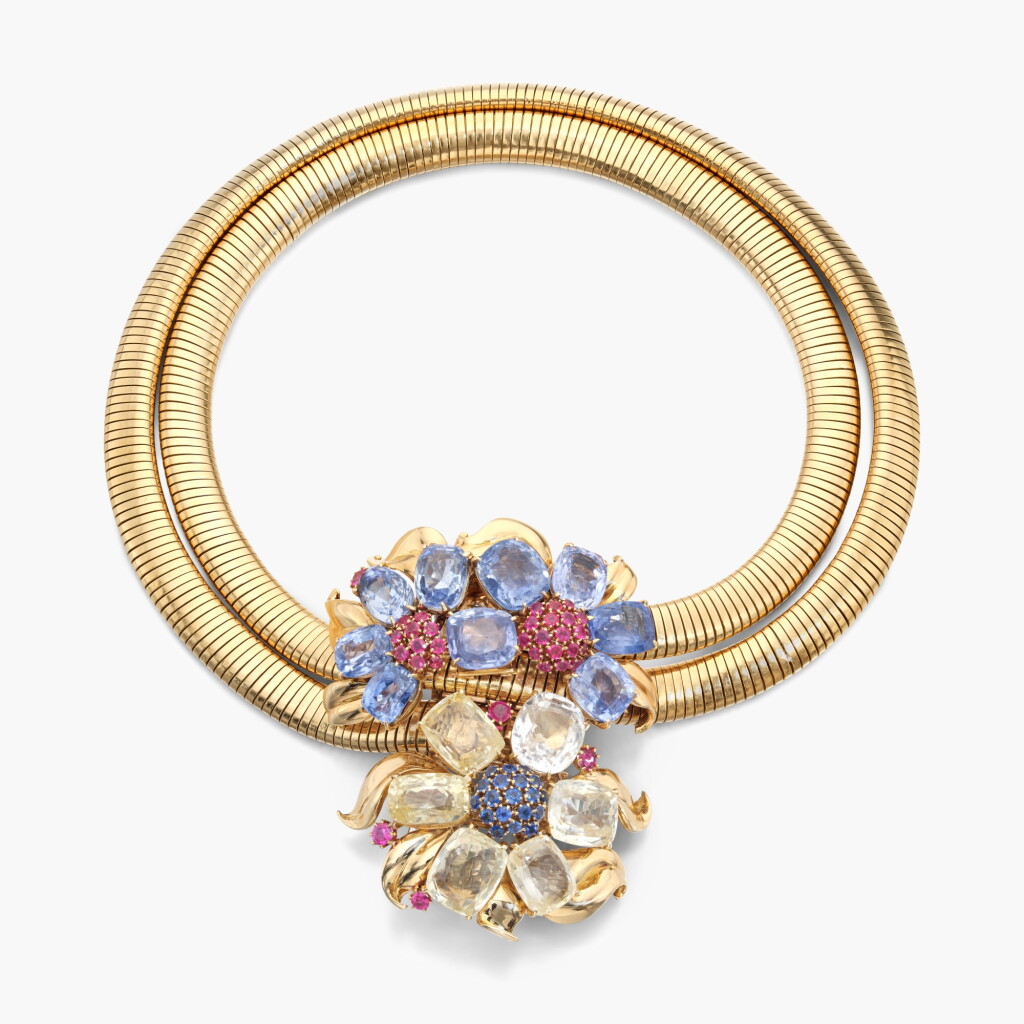
Transformable Gold, Sapphire, Yellow Sapphire and Ruby ‘Passe-Partout’ Set
Live auction begins on:
November 11, 04:00 PM GMT
Estimate
70,000 - 100,000 CHF
Bid
50,000 CHF
Lot Details
Description
Comprising a pair of brooches set with cushion-shaped sapphires and yellow sapphires respectively, accented by circular-cut rubies and sapphires, and a chain of gaspipe-linking, alternately forming several different necklaces, a choker, a bracelet and a belt, signed Van Cleef & Arpels, numbered, partial maker’s mark for Péry & Fils, French assay marks for gold, two brooch fittings, two clasp fittings, lower half of the larger brooch detachable, terminals of the chain detachable, fitted case stamped Van Cleef & Arpels; circa 1939.
Approximate measurements: length of chain 730mm, length of the different transformations adjustable, brooches 55 x 40mm and 50 x 35mm respectively
Nathalie Chapuis (ed.), The Van Cleef & Arpels Collection 1906-1953, Paris, 2023, pgs. 348-355 for the Passe-Partout.
The Passe-Partout: An Icon of Ingenuity
Van Cleef & Arpels launched the highly transformable ‘Passe-Partout’ jewellery collection around 1939 and exhibited it prominently at the World Fair held in New York that same year. Versatility of wear has remained a strong point of Van Cleef & Arpels to this day, but no other jewel summarises the house’s signature ingenuity better than the ‘Passe-Partout’ which allowed the wearer to transform one single piece of jewellery into several different necklaces, a choker, a bracelet, a pair of brooches and even a belt, with the help of a cleverly designed clasp fittings.
The 1930s were a period of great innovation at Van Cleef & Arpels. The decade saw the development of the maison’s signature mystery-setting as well as the minaudière vanity case and reached a culmination point in the ‘Passe-Partout’. The patented ‘Passe-Partout’ style consists of a chain of gaspipe linking and a pair of brooches designed as flower heads, usually one with yellow sapphire petals, the other with blue sapphire petals. Via a clasp fitting with different rails the chain can be arranged in a surprisingly diverse range of configurations.
The ‘Passe-Partout’ is a testimony to the undeniable style and glamour of the late 1930s, all the while also reflecting the hardships of the era. As war was approaching in Europe, the habitual global access to gemstones was impaired, thus Van Cleef & Arpels turned to large, pale and moderately included Ceylon sapphires which only a few years before would have been considered unsuitable for a high jewellery piece. Because of a lack of materials, the maison highlighted the unique beauty and charm of a previously neglected gemstone. The economic turmoil of the 1930s also meant that one piece of jewellery allowing for numerous ways of wear held a particularly strong appeal to their clients. Additionally, during World War II platinum was restricted to critical military use, thus yellow gold fully returned to the forefront of jewellery design, after being relegated to second place during the earlier art deco style, a stylistic evolution fully on display in the ‘Passe-Partout’. The brooches forming the ‘Passe-Partout’ were usually designed as a single yellow sapphire and blue sapphire flower head. The fact that the blue sapphire brooch of the set offered in this sale features a double flower head is a particularly rare variation on the style.
The ‘Passe-Partout’ featured prominently in the media of the time. Hélène Arpels, the wife of Louis Arpels, was photographed wearing a ‘Passe-Partout’ choker and bracelet at the Longchamps races. During the late 1930s and early 1940s, Hollywood emerged as the second capital of style next to Paris with its movie stars becoming aspirational style icons for eager audiences all over the world. Two of Hollywood’s most stylish stars, Merle Oberon and Paulette Goddard, each owned a suite of ‘Passe-Partout’ jewels and were photographed numerous times wearing them. In fact Ms Oberon wore her personal ‘Passe-Partout’ as a necklace in the final scenes of the 1940 romantic melodrama ‘’Til We Meet Again’.
The ‘Passe-Partout’ remains one of Van Cleef & Arpels’ most iconic and recogniseable designs that speaks eloquently of the world it was born into, while at the same time being a shining example of creativity, ingenuity and timeless design.