
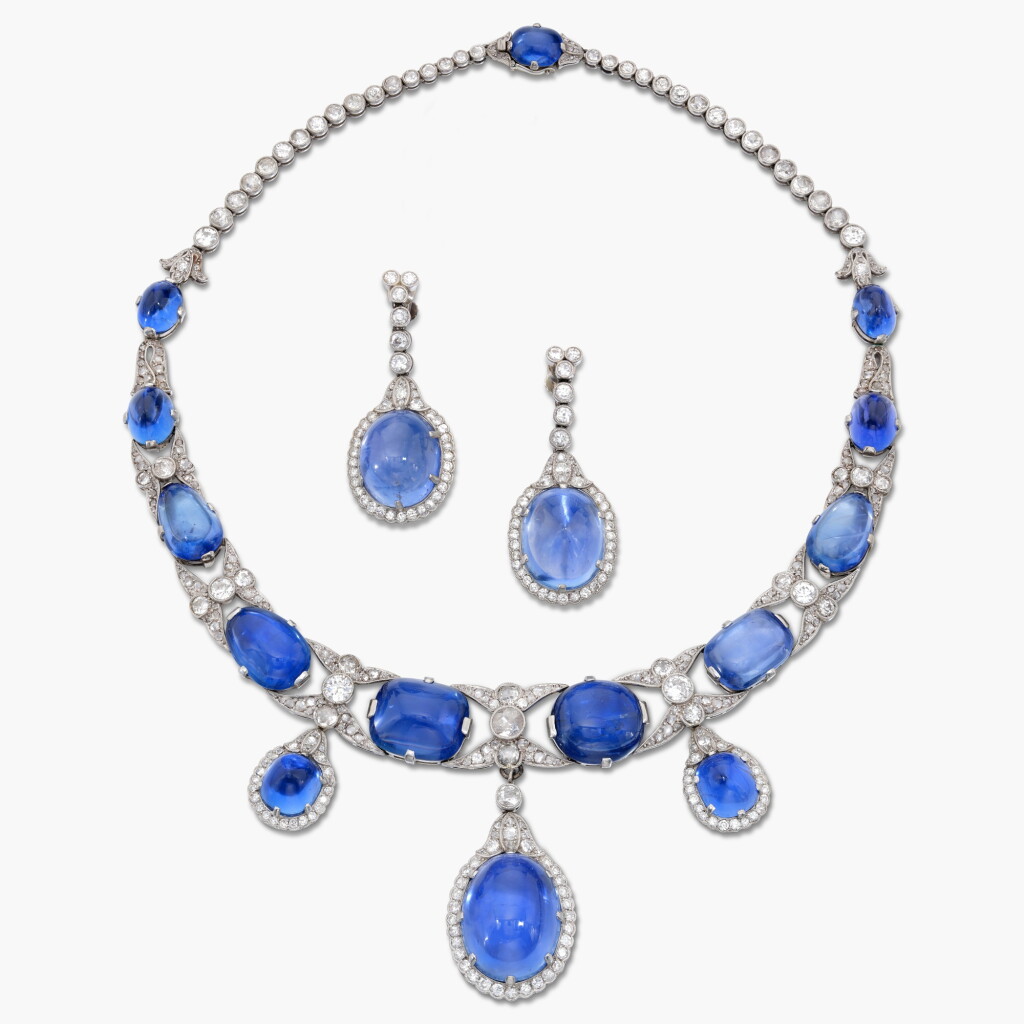
Formerly in the Collection of Sibylla of Saxe-Coburg and Gotha, Duchess of Västerbotten (1908-1972)
Impressive Sapphire and Diamond Demi-Parure 非凡 藍寶石 配 鑽石 項鏈 配 耳墜套裝, 二十世紀初期及以後
Live auction begins on:
November 11, 04:00 PM GMT
Estimate
300,000 - 500,000 CHF
Bid
220,000 CHF
Lot Details
Description
Comprising a necklace and a pair of pendent earrings featuring a graduated series of cabochon sapphires, framed by millegrain-set old European-cut diamonds, highlighted by single- and rose-cut diamonds, earrings with screwback fittings and security hooks, pendants on necklace detachable, fitted case stamped Rath München, the lid applied with the gilt-metal cypher of Princess Sibylla; early 20th century and later.
Approximate measurements: length of necklace 450mm, earrings each 50 x 20mm
SSEF report no. 158324: fifteen sapphires Ceylon, one sapphire Burma, sixteen sapphires no indications of heating, one sapphire minor oil
By tradition the sapphires belonged to Dagmar of Denmark, Empress Maria Feodorovna of Russia (1847-1928)
Wedding present from Tsar Ferdinand of Bulgaria (1861-1948)
Princess Sibylla of Saxe-Coburg and Gotha, Duchess of Västerbotten (1908-1972)
Princess Birgitta of Sweden, Princess of Hohenzollern-Sigmaringen (1937-2024)
Princess Sibylla of Saxe-Coburg and Gotha
Sibylla of Saxe-Coburg and Gotha (1908-1972) was the mother of the current Swedish King Carl XVI Gustaf. She was the daughter of Charles Edward, Duke Albany (1884-1964), the last reigning Duke of Saxe-Coburg and Gotha. Her paternal grandfather was Prince Leopold, Duke of Albany (1853-1884), the youngest son of Queen Victoria and Prince Albert, who died tragically young from complications of hereditary haemophilia, four months before the birth of his son Charles Edward. In 1900, sixteen year-old Charles Edward succeeded his uncle Alfred (1844-1900) as sovereign Duke of Saxe-Coburg and Gotha and moved to Germany. The German princely states were abolished at the end of World War I and as Charles Edward’s primary duty was with his Dukedom, he was stripped of his British titles by George V during the conflict. Left increasingly isolated from his immediate family, he was very susceptible to Germany’s disastrous political developments during the interbellum, an association that would forever cloud Sibylla’s existence and public image.
In 1932, Princess Sibylla married Prince Gustaf Adolf, Duke of Västerbotten (1906-1947), the second in line to the Swedish throne. The wedding was a glittering Royal celebration, with the couple’s relations from all over Europe in attendance. The abdicated Tsar Ferdinand of Bulgaria (1861-1948) gifted the bride this impressive sapphire and diamond necklace. At the time the sapphires which are currently set on the pair of earrings were pendants on the front of the necklace. According to tradition, the cabochon sapphires belonged to the last Russian Tsar’s mother, Tsarina Maria Feodorovna (1847-1928). She survived the Russian Revolution and spent her last years in her native Denmark. Presumably the Bulgarian Tsar purchased these sapphires from her during that time. Tsar Ferdinand was a noted connoisseur of jewels and gemstones, his collection included a coloured diamond tie pin designed as a fleur-de-lys (sold in these rooms on 13 November 2024) and he acquired a highly important pair of sapphire earrings and a natural pearl and diamond brooch from the sale of the French Crown Jewels in 1887. Tsar Ferdinand spent his exile living in Coburg, he was in fact born into the junior Austro-Hungarian branch of the Saxe-Coburg and Gotha family known as Saxe-Coburg and Gotha-Kohary. His dynastic link to Sibylla and the fact that he lived in the town which was once her father’s capital would explain the importance of his wedding gift.
Princess Sibylla prominently wore her sapphire and diamond necklace for decades. The necklace can be seen on countless photos of Princess Sibylla, often worn together with one of the numerous historical tiaras that make up the Swedish Royal collection. In Sweden and all over the world, the Royal family is much admired for the way they share the enjoyment of their highly prestigious, historical jewellery collection with the public, an act of generosity underscoring the social covenant between the monarchy and the nation. At some stage two pendants from the front of the necklace were removed to make up the present pair of earrings, the fitted case was adapted to reflect this modification. Additionally the imprint in the fitted case shows that the necklace was lengthened as well.
The Duke and Duchess of Västerbotten were blessed with five children: the Princesses Margaretha (1934), Birgitta (1937-2024), Désirée (1938) and Christina (1943) and Prince Carl Gustav (1946). Their happiness was cut short when Gustaf Adolf was killed in an airplane crash. His plane coming from Amsterdam crashed after a short layover in Copenhagen. The plane also carried the well-known classical soprano and Hollywood film star Grace Moore, none of the passengers survived the crash. Following the accident, Sibylla mainly focused on raising her five children. As the family lived in the Haga Palace in Solna, the four princess were dubbed the 'Haga Princesses' by the press. Sibylla’s father-in-law King Gustaf VI Adolf of Sweden had been widowed in 1920, he married his second wife Louise Mountbatten in 1923. When Queen Louisa passed away in 1965, Sibylla took on duties as First Lady of Sweden. This gave her ample opportunities to wear her jewellery collection. She also sometimes loaned her sapphire demi-parure to her daughters who took on more representational duties as they grew into their twenties. Unfortunately, Princess Sibylla suddenly passed away in 1972, the year before her son became King.
Princess Birgitta of Sweden (1937-2024)
The sapphire and diamond demi-parure was inherited by Sibylla’s daughter Princess Birgitta. In 1961, Princess Birgitta had married Prince Johann Georg of Hohenzollern-Sigmaringen (1932-2016) who was a noted art historian. Together they lived in Munich and had three children. A life-long passionate golfer, Princess Birgitta resided mainly in Majorca during the second half of her life. All through the decades, she assisted her brother in representational functions and greatly enjoyed wearing the magnificent historical jewels from either her personal collection or the Swedish Royal collection. She wore the sapphire and diamond demi-parure on many occasions, most notably at the wedding celebrations of her nieces Crown Princess Victoria and Princess Madeleine in 2010 and 2013 respectively.