
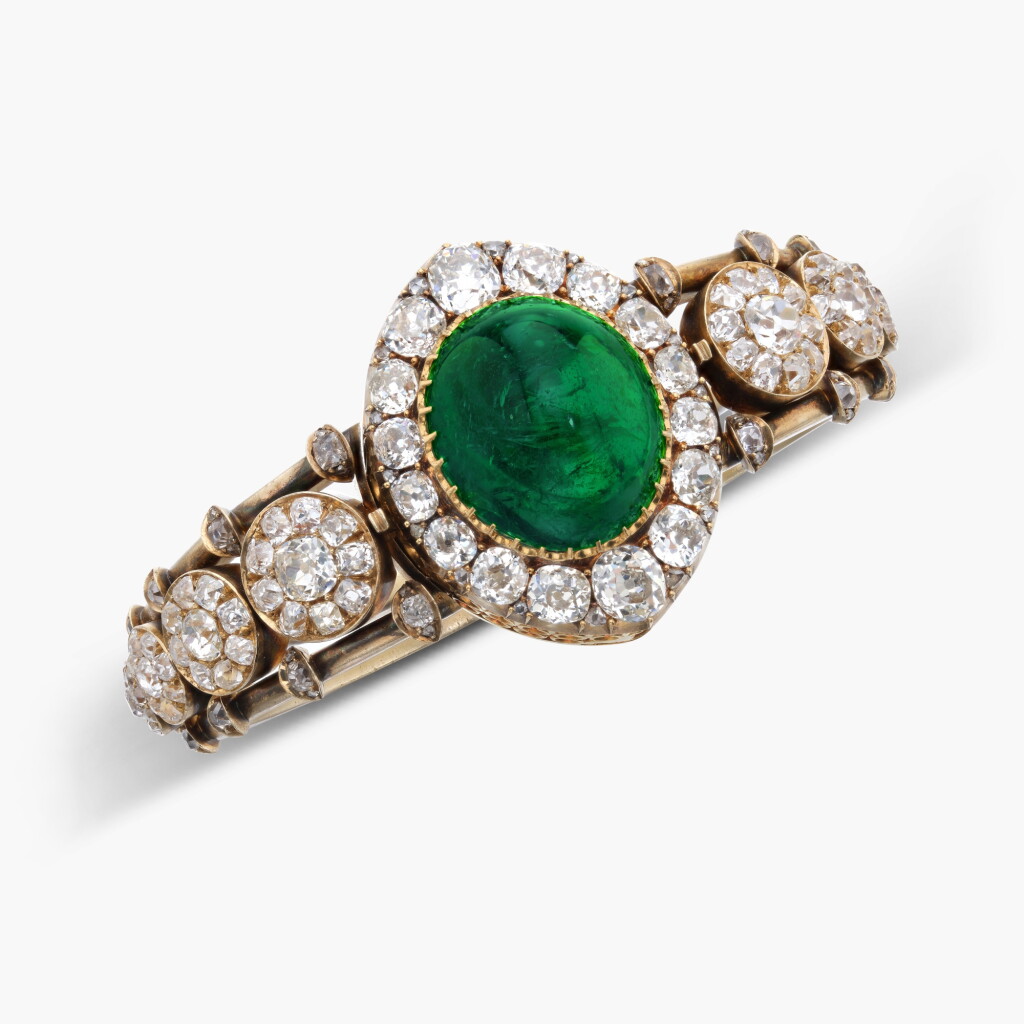
Formerly in the Collection of Amélie of Orléans, Queen of Portugal (1865-1951)
Superb Antique Emerald and Diamond Bangle 古董珍藏 27.38克拉「哥倫比亞」祖母綠 配 鑽石 手鐲, 約1880年代
Auction Closed
November 11, 06:10 PM GMT
Estimate
70,000 - 100,000 CHF
Lot Details
Description
The detachable centre featuring a cabochon emerald weighing 27.38 carats within an old mine-cut diamond border accented by rose-cut diamonds, scratched numbering, French warning import marks; 1880s.
Approximate inner circumference: 160mm
SSEF report no. 155325, 15 June 2026: emerald 27.38 carats, Colombia, minor oil
Amélie of Orléans, Queen of Portugal (1865-1951)
Princess Esperanza of Bourbon-Orléans (1914-2005)
Princess Maria da Gloria of Orléans-Braganza, Crown Princess of Yougouslavia
Sotheby's New York, December 9-10, 1981, lot 429
Gabriele Murdock (1941-1985), Sotheby’s, New York, December 7, 1999, lot 624
Amélie of Orléans: The Last Queen of Portugal
Amélie of Orléans (1865-1951) was born as the eldest daughter of the Count and Countess of Paris. At the time her family, the former French ruling Orléans dynasty, lived in exile in Great Britain. When Amélie was six years old, her parents were allowed to return to France again after the fall of the Second French Empire. She and her siblings grew up in Paris at the Hôtel Matignon. In 1886, Amélie met the Portuguese Crown Prince Don Carlos (1863-1908) and the pair soon married. Their lavish engagement celebrations were ill-perceived by the French Republic as a sign of the Orléans’ dynastic ambition and contributed to the Orléans throne pretender being exiled from France once again. The bride’s wedding gifts included a highly important emerald and diamond parure, likely mounted by the former French Crown jeweller Bapst, comprising a tiara, a necklace, a devant-de-corsage and a set of smaller shoulder brooches which were given by the bride’s parents and her paternal great-uncle, the Duke of Aumale.
When Amélie arrived in Portugal, legend has it she stepped of the train with her left foot first, a bad omen for things to come. The Portuguese monarchy was increasingly unpopular while the country’s economy was in dire straits. When Don Carlos succeeded his father in 1889 as King Carlos I, his popularity would be tarnished due to the British Ultimatum of 1890, which forced Portugal to relinquish important territorial claims in Africa to Great Britain. His lavish lifestyle and indiscrete extramarital affairs were further cause for consternation at a time when Portugal was declared bankrupt twice, once in 1892 and again in 1902. Amélie’s charitable nature, personable character and regal presence, standing an exceptionally tall 1.82m, won her the sympathy of her compatriots. She worked tirelessly supporting schools, hospitals and the Red Cross and also founded the Institute Dona Amelia to support workers’ rights as well as the National Association against Tuberculosis. The Queen’s personal popularity was, however, hampered by a public perception of her getting overly involved in state affairs and being spendthrift like her husband.
On 1 February 1908, anti-monarchist feelings came to a tragic boiling point in the so-called Lisbon Regicide. When Carlos I and Amélie were riding in an open carriage over Lisbon’s iconic Praça do Comércio together with their two sons, twenty-year-old Luís Filipe, Prince Royal, and eighteen-year-old Manuel, Duke of Beja, they were attacked by two shooters who killed the King and Crown Prince. The Queen, who remained unharmed, was reported to have hit the assailants on the head with her bouquet in an attempt to protect her youngest son. The Lisbon Regicide greatly incensed the international community, but the instability of the country was such that the young King Manuel II’s reign only lasted for less than two years, ending with the Republican Revolution of 5 October 1910.
King Manuel and his mother took up exile in Great Britain, where she remained until 1920. King Manuel married Princess Augusta Victoria of Hohenzollern in 1913. Though the marriage was harmonious, the couple remained childless. In 1920, Queen Amélie moved from Great Britain to France and acquired the château of Le Chesnay near Versailles where lived out the rest of her life. In 1932, Amélie suffered a third devastating loss when King Manuel unexpectedly succumbed to an acute oedema of the throat at the age of only 42. Prime Minister António de Oliveira Salazar, who then ruled over Portugal, allowed for the former King to be interred at the Pantheon of the House of Braganza in Lisbon with befitting ceremony, however, his widow and mother could not return to the country to attend. In the ensuing years, Queen Amélie and de Salazar would establish a cordial correspondence. During the occupation of France in World War II, he offered her asylum in Portugal, but she preferred to remain in her chosen country of exile, albeit under Portuguese diplomatic protection. After the war, Queen Amélie did make a return visit to Portugal where the population fondly received this gracious lady representing a long-vanished past.
As Queen Amélie’s children predeceased her, she left her extensive jewellery collection to several different relatives. The important emerald parure, attributed to Bapst, she willed to Henri, Count of Paris (1908-1999), the head of the House of Orléans, since these emeralds were wedding gifts of her parents and great-uncle and presumably had been in the Orléans family before their time. The suite subsequently appeared at auction in London in 1959, at that point the large central square emerald had already been removed from the necklace which now appeared as a graduated fringe of pear-shaped stones. To the branch of the Braganza now holding the claim to the Portuguese throne she gave the diamond tiara which had been a wedding gift of her father-in-law. Her cabochon emerald bangle and brooch as well as the emerald devant-de-corsage which she wore with her historical emerald set she bequeathed to her niece and goddaughter Princess Esperanza of Bourbon-Orléans (1914-2005), who in turn gave them as wedding presents to her daughter Princess Maria da Gloria of Orléans-Braganza when she married Crown Prince Alexander of Yugoslavia in 1972. The Princess parted with the three emerald pieces at Sotheby’s New York in 1981 where all three were acquired by Gabriele Murdock.