
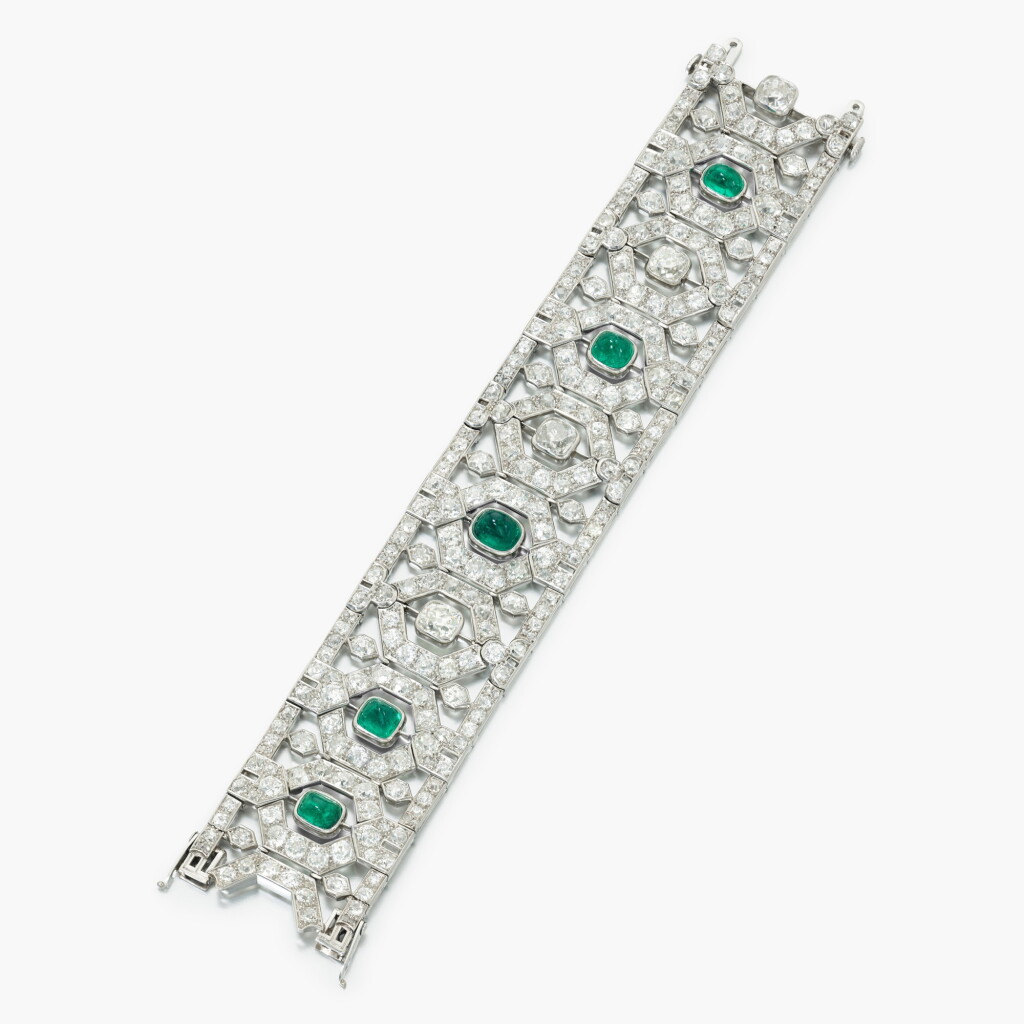
Formerly in the Collection of Alexandrine of Mecklenburg-Schwerin, Queen of Denmark (1879-1952)
Art Deco Emerald and Diamond Bracelet 裝飾藝術風格 祖母綠 配 鑽石 手鏈, 約1920年代
Live auction begins on:
November 11, 04:00 PM GMT
Estimate
50,000 - 80,000 CHF
Bid
35,000 CHF
Lot Details
Description
Set with sugarloaf cabochon emeralds and old mine-cut diamonds, fitted case stamped A. Michelsen, Joaillier de la Couronne Copenhague; 1920s.
Approximate length: 180mm, one additional panel removed measuring approximately 20mm
Alexandrine of Mecklenburg-Schwerin, Queen of Denmark (1879-1952)
Knud, Hereditary Prince of Denmark (1900-1976) and Princess Caroline-Mathilde of Denmark (1912-1995)
Princess Elisabeth of Denmark (1935-2018)
Jewellery and Handbags, Bruun Rasmussen, Copenhagen, 1 December 2022, Lot 444
Bjarne Steen Jensen, Juvelerne i det Danske Kongehus, Copenhagen, 2002, pg. 170.
Alexandrine of Mecklenburg-Schwerin, Queen of Denmark
Alexandrine of Mecklenburg-Schwerin (1879-1952) was born as the eldest daughter of Grand Duchess Anastasia Mikhailovna of Russia (1860-1922) and Friedrich Franz III, Grand Duke of Mecklenburg-Schwerin (1851-1897). Her mother was a very unconventional and eccentric person who preferred spending as little time as possible in the sleepy North-German town of Schwerin. Therefore, Alexandrine and her two siblings, the future Grand Duke Friedrich Franz IV (1882-1945) and Cecilie, the future Crown Princess of Prussia (1886-1954), had an atypically nomadic childhood between their father’s dynastic lands and their mother’s cosmopolitan lifestyle.
In 1898, Alexandrine married Prince Christian of Denmark, the future King Christian X (1870-1947). The couple were married at the mother-of-the-bride’s villa ‘Wenden’ in Cannes which was highly unusual for a Royal wedding at the time. The couple was blessed with two children: Prince Frederick, the future King Frederick IX (1899-1972) and Prince Knud (1900-1976).
In 1912, Alexandrine’s husband acceded to the Danish throne starting his 25 year long reign. Between 1918 and 1944 they additionally held the titles of King and Queen of Iceland, ruling both countries as a personal union. In 1918, Iceland became independent from Denmark via referendum, but retained its monarchy until the Republic of Iceland was established in 1944, again through a referendum.
Alexandrine was a dutiful and discrete Queen who stood firmly by her husband’s side and diligently supported good causes with unfaltering grace and intelligence. As such she was much beloved by the Danish population even through the dark days of both world wars. Though Queen Alexandrine did wear the magnificent Crown Jewels of the Danish monarchy and the important jewels she received as wedding presents from her Russian relations, she was not particularly fond of adornment, pomp and circumstance. This art deco emerald and diamond bracelet was a relatively late and uncharacteristically lavish addition to her jewellery collection. It was most likely a gift from her husband on the occasion of their silver wedding anniversary in 1923 or a present for her fiftieth birthday in 1929.
Upon the Queen’s death the bracelet was bequeathed to her second son Prince Knud and his wife Caroline-Mathilde. Until the laws of succession were changed in 1953 allowing King Frederick IX’s daughter Margrethe to eventually ascend to the throne in 1972, Prince Knud was the heir presumptive to his brother and known as Hereditary Prince. Knud and Carline-Mathilde in turn bequeathed the emerald and diamond bracelet to their only daughter Princess Elisabeth of Denmark. Princess Elisabeth never married, but had a distinguished career in diplomacy having held roles at the Danish embassy in Washington and at the United Nations in Geneva during the 1980s and 90s.