
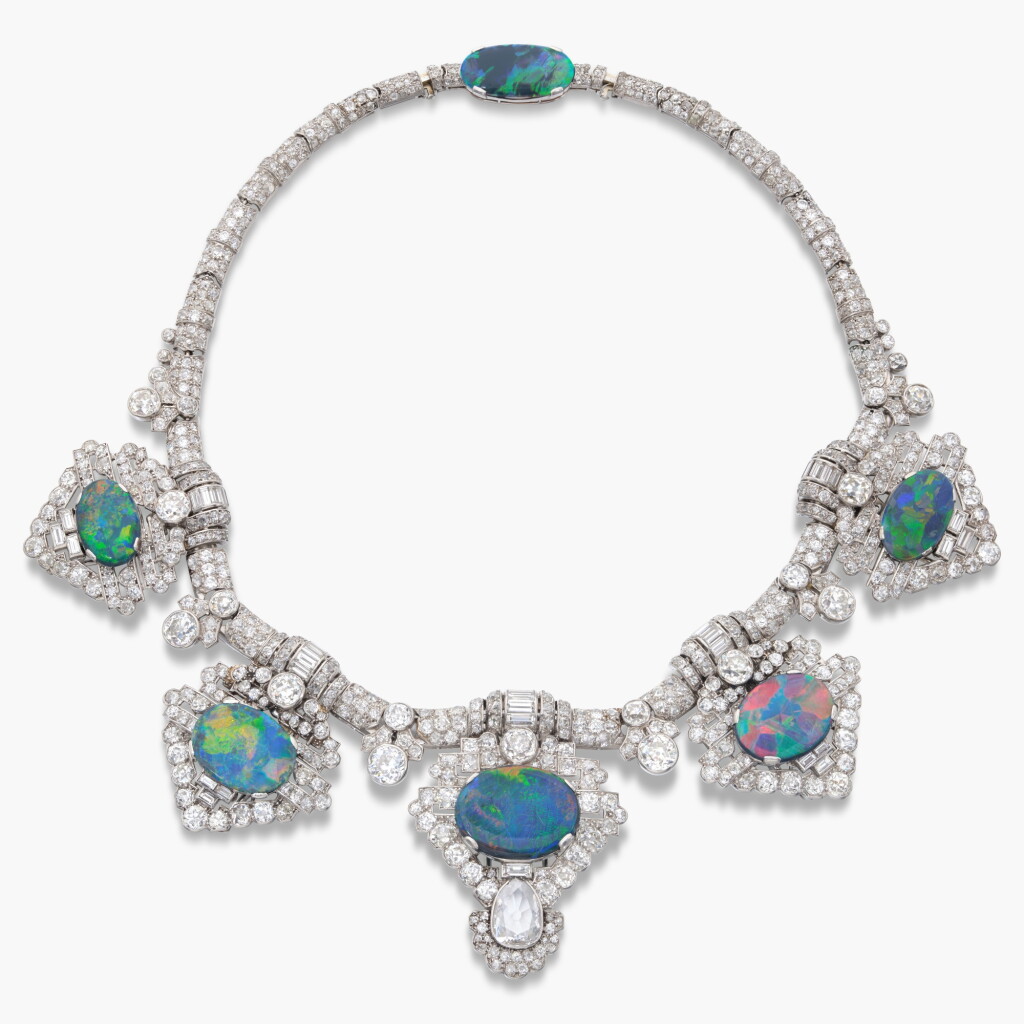
Formerly in the Collection of Mary Cavendish, Duchess of Devonshire (1895-1988)
Cartier
Superb Art Deco Black Opal and Diamond Tiara/Necklace-Brooch Combination 卡地亞 | 卓越非凡 裝飾藝術風格 黑歐泊 配 鑽石 冠冕 或 項鏈 及 胸針, 約1937年
Live auction begins on:
November 11, 04:00 PM GMT
Estimate
780,000 - 1,100,000 CHF
Bid
550,000 CHF
Lot Details
Description
Featuring five detachable brooches each centring an oval black opal, set throughout with old mine-, old European- and single-cut diamonds, accented by baguette diamonds, the front highlighted by a collet-set pear-shaped diamond, unsigned, tiara fitting, fitting to wear the three central brooches as a devant-de-corsage, one small diamond deficient, fitted case stamped Cartier; circa 1937.
Approximate measurememts: length of necklace 430mm, inner circumference of tiara: 370mm, brooches 55 x 40mm, 40 x 40mm and 40 x 35mm respectively
Mary Cavendish, Duchess of Devonshire (1895-1988)
Thence by descent
Cartier, Victoria & Alber Museum, London, 12 April – 16 November 2025, pg 72 – 73 in the catalogue.
Helen Molesworth and Rachel Garrahan (eds.), Cartier, London, 2025, pg 72 – 73.
The Superb Devonshire Black Opal Tiara/Necklace
The extraordinary, transformable opal and diamond tiara/necklace was created by Cartier in the late 1930s for Mary Cavendish (1895-1988), then Marchioness of Hartington and later Duchess of Devonshire. Most likely, the jewel was commissioned in the context of the 1937 coronation of King George VI, an occasion that give rise to a large number of spectacular commissions that allowed Cartier London to reach its creative pinnacle during the art deco period and experiment with numerous unusual high jewellery materials and shapes. In doing so, Cartier fused the splendour of the Edwardian-era British court with mid-20th century innovation and aesthetics. According to family tradition, the exquisite black opals set on the jewel were provided by the client. The Marquess and Marchioness of Harrington had undertaken an extensive government tour of Australia and New Zealand in 1936-1937, during which they were presented with these six exceptional opals, Australia’s signature gem that is deeply connected to the country’s national identity.
In 1953, the jewel featured prominently in another coronation, that of George VI’s daughter Queen Elizabeth II. Mary Cavendish, by this time Dowager Duchess of Devonshire, held the office of Mistress of the Robes to the young Queen. As such she had a prominent part to play in the glittering ceremony. The Duchess walked just behind the Queen and her train-bearers during the stately procession and assisted the Queen with the numerous quick-changes and rituals performed during the ceremony. This was the first coronation of a British monarch in history to be filmed in its entirety in colour and televised. As such viewers of the telecast and ensuing film release could follow along the complete ancient mass and admire the robes and jewels in every minute detail. The Dowager Duchess of Devonshire wore the opal and diamond necklace by Cartier together with the impressive and historical diamond-set Devonshire palmette tiara. As such, the necklace was one of the jewels most prominently featured during the ceremony, second only to those of the Queen herself.
On 5 February 2026, the opal and diamond necklace was worn by director Emerald Fennell at the London première of her film adaptation of the classic novel Wuthering Heights held at the Odeon Theatre on Leicester Square. The entire press tour for the film starring Margot Robbie featured exquisitely selected outfits inspired by the Gothic, historical romance tone of the film. Historical jewellery featured prominently on the press tour, as exemplified by the Taj Mahal diamond formerly in the collection of Elizabeth Taylor, worn by Margot Robbie at the Los Angeles première of the film. Emerald Fennell used jewellery throughout the movie both to reflect the evolution of Margot Robbie's character Cathy and to establish the colourful worldbuilding. Therefore, it is fitting that a director so in tune to using the visual language of jewellery in her art, would choose to wear this exquisite jewel.
Mary Cavendish, Duchess of Devonshire (1895-1988)
From the 1930s onwards, Mary Cavendish frequently wore her opal and diamond Cartier jewel in all its many possible transformations, whether as a necklace, tiara, five clips or on its devant-de-corsage fitting. The position she held as Mistress of the Robes to Queen Elizabeth II between 1953 and 1967, furthermore gave her many occasions to enjoy wearing her spectacular piece.
Mary Alice Cavendish was born in 1895 as the daughter of fourth Marquess of Salisbury at Hatfield House, Hartfordshire. In 1917, she married Edward Cavendish (1895-1950), the eldest son of the 10th Duke of Devonshire. As heir to the Dukedom, he held the curtesy title of Marquess of Hartington. Lord Hartington had a distinguished career in the British military and government, notably serving on the British Peace delegation at the Treaty of Versailles. Between 1936 and 1940, Lord Hartington served as Under-Secretary of State for Dominion Affairs and this capacity he undertook the aforementioned tour of Australia and New Zealand. In 1938, he inherited the Dukedom from his father and became the 10th Duke of Devonshire. The estate of the Dukes of Devonshire encompassed the historical Derbyshire stately homes Chatsworth House and Hardwick Hall, masterpieces of baroque and Elizabethan architecture respectively.
The tenth Duke and Duchess sadly lost their oldest son and heir William in 1944, when he died in action during the Liberation of Belgium. William had been married to Kathleen Kennedy, the sister of John F. Kennedy, only four months before. Six years later, the 10th Duke lost his life under mysterious circumstances. As Dowager Duchess, Mary Cavendish dedicated herself to Royal service as Mistress of the Robes to Queen Elizabeth II accompanying the Monarch during many state visits and important functions. The Queen appointed the Dowager Duchess Dame Grand Cross of the Royal Victorian Order in 1955, an honour only bestowed by the monarch upon personal discretion. To everyone who knew her, Mary Cavendish is remembered as a refined and kindhearted aristocrat who tirelessly fulfilled the duties of her station with unwavering grace.