Andy Warhol
Beethoven (see F. & S. IIB.390-393)
Lot Closed
September 23, 01:05 PM GMT
Estimate
70,000 - 100,000 GBP
We may charge or debit your saved payment method subject to the terms set out in our Conditions of Business for Buyers.
Read more.Lot Details
Description
Andy Warhol
1928 - 1987
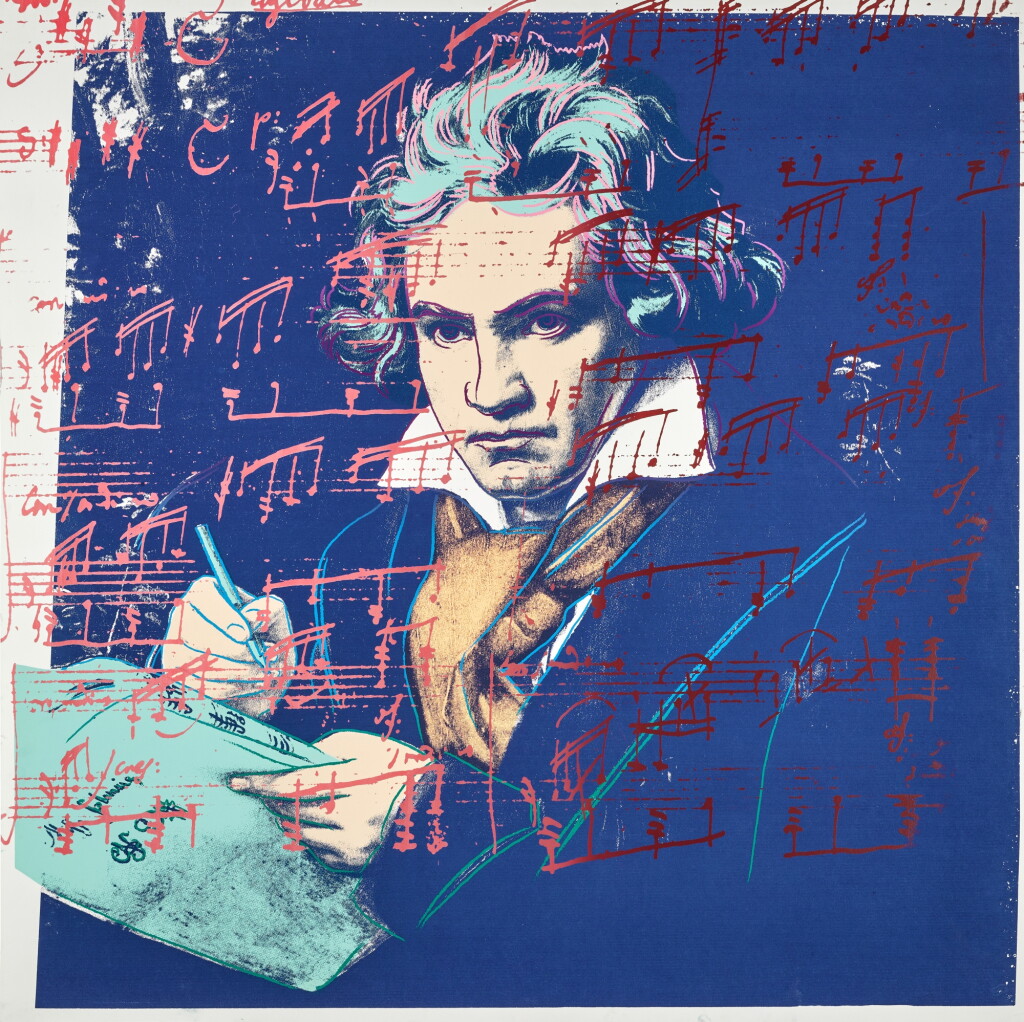
Beethoven (see F. & S. IIB.390-393)
signed in pencil by the Executor of the Andy Warhol Estate, the publisher and the printer, and inscribed TP 10/72 on the stamped certificate of authenticity verso (as issued)
screenprint in a unique colour combination on Lenox Museum Board
sheet: 1017 by 1015 mm. 40 by 40 in.
Executed in 1987, this impression is one of 72 unique trial proofs aside from the edition of 60 plus 15 artist's proofs, with the blindstamp of the printer, Rupert Jasen Smith, published by Herman Wünsche.
Beethoven forms part of the final body of screenprints created by Andy Warhol in 1987, shortly before his untimely death. Drawing upon Joseph Karl Stieler's celebrated 1820 portrait of Ludwig van Beethoven, Warhol reimagined the composer through his characteristic use of vivid colour and bold graphic contrasts. In doing so, he recast Beethoven as a twentieth-century cultural icon, placing him alongside the celebrities, artists and public figures that populated his oeuvre.
Throughout his career, Warhol explored the mechanisms through which individuals become cultural icons. Whereas his portraits of Marilyn Monroe, Elvis Presley and Elizabeth Taylor examined the phenomenon of twentieth-century celebrity, Beethoven applies the same lens to a figure whose legacy transcends time and geography. Striking colour contrasts and graphic intervention reinvigorate the nineteenth-century portrait, highlighting the enduring power of Beethoven's image in the modern imagination.
The present work is a trial proof in a unique colourway, produced during the printmaking process to evaluate possible colour palettes, registration and overall visual impact prior to the finalisation of the edition. Such impressions offer valuable insight into the artist's working methods and the close collaboration between Warhol and his master printers. Created at the culmination of his career, Beethoven encapsulates Warhol's enduring engagement with celebrity, the power of repetition and cultural mythology. By translating one of Western music's most celebrated figures into the visual language of Pop Art, he created an image that bridges historical tradition and contemporary culture with remarkable immediacy.
You May Also Like