Looking Forward: The Collection of Beverly Grossman
Andy Warhol
Cowboys and Indians (Feldman & Schellmann II.377-386)
Auction Closed
October 8, 05:14 PM GMT
Estimate
700,000 - 1,000,000 USD
Lot Details
Description
Looking Forward: The Collection of Beverly Grossman
Andy Warhol
1928 - 1987
Cowboys and Indians (Feldman & Schellmann II.377-386)
each signed in pencil, nine numbered 11/250, John Wayne inscribed UNIQUE
the complete set of ten screenprints in colors on Lenox Museum Board
sheets: 36 by 36 in. 914 by 914 mm.
Executed in 1986, this set is number 11 from the edition of 250 plus 50 artist's proofs, with the blindstamp of the printer, Rupert Jasen Smith, published by Gaultney, Klineman Art, Inc., and with their inkstamp on the verso.
(10 prints)
Gaultney-Klineman Art, Inc., New York
Acquired from the above in November 1989 by the present owner
For more than six decades, art was at the center of Beverly Grossman’s life. As a collector, philanthropist, and museum leader, Beverly’s curiosity and generosity helped shape the cultural landscape of Minneapolis. Her education in contemporary art began in the 1960s through relationships that would prove lifelong inspirations. Among them was Gordon Locksley, then her hairdresser and an aspiring art student who later became a prominent collector and dealer to Pop artists including Andy Warhol, with whom Beverly also developed a close personal connection. Even more influential was her friendship with pioneering Minneapolis dealer Felice Wender, who introduced her to artists, deepened her understanding of their work and fostered enduring relationships with figures including Robert Indiana, Tom Wesselmann and Roy Lichtenstein. For Beverly, collecting was inseparable from friendship, conversation and firsthand engagement with artists, a philosophy that is reflected in the Pop Art prints from her extraordinary collection, including the present complete set of Andy Warhol's Cowboys and Indians.
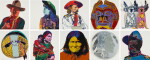
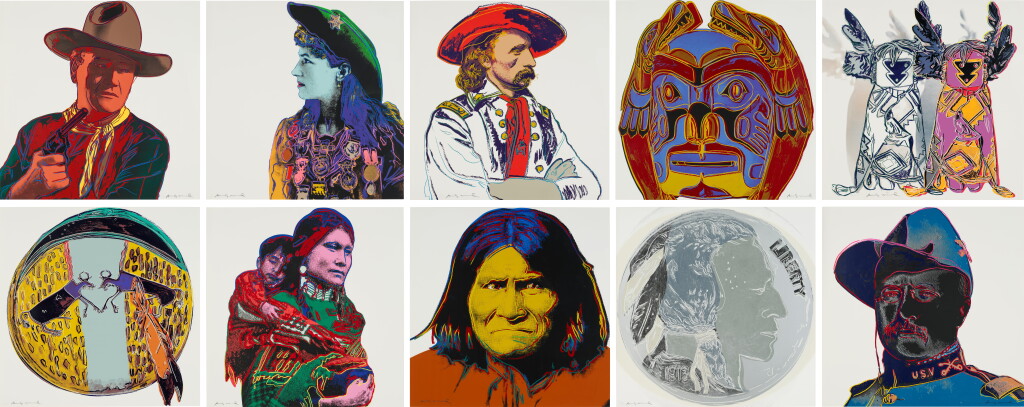
Andy Warhol’s infatuation with the American West began with a childhood love of B-Western movies and deepened with an affinity for cowboy boots, the collecting of Western landscapes by artists such as Albert Bierstadt and the directing of Westerns during his experimental filmmaking endeavors of the 1960s. Executed in 1986, Cowboys and Indians was one of the artist’s last major print portfolios, and the culmination of a long fascination with the frontier. Each of the ten screenprints features a different icon of Western culture, including Hollywood’s favorite cowboy John Wayne, sharpshooter Annie Oakley, and the legendary Apache leader Geronimo. Although Warhol spent time in Arizona, Texas and New Mexico, the Cowboys and Indians prints are more grounded in the region’s mythology than its reality. Like so many children of his generation, Warhol fell in love with the genre through the movies and the choice to assemble the portfolio reflects his well-known focus on how objects and faces are imprinted onto the collective American psyche. The prints harken back to notable Warhol iconography such as soup cans, advertisements, or celebrated figures in society. Arthur C. Danto writes that “Warhol’s political gift was his ability to make objective as art the defining images of the American consciousness.”1
If objectifying Coca-Cola bottles represents democratic consumerism, then portraying the icons of the American West, both fictional and historical, represents something more purposeful. Across the ten screenprints in Cowboys and Indians, Warhol juxtaposes American figures with important Native American people and objects. Simultaneously, Warhol subtly crafts a narrative that forces us to reconsider our own understanding of Westward expansion versus how it has been mythologized.
Warhol’s portrait of General Custer evokes stories of the soldier’s last stand at Little Bighorn, a resounding victory for the Lakota, Northern Cheyenne, and Arapaho in the Great Sioux War of 1876. Custer's widow worked hard in the following decades to redeem her husband's reputation, embracing the veneration with which Warhol often imbued his subjects. His portrayal of Geronimo is based on a photograph of the Apache leader taken by A.F. Randall in 1886 shortly after his surrender to American forces. Warhol chose to frame just his face, honoring his fierce, dignified expression and thus obscuring his controversial status as a prisoner.
Even the portfolio’s objects display the contrast between violence and tradition. Plains Indian Shield depicts an artifact of the Crow Tribe used by Native American warriors in the Great Sioux War, yet the indigenous design is accentuated by a vivid and striking color palette. The viewer is uncertain which aspect of the shield’s storied past is being emphasized and this dichotomy between notoriety and inherent beauty is seen in the artist’s work time and again. The same can be said for Northwest Coast Mask, which features a Kwakwaka'wak ceremonial mask depicting Sisiutl, a two-headed sea serpent commonly tied to themes like war and protection. Once more, Warhol’s choice in subject blurs the distinction between conflict and cultural significance. These historical relics are accompanied by instantly recognizable portraits. In placing objects with complex cultural significance alongside the well-known images of John Wayne and Teddy Roosevelt, Warhol suggests we consider the U.S. President and the Hollywood star as equally significant, again a traditional Warholian theme, choosing to embrace fame without defining its foundation.
While the politically charged Cowboys and Indians prints do not share the frictionless quality found in much of Warhol’s work, the portfolio carries an abundance of societal and cultural depth, forcing us to ask questions about American history. Warhol’s unrelenting tendency to imbue his subject matter with vibrant, unexpected color is evident throughout Cowboys and Indians and per critic Peter Schjeldahl these qualities are “why the artist became, “the instrument with which American culture designated itself.”2
Of all of Warhol’s print portfolios, Cowboys and Indians is perhaps the most explicit display of the artist's love for and fascination with his own country, overtly capturing the intersection of American history, mythology, and consciousness that underpins so much of his work.
1. Arthur C. Danto, "Warhol and the Politics of Prints," Andy Warhol Prints: A Catalogue Raisonné 1962-1987, New York, 2003, p. 13
2. Peter Schjeldahl, “There’s Still No Escaping Andy Warhol,” The New Yorker, 2018
You May Also Like