Nicolas de Largillierre
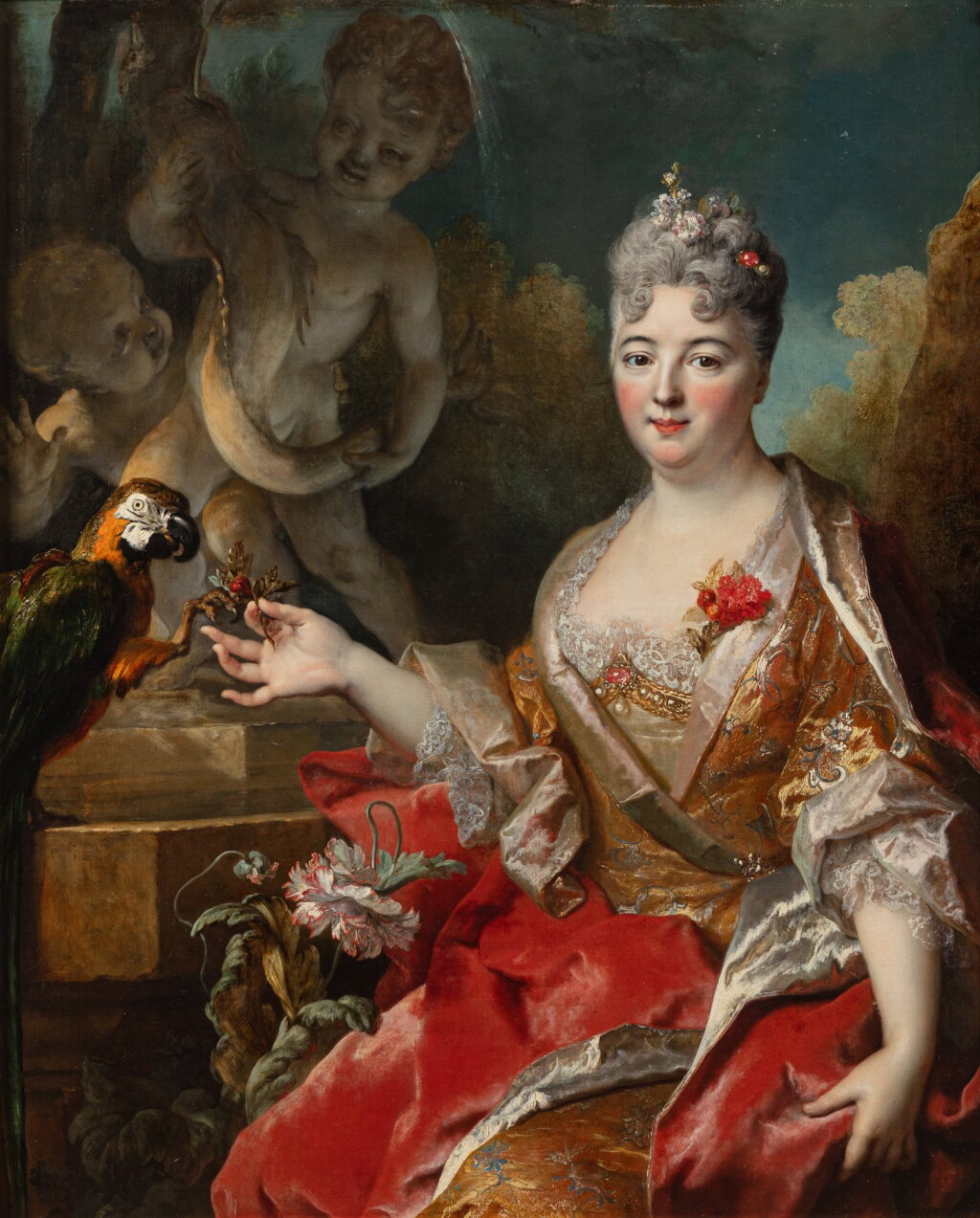
Portrait of a woman with a macaw
Auction Closed
November 4, 07:28 PM GMT
Estimate
25,000 - 40,000 EUR
Lot Details
Description
Nicolas de Largillierre
Paris 1656 - 1746
Portrait of a woman with a macaw
Oil on canvas
119,3 x 98,6 cm ; 47 by 38⅞ in.
We are grateful to Monsieur Dominique Brême, who confirmed the authenticity of this painting after first-hand inspection.
Dr. Rieux, Roanne, by 1890;
Princess de Faucigny-Lucinge, née Marie Juliette Elisabeth Amélie 'May' Ephrussi (1880-1964), by 1928 and 1936;
André J. Seligmann, Paris;
Confiscated from the above by the Einsatzstab Reichsleiter Rosenberg (ERR, inv. no. Sel. 7), 1940;
Repatriated to France, 28 December 1945, and subsequently restituted to the Seligmann family, 8 May 1946;
Anonymous sale, Me Rheims, Palais Galliera, Paris, 10-11 December 1962, lot 123 (as titled Portrait présumé de la duchesse de Châteauroux);
With François Heim, Paris, in 1974;
By whom sold, Crédit Municipal, Paris, 9 April 1981, lot 6 (as titled Portrait présumé de la duchesse de Châteauroux, cancelled sale);
By whom sold (Collection H.), Me Labat, Hôtel Drouot, Paris, 4 June 1984, lot 8 (as titled Portrait présumé de la duchesse de Châteauroux);
Anonymous sale, Christie's, New York, 9 June 2010, lot 83.
Roanne, Ville de Roanne, L'Exposition rétrospective forézienne de Roanne, June 1890, no. 722;
Paris, Petit Palais, Exposition N. de Largillierre, May-June 1928, first ed. of catalogue, no. 77; second ed. of catalogue, no. 85 (listed with incorrect dimensions and as titled La Duchesse de Châteauroux);
Paris, André J. Seligmann, Portraits français de 1400 à 1900, June-July 1936, no. 33 (as titled La duchesse de Châteauroux).
M.S. Rosenfeld, Largillierre and the Eighteenth-Century Portrait, Montreal 1981-82, p. 123 (where erroneously dated to circa 1725 and referred to as no. 82 in the 1928 exhibition catalogue).
A member of the Académie and a leading portraitist of the late reign of Louis XIV and the Regency, Nicolas de Largillierre distinguished himself from his contemporaries, notably Hyacinthe Rigaud, through his dual training in both the Flemish and English traditions. Born in Paris, and raised in Antwerp, he began his career in the workshop of the painter Antoine Goubau before joining that of Peter Lely, the heir to Van Dyck’s tradition. This dual heritage is reflected in his taste for chiaroscuro, his rich colors reminiscent of Rubens and Van Dyck, and his virtuosity in rendering materials, fabrics, and accessories with remarkable precision.
In this Portrait of a Woman with a Macaw, the distinctive features of this training are fully apparent. The treatment of light lends the work a warm atmosphere, less dramatic than that found in Rigaud’s portraits. It creates subtle reflections on the silk and brocades and gives an almost miniaturist precision to the lace.
Largillierre places his sitter in a garden, at the foot of a fountain, whose play of light is reflected in the water and illuminates a sculpture of putti playing with a sea creature, as well as the parrot with which the sitter is interacting. The motif of the parrot is not uncommon in the artist’s work. It can notably be found in his Decorative Composition, with Curtains, Landscape and Animals, now in the Louvre Museum (c. 1725–1730, oil on canvas, inv. RF 1979 59). An animal associated with prestige, the parrot signals access to exotic curiosities brought from the colonies and trading posts. It thus attests to the sitter’s, now anonymous, membership of the social elite. It also introduces a dynamic note into this otherwise composed and formal portrait.
The objects surrounding the figure likewise contribute to the staging of the sitter’s status and tastes. Richly adorned with pearls and heavy fabrics, she wears floral motifs that echo the flowers adorning her hairstyle and bodice, as well as those in the garden. With her bright gaze directed toward the viewer, Largillierre creates the impression of having captured her in a fleeting moment. The painter’s talent as a portraitist thus lies above all in his ability to convey the sitter’s vivid, living presence.