José María Sert
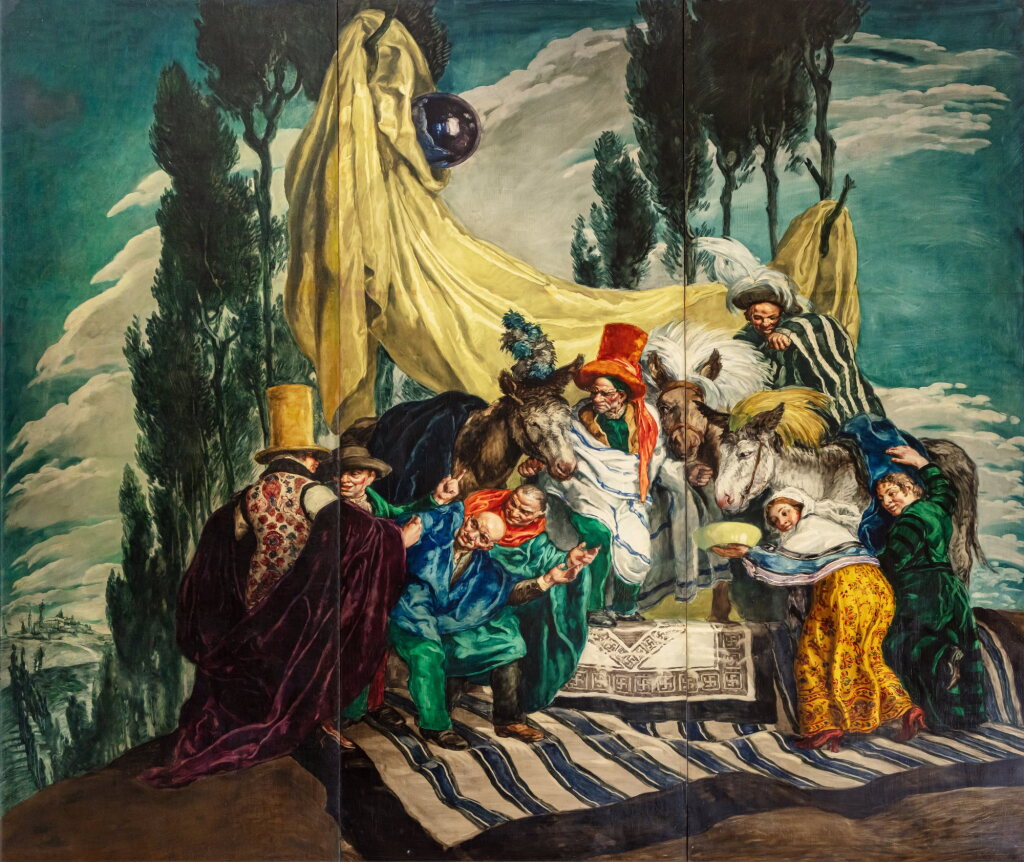
El vendedor de burros (The Donkey Seller)
Auction Closed
November 4, 07:28 PM GMT
Estimate
70,000 - 100,000 EUR
Lot Details
Description
José María Sert
Barcelona 1874 - 1945
El vendedor de burros (The Donkey Seller)
Oil on three panels, unframed
275 x 296,7 cm ; 108¼ by 116¾ in.
Collection Henry Carnegie Phipps (purchased in 1924);
Thence by descent;
By whom sold ('Property from the Ogden Phipps Family Trust'), Sotheby's, London, 3 June 2009, lot 89;
Where acquired.
New York, Wildenstein Galleries, J.M. Sert, February 1924, room 1, no. 3.
M. Fanton, 'Brilliant Exhibit of Spanish Decorations', in Arts & Decoration, New York, March 1924, vol. XX, no. 5, pp. 8, 75;
The Sphere, London, 12 July 1924;
A. del Castillo and A. Cirici, José María Sert. Su vida y su obra, Barcelona & Buenos Aires, 1947, pp. 114, 119-120, pl. 52, illustrated;
Madrid, Palacio de Velázquez, Parque del Retiro, José María Sert 1874-1945, 1987, pp. 106-107.
"The extraordinary liveliness of movement, the dynamic brushwork, the compositional mastery, and that daringly blended explosion of colour place this series among the most significant works of the artist’s most productive period."(A. del Castillo and A. Cirici, 1947)
Lots 65-69 comprise six monumental paintings by José Maria Sert, formerly in the collection of Henry Carnegie Phipps, that once adorned his residences in Palm Beach, and latterly Roslyn, Long Island. Phipps (1879-1953) was an American financier who participated in many of the business ventures established by his father, Henry Phipps Jr, who was the second-largest shareholder of the Carnegie Steel Company when it sold in 1901.
Painted during 1922-23, the panels, originally a series of nine, were commissioned by King Alfonso XIII of Spain as designs for tapestries - to be woven by the Real Fabrica de Tapices (Royal Tapestry Workshop) – for his palace at La Granja. While the tapestries were never realised, Sert subsequently exhibited the preparatory panels at the Wildenstein Gallery in New York in 1924. The exhibition proved a resounding success, marking Sert’s first major introduction to the American market, and its popularity led the gallery to extend the show by a further ten days.
The royal commission called for an extraordinary ambition of scale. Sert drew inspiration from the great decorative cycles of the Baroque period and from the celebrated tapestry designs of Rubens. For his subject matter, he turned to the street performers and circus acrobats that had captivated him during his childhood in Barcelona. Balancing spectacle and ceremony with folklore and humour, Sert created a vibrant theatrical world animated by a whirlwind of colour, movement and imagination.
Imbuing scenes of everyday life with the fantastical, the series reflects the creative affinity that developed between Sert and Salvador Dalí during the 1920s. The remarkable breadth of Sert’s imagination is evident in details such as the elaborate, quasi-mechanical structure in Los pajareros and the fruit tree sprouting improbably from a mountain summit in Recolección. These visionary compositions anticipate key elements of Surrealism, demonstrating Sert’s ability to transcend reality and transform decorative painting into a realm of invention and fantasy.
You May Also Like