
Property from an American Private Collection
Frederick Arthur Bridgman
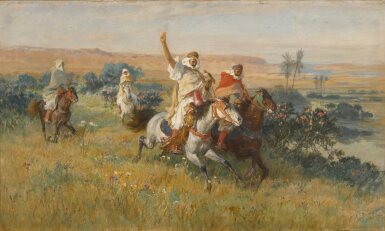
The Falcon Hunt
Auction Closed
April 28, 02:55 PM GMT
Estimate
30,000 - 50,000 GBP
Lot Details
Description
Property from an American Private Collection
Frederick Arthur Bridgman
American
1847 - 1928
The Falconers
signed F.A. Bridgman lower right
oil on canvas
Unframed: 57 by 95 cm., 22½ by 37⅜ in.
Framed: 67 by 105 cm., 26⅜ by 41⅜ in.
Four men on horseback cross a richly terrain, dotted with dark green vegetation and speckled flora. This energetic foreground of the riders traversing the composition is framed by a setting of serene sky, barren desert cliffs, and faded palm trees. A faint sea recedes into the distance; a poetic reality often evident in Bridgman’s paintings where two lands converge. Two central figures – on a grey and a brown horse, elegantly dressed in silks and white robes – dominate the scene. The blinkered horses echo the intensity of their riders, whose firm, focused expressions introduce a sense of purpose that contrasts with their leisurely activity. Both riders’ fixed gazes are on the horses. Yet, while one clutches both reins, the other raises his right arm in a decisive gesture that cuts vertically across the landscape. His left hand grips a falcon, the clue pointing to the group’s engagement in the activity of falconry. With neither hand grasping the reins, the leader demonstrates remarkable control and skill, remaining composed as he manages both horse and falcon with ease.
Aligning with his orientalist subjects, Bridgman was fascinated by scenes of everyday life in North Africa, and the relationships between humans and animals. He observed a sense of inclusion between human-animal engagement, noted by Gerald M. Ackerman that ‘in Arab lands people of modest means could indulge endlessly in expansive upper-class pastimes such as horseback riding and hunting.’ Despite being art historically associated with status and nobility, falconry represents universality, symbolising Berber and Arab culture as a whole, and serving as an emblem for society at large. The sport has ancient origins, appearing in Chinese tomb paintings over two thousand years ago, later established in British and Middle Eastern traditions from the 12th century until the mid-20th century. In Middle Eastern culture, the falcon symbolises power and cultural heritage, the national emblem of the United Arab Emirates and a central element of Arab tradition.
Falconry involves training birds of prey, particularly falcons, to soar through the sky at incredible speeds. Although the sport declined from the mid-1600s to the early 1800s, due to a rising interest in hunting and shooting game, it experienced a resurgence in the early 19th century, with clubs forming and wealthy patrons hiring gamekeepers. The falcon is a Peregrine Falcon, identifiable by its chestnut coat and cream-coloured body. Falconry reflects the close relationship between culture and nature in Middle Eastern society: while the landscape appears natural and harmonious, Bridgman has implicitly shaped the scene to accommodate this pursuit. By keeping the sky clear and scene free of visual distractions, Bridgman directs the viewer’s focus to the elegance of the falcon in the rider’s hand.