
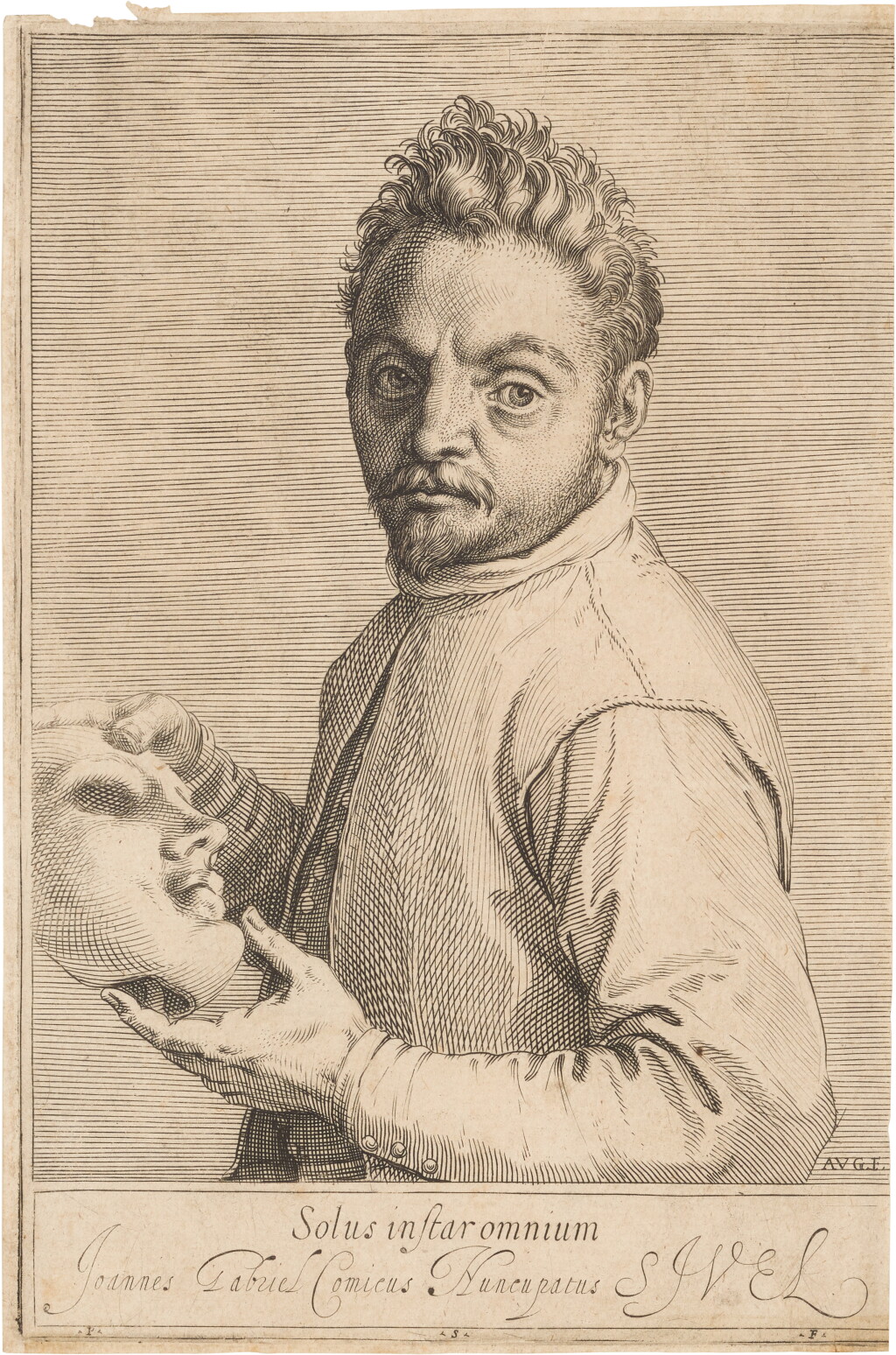
Agostino Carracci
Portrait of Giovanni Gabrielli, called "Il Sivello" (Bartsch 120; Bohlin 212)
Estimate
500 - 1,000 GBP
We may charge or debit your saved payment method subject to the terms set out in our Conditions of Business for Buyers.
Read more.Lot Details
Description
Agostino Carracci
1557 - 1602
Portrait of Giovanni Gabrielli, called "Il Sivello" (Bartsch 120; Bohlin 212)
engraving on laid paper with a Kneeling Saint Holding a Cross in a Circle watermark
circa 1599
a fine, clear impression of the second (final) state
sheet: 192 by 127 mm. 7½ by 5 in.
The Portrait of Sivello is one of Agostino Carracci’s most famous portrait prints, showing his mastery of the burin and his ability in capturing both the physical presence and the personality of the sitter. The engraving portrays Giovanni Gabrielli, called ‘Il Sivello’, a well-known comic actor widely celebrated in the seventeenth century for his talent in imitation, hence the motto ‘Solus instar omnium’ (One alone in the likeness of all) engraved below the image.1
This is a fine impression of the second and final state, signed AVG. F. at lower right, and published by Pietro Stefanoni (c. 1557-1642), whose initials (P·S·F·) appear along the lower edge of the sheet.2 The composition was carefully studied. It follows the conventions of Agostino’s painted portraits, with the sitter presented holding his attribute, a mask, with both hands, looking towards the viewer.3 A unique first state at Chatsworth shows only the head and collar engraved, while the bust and the mask are drawn in black chalk.4 In the first idea, the mask faces outwards, whilst in the final print it has been rotated to face the actor. Diane De Grazia suggested that Agostino engraved the bust and mask freehand directly on the plate, following the outlines laid down in the drawing.5
Agostino’s earlier portraits, such as those for Antonio Campi’s Cremona fedelissima città or the large Carlo Borromeo and Self-Portrait of Titian, were mostly posthumous tributes based on other artists’ designs. Towards the end of his career, by contrast, his sitters were living people he could portray himself.6 This direct study of the model is evident in Sivello’s face: the closed lips echo those of the mask, while the wide-open eyes are heightened by the expressive modelling of the brows and eye sockets. The regular hatching of the background suggests that a workshop assistant finished the plate after Agostino had established the figure.
A similar pose and rendering of the facial features is found in portrait drawings of the same period, such as a pen drawing of a young boy, which was most probably also intended for engraving.7 In 1590s the Carracci produced an extraordinary array of portrait drawings of family and friends, drawn from life and famous for their immediacy, a quality rooted in the study from the model practised in the Carracci academy. The print is dated circa 1599 on stylistic grounds, being close in technique to Agostino’s Omnia vincit Amor of that year.8 At that time, Agostino was in Rome, working with his brother Annibale on the decoration of the Palazzo Farnese. Shortly afterwards he moved to Parma in the service of Duke Ranuccio Farnese, where he died prematurely in 1602.
Essay by Laura Staccoli
[1] Malvasia reports that he “would act an entire commedia on his own performing the parts of all the characters on stage”. He adds that Sivello was the father of the actor Scappino and “played one hundred different types of instruments”. Malvasia (1678), vol. 1, pp. 96–97. See also Takahatake in Cropper and Pericolo (2017), pp. 194–95, and n. 371. Bellori likewise records that Sivello “recitava solo la Comedia, cambiando habito, e voce”: Bellori (1672), p. 116. Giovanni Antonio Massani, writing in 1646, states that Agostino portrayed Sivello in this way “per denotare la sua eccellenza nell’imitare”: quoted in Mahon (1947), p. 266.
[2] Stefanoni, from Valstagna near Vicenza, was a dealer in prints, drawings, antiquities and medals, and probably an engraver himself; his address also appears on prints by Lodovico Carracci, Guido Reni and Francesco Brizio. He was in contact with Agostino in 1599: in a letter to Ulisse Aldrovandi of 23 January of that year he records that “Il Sr. Agostino Caracci dissegnò quello [animaletto], che mandai a V.S. Ecc.ma” (Bologna, Biblioteca Universitaria, MS Aldrovandi 136, vol. XXVII, cc. 241v–242r); see Takahatake’s unpublished thesis, The Print Industry in Bologna (2006), p. 111, n. 245, and Appendix N, p. 315. See also Isabella Rossi, "Pietro Stefanoni e Ulisse Aldrovandi: Relazioni Erudite tra Bologna e Napoli," in Studi di Memofonte, online journal, August 2012, pp. 3-30.
[3] See for instance Agostino’s Portrait of a Boy in the Gemäldegalerie Alte Meister, Dresden dated c. 1590 (inv. no. 316).
[4] Chatsworth, Devonshire Collections, inv. 415 (engraving and black chalk, 168 × 125 mm), from the collection of Lord Somers.
[5] De Grazia (1984), p. 193, cat. no. 212.
[6] See the entry by Bastian Eclercy in Pollock–Vitali (2020), pp. 279-280, cat. no. 138.
[7] Pen and brown ink and red chalk, 162 × 112 mm; Christie’s, Fine Old Master Drawings, 9 December 1975, lot 13A. De Grazia (1984), p. 193, cat. no. 212a.
[8] De Grazia (1984), p. 193, cat. no. 212; for Omnia vincit Amor, see cat. no. 210.