
Property from the Estate of Stanley Moss
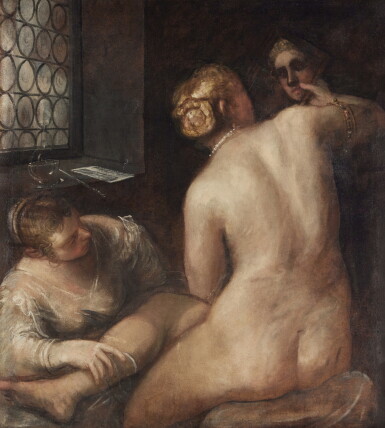
Attributed to Jacopo Robusti, called Jacopo Tintoretto and Workshop
Toilet of Venus
Auction Closed
June 2, 05:22 PM GMT
Estimate
60,000 - 80,000 USD
Lot Details
Description
Property from the Estate of Stanley Moss
Attributed to Jacopo Robusti, called Jacopo Tintoretto and Workshop
Venice 1518 - 1594
Toilet of Venus
oil on canvas
canvas: 45 ½ by 40 ½ in.; 115.6 by 102.9 cm
framed: 55 ½ by 50 ⅞ in.; 139.7 by 129.2 cm
Probably George Granville Leveson-Gower (1786-1861), 2nd Duke of Sutherland, Stafford House, London, by 1838;
Probably William Graham (1817–1885), London;
Probably thence by descent to his daughter, Frances, Lady Horner (1854-1940), Mells Park, Somerset and London;
Private collection, Brünn (Brno), Moravia, Czechoslovakia, by 1925;
With Durlacher Bros., New York and London, by 1926;
From whom acquired by Julius Böhler, Munich, 1929;
From whom acquired by Richard von Kühlmann (1873-1948), Berlin, October 1929;
From whom acquired by Julius Böhler, Munich and Lucerne, 1938;
From whom acquired by Mario, Luigi and Giuseppe Bellini, Florence, October 1954;
From whom acquired by J. Paul Getty for the J. Paul Getty Museum, Pacific Palisades and later Malibu, 1954-1992 (inv. no. 54.P-7);
By whom deaccessioned and sold ("The Property of the J. Paul Getty Museum"), New York, Christie’s, 21 May 1992, lot 18 (as Jacopo Tintoretto);
Where acquired by Stanley Moss.
Probably London, British Institution, Exhibition of Old Masters, 1838, no. 13 (lent by the Duke of Sutherland);
Brün (Brno), Alte Meister in mährischem Privatbesitz, 1925, no. 115;
Raleigh, North Carolina Museum of Art, Masterpieces of Art: In Memory of William R. Valentiner, April 7 - May 17, 1959, no. 37 (lent by J. Paul Getty Museum, Santa Monica);
Athens, National Gallery of Greece, El Greco in Italy and Italian Art, 18 September – 31 December 1995, no. 18 (lent by Stanley Moss).
"British Institution," in The Observer (12 August 1838);
M. Steif, “Alte Meister in mährischen Privatbesitz; eine einleitende Worte zur Ausstellung im Brünner Künstlerhaus,” in Belvedere 7 (February/March 1925), p. 44, reproduced;
“An Exhibition of Three Paintings,” in Art News (8 January 1927), pp. 1-2, reproduced;
W. Freund, “Von amerikanischen Kunsthandel,” Der Cicerone (19 April 1927), pp. 239-240, 242, illus.;
D.B. von Hadeln, "Veronese's Venus at her Toilet," in Burlington Magazine 54 (March 1929), p. 116, reproduced pl. II,B (as Tintoretto);
L. Burchard, in Das unbekannte Meisterwerk in öffentlichen und privaten Sammlungen, W.R. Valentiner (ed.), vol. I, Berlin 1930, cat. no. 27, reproduced (as Tintoretto);
E. von der Bercken, Die Gemälde des Jacopo Tintoretto, 1942, pp. 117, 148, cat. no. 237, reproduced;
F. Hartlaub, Zauber des Spiegels. Geschichte und Bedeutung des Spiegels in der Kunst, 1951, pp. 80, 108, reproduced pl. 97;
S. Poglayen-Neuwall, “Titian's Pictures of the Toilet of Venus and their Copies,” in Art Bulletin (16 December 1954), p. 378;
L. Langsner, “Art News from Los Angeles," in Art News (March 1955), p. 14;
“New Acquisitions,” The Art Quarterly (1955), p. 86, reproduced fig. 1;
W. R. Valentiner, in The J. Paul Getty Museum Guidebook (second edition), W. R. Valentiner and P. Wescher (eds.), Los Angeles 1956, pp. 20, 24 note 7, cat. no. 17, reproduced;
B. Berenson, Italian Pictures of the Renaissance: Venetian School, 1957, vol. I, p. 178;
B.B. Fredericksen, A Handbook of Paintings in the J. Paul Getty Museum, 1965, p. 12, cat. no. A54-P-7, reproduced on the cover (as Jacopo Tintoretto);
J. Paul Getty, The Joys of Collecting, New York 1965, pp. 31, 103, reproduced;
W. Davenport, Art Treasures of the West, 1966, pp. 38-39, reproduced;
C. Bernari and P. De Vecchi, L'opera completa del Tintoretto, Milan 1970, pp. 137-138, cat. no. G15, reproduced (listed among works not considered autograph and that are attributable, or executed by, the workshop);
S. Béguin and P. de Vecchi, Tout l'œuvre peint de Tintoret, Paris 1971, p. 134, cat. no. E-10, reproduced;
B.B. Fredericksen, Catalogue of the Paintings in the J. Paul Getty Museum, Malibu 1972, vol. I, pp. 39-40, cat. no. 40, reproduced (as Jacopo Tintoretto);
B.B. Fredericksen and F. Zeri, Census of Pre-Nineteenth-Century Italian Paintings in North American Public Collections, Cambridge 1972, p. 200;
R. Pallucchini and P. Rossi, Tintoretto, Le opere sacre e profane, Milan 1982, vol. I, p. 211, cat. no. 383; vol. II, p. 546, reproduced fig. 494 (as Jacopo Tintoretto, circa 1578);
P. Hills, in O Gkreko stēn Italia kai i italikē technē, exhibition catalogue, N. Hadjinicoloaou (ed.), Athens 1995, cat. no. 18, reproduced;
O. Garnett, "The Letters and Collection of William Graham—Pre-Raphaelite Patron and Pre-Raphael Collector," in Volume of the Walpole Society 62 (2000) p. 334, cat. no. d309, reproduced fig. 202;
R. Echols and F. Ilchman, "Toward a New Tintoretto Catalogue with a Checklist of Revised Attributions and a New Chronology," in Jacopo Tintoretto, Proceedings of the International Symposium on Jacopo Tintoretto, M. Falomir (ed.), Madrid 2009, p. 143, cat. no. S38 (as Workshop of Tintoretto, 1580s, "possibly by Domenico").
Exploring themes of beauty, reflection, and illusion, this poetic canvas depicts a young woman, traditionally identified as Venus, seated at her toilette and attended by a maidservant within a shadowed Venetian interior. Turning her back to the viewer while contemplating her own reflection in a handheld mirror, the goddess is presented simultaneously from multiple viewpoints, a device that underscores the artifice and ingenuity of the composition. The tilted mirror, delicately bridged by Venus’s hand, further collapses the boundary between reality and illusion, transforming the scene into a meditation on beauty, perception, and the act of looking itself.
The composition reveals a strong debt to Titian, whose celebrated treatments of Venus with a Mirror (National Gallery, Washington) and Venus and Adonis (London, Madrid, New York, and Washington) established enduring paradigms for sensual mythological imagery in Venice during the second half of the sixteenth century.1 In particular, the pose of the nude in the present work—especially from the waist downward—closely recalls the celebrated Venus in Titian’s Venus and Adonis, while the motif of the mirror derives more broadly from Titian’s numerous variations on the theme of Venus contemplating her reflection. Tintoretto and his workshop reinterpret these Titianesque inventions with a more introspective and atmospheric sensibility. Unlike Titian’s goddess, who often engages the gaze of an unseen admirer, the figure here appears absorbed in her own reflection, her fully mirrored visage transforming the composition into a meditation on perception and illusion. The juxtaposition of Venus seen simultaneously from the back and in reflection also recalls the contemporary paragone between painting and sculpture, presenting feminine beauty from multiple viewpoints at once. Although traditionally identified as Venus, the figure remains deliberately ambiguous: absent are her customary attendants and attributes—neither cupids nor doves appear—allowing the painting to function less as a straightforward mythological narrative than as an exploration of beauty, artifice, and the act of looking itself. The leaded-glass window and glass vessel at left further situate the work within Tintoretto’s pictorial vocabulary, recalling the nearly identical morif in Mars and Venus Surprised by Vulcan in Munich.2
Though modern scholars have cautiously associated it with Jacopo Tintoretto's workshop, the present painting has traditionally been regarded as a product of the master himself. Indeed, when J. Paul Getty acquired the painting in 1954 for his newly-opened museum, and for the nearly forty years that it remained in the museum's collection, it was catalogued as late work by Jacopo Tintoretto. Rodolfo Pallucchini and Paola Rossi dated the painting to circa 1578 and compared it to the artist’s late mythological works, including the female allegories painted for the Antecollegio of the Doge’s Palace and the Nine Muses at Hampton Court. Burton B. Frederickson, Ludwig Burchard, and August L. Mayer can be listed among other scholars who published the work as an autograph Tintoretto. In the catalogue of the 1995 Athens exhibition, Paul Hills likewise endorsed an attribution to Tintoretto, noting the possibility of some studio assistance. More recently, Robert Echols and Frederick Ilchman have reclassified the painting as a workshop production, possibly by Jacopo's son and pupil Domenico Tintoretto.
1 Titian, Venus with a Mirror. Washington, D.C., National Gallery of Art, inv. no. 1937.1.3; Titian and his studio produced several versions of Venus and Adonis, including notable examples in the following museum collections: London, National Gallery, inv. no. NG34. Madrid, Museo del Prado, inv. no. P000422. New York, Metropolitan Museum of Art, inv. no. 49.7.16. Washington, D.C., National Gallery of Art, inv. no. 1942.9.84.
2 Jacopo Tintoretto, circa 1555, Venus and Mars Surprised by Vulcan. Munich, Alte Pinakothek, inv. no. 9257.