
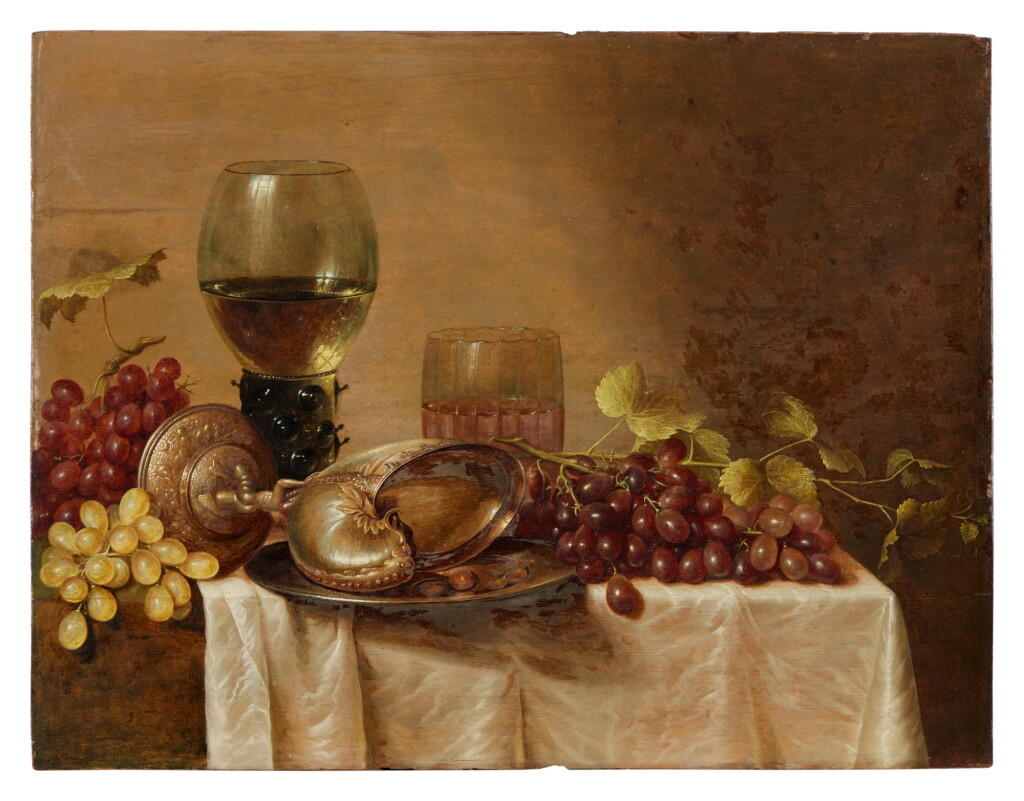
Attributed to Willem Claesz. Heda and Workshop
Still Life with an Overturned Nautilus Cup, Roemer of Wine, Glass Tumbler, and Grapes
Auction Closed
June 2, 05:22 PM GMT
Estimate
20,000 - 30,000 USD
Lot Details
Description
Attributed to Willem Claesz. Heda and Workshop
Haarlem circa 1596 - 1680
Still Life with an Overturned Nautilus Cup, Roemer of Wine, Glass Tumbler, and Grapes
oil on panel
panel: 20 ⅛ by 26 ⅛ in.; 51.1 by 66.4 cm
framed: 27 ⅝ by 33 ⅞ in.; 68.6 by 86.0 cm
With Matthiesen Gallery, London, circa 1946 (as Pieter Claesz.);
Anonymous sale, London, Sotheby's, 10 July 1968, lot 110 (as Pieter Claesz.);
Where acquired by the grandparents of the present collectors.
This refined still life, attributable to Willem Claesz. Heda and his workshop, exemplifies the restrained elegance and subtle tonal harmonies associated with the Haarlem school of the mid-seventeenth century. Arranged upon a draped table are a roemer partially filled with wine, a ribbed glass tumbler, bunches of red and white grapes, and an overturned nautilus cup whose nacreous surface gleams with light at center. The carefully balanced composition and subdued palette reflect the monochromatic “banketje” tradition pioneered by Heda and his contemporaries, in which sumptuous objects and foods are rendered with remarkable sensitivity to texture and reflection.
As Dr. Fred G. Meijer has observed, some of the still-life objects can also be found in other still lifes by Heda and his workshop; for example, the same roemer and nautilus cup also appear in a painting signed by Heda and dated 1640 in the Suermondt-Ludwig-Museum, Aachen (inv. no. GK 185). The handling of the roemer in particular demonstrates a sophisticated understanding of transparency and reflected light characteristic of Heda’s hand, suggesting the direct involvement of the master himself. At the same time, certain passages—including the treatment of the grapes and the animated highlights across the white tablecloth—differ from Heda’s typical handling and point toward collaboration with another accomplished hand within the workshop. Though the precise authorship of the secondary hand remains uncertain, the picture may plausibly be dated to the 1640s, during the mature phase of Heda’s career.
We are grateful to Dr. Fred G. Meijer for his assistance in the cataloguing of this lot.