
Property from the Estate of Stanley Moss
The Pseudo-Guardi
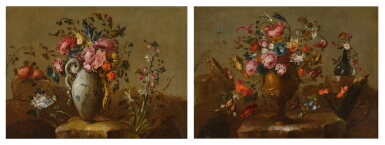
Still Life of Flowers in a Metal Vase, an Overturned Basket of Cherries and Fruit, and a Glass Bottle with Flowers on a Rocky Ground; Still Life of Flowers in a Blue and White Ceramic Vase, Fruit, and a Stalk of Gladiolas on a Rocky Ground
Auction Closed
June 2, 05:22 PM GMT
Estimate
40,000 - 60,000 USD
Lot Details
Description
Property from the Estate of Stanley Moss
The Pseudo-Guardi, alias the “Maestro dei Fiori Guardeschi”
active in Venice in the second half of the 18th century
Still Life of Flowers in a Metal Vase, an Overturned Basket of Cherries and Fruit, and a Glass Bottle with Flowers on a Rocky Ground;
Still Life of Flowers in a Blue and White Ceramic Vase, Fruit, and a Stalk of Gladiolas on a Rocky Ground
oil on canvas, a pair
each canvas: 32 by 43 ¾ in.; 81.3 by 111.1 cm
each framed: 51 by 60 in.; 129.5 by 152.4 cm
Anonymous sale, Monaco, Christie's, 7 December 1991, lot 7;
Where acquired by Stanley Moss.
R.B. Simon, Visions and Vistas: Old Master Paintings and Drawings, exhibition catalogue, New York 2000, pp. 90-94, reproduced (as Attributed to Francesco Guardi).
These two dramatic still lifes exemplify the style of a number of “evanescenti e capricciose composizioni di fiori, in vasi, in cesti, e in piatti inclinati, in coppe di ceramica o di vetro” that have traditionally been gathered under the authorship of the “Pseudo Guardi.”1 Like the present canvases, the works in this group are usually horizontal in format, with gray backgrounds, and with various containers filled with copious arrangements of flowers, all positioned on rocky outcrops. Given their scale and visual impact, they were clearly meant for elegant interiors, as pairs or ensembles, and the fluidity of their brushwork and precious palette are entirely consonant with the taste of the Venetian rococo.
In the past, some of these paintings have been attributed to Francesco Guardi himself. Giuseppe Fiocco was the first to give two such canvases to Guardi, connecting them to two frescoed still lifes in the parish church in Vico d’Anaunia (Trento); he was followed by other art historians in this identification, significantly including Giuseppe Morassi.2 The active and varied studio of Guardi’s older brother Gianantonio and the mystery of Francesco’s own early career before becoming a vedutista in the 1750’s allowed scope for this speculation. The question remained much debated until 1984 when Luigi Salerno coined the moniker of the “Pseudo Guardi” for them, much in use until Egidio Martini suggested the more apposite appellation of the “Maestro dei Fiori Guardeschi.”3 Subsequent attempts to identify the author of these paintings have been made, including to Nicolò Guardi, the younger brother of Gianantonio and Francesco.4
1 “evanescent and whimsical floral arrangements, in vases, in baskets, and on tilted plates, in ceramic or glass cups” see E. Safarik and F. Bottari, “Le decorazioni floreali in ambito guardesco” in La Natura Morta in Italia, Milan 1989, vol. I, p. 342.
2 See. G. Fiocco, “Francesco Guardi pittore di fiori,” in Arte Veneta, IV, pp. 76-85; and A. Morassi, “Guardi Peintre des Fleurs,” in Connaissance des Arts CXXIX, pp. 65-71.
3 See L. Salerno, La natura morta italiana, Rome 1984, pp. 314-5; E. Martini, Pinacoteca Egidio Martini a Cà Rezzonico, Venice 2002, pp. 188-189, cat. 150, reproduced.
4 For a recent and full discussion of the historical debate on this group, their attribution, and that Nicolò Guardi is their possibile author, see G. Bocchi, “Francesco Guardi pittore di fiori” in Francesco Guardi nella terra degli avi: Dipinti di figura e capricci floreali, 2012, pp. 87-147. Bocchi also discusses still lifes of a different type that may be correctly attributed to Francesco.