
Property from the Estate of Stanley Moss
Paolo Caliari, called Paolo Veronese
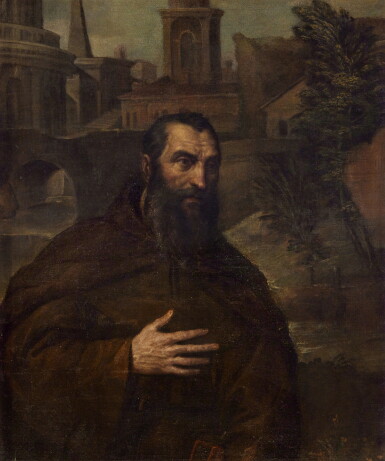
Portrait of a Man as a Friar
Auction Closed
June 2, 05:22 PM GMT
Estimate
20,000 - 30,000 USD
Lot Details
Description
Property from the Estate of Stanley Moss
Paolo Caliari, called Paolo Veronese
Verona 1528 - 1588 Venice
Portrait of a Man as a Friar
oil on canvas
canvas: 34 ⅛ by 28 ⅝ in.; 86.7 by 72.7 cm
framed: 43 ⅛ by 37 ½ in.; 109.5 by 95.3 cm
Conte Alberto Valmarana d’Altavilla, Veneto, Italy;
By whom sold, Milan, Sotheby's, 11 June 2002, lot 104 (as Attributed to Paolo Caliari, called Veronese);
Where acquired by Stanley Moss.
Although most familiar today as painter of grandiloquent biblical or historical compositions and often on a large scale, Paolo Veronese was also an extremely adept portraitist. Even in some of his most famous subject pictures there are “hidden”, likenesses of patrons or friends, or even, occasionally, a self-portrait.1 His subject were naturally drawn from the Venetian aristocracy or occasionally from the intellectual or artistic world of Venice, such as the Portrait of Alessandro Vittoria, the famous sculptor (Metropolitan Museum of Art, New York, inv. 46.31).
The present Portrait of a Friar would appear to be a late work of the artist and perhaps connected to a larger composition. Filippo Pedrocco considered the painting to date to the early 1580s, noting that the treatment of the landscape and trees parallels that of other works of those years.2 He adds that the restrained palette of the composition also suggests this late dating, noting that “[t]his virtuosic chromatic musical score—a splendid symphony of browns,—constitutes an additional confirmation of the late dating of the painting to the beginning of the 1580s.”3 He then went on to suggest that the picture might have been a posthumous portrait of Daniele Barbaro (died 1570), one of Veronese patrons for the decoration in fresco of the Villa Maser. This identification of the sitter has more recently been questioned by Xavier Salomon, who however does support the attribution of the present painting in full to Veronese, also dating the work to the artist’s late work.
1 Perhaps most famously, Veronese includes portraits of numerous luminaries, including his fellow artists Titian, Tintoretto and Bassano alongside him as a group of musicians in the Marriage at Cana painted for the refectory of Benedictines of San Giorgio Maggiore, Venice (now Musée du Louvre, Paris, inv. 1192).
2 Speicfically the Baptism of Christ, Courtauld Insitutie, London, another Baptism at the J. Paul Gettery Museum, Los Angeles, and the Ressurrection fo Christ in the Puskhin Musuem, Moskow.
3 In a private communication with the owner, dated 15 October, 2002.