
Property from the Estate of Stanley Moss, Sold Without Reserve
Codex Ursinianus Copyist (active circa 1625)
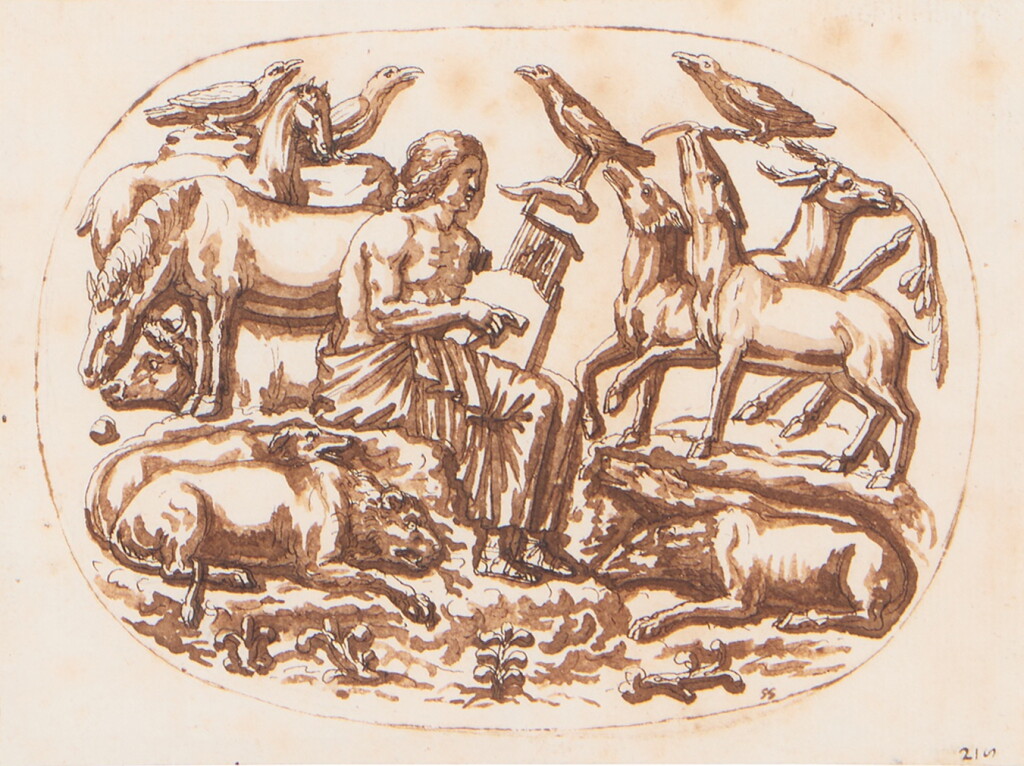
Orpheus charming the Animals, after the Antique
No reserve
Auction Closed
June 2, 05:22 PM GMT
Estimate
3,000 - 5,000 USD
Lot Details
Description
Property from the Estate of Stanley Moss, Sold Without Reserve
Codex Ursinianus Copyist (active circa 1625)
Orpheus charming the Animals, after the Antique
Pen and brown ink and wash over traces of black chalk, within a brown ink oval;
bears numbering within the drawn oval, lower right: 55
bears further numbering in brown ink, lower right: 218
128 by 171 mm; 5 by 6 ¾ in.
Commissioned by Cassiano dal Pozzo (1588-1657), Rome (bears numbering 218, and on ‘Type A’ mount of the Museo cartaceo),
Carlo Antonio dal Pozzo (1606-1689), Rome,
thence by descent to Cosimo Antonio dal Pozzo (1684-1740), Rome;
Pope Clement XI (1649-1721), the Vatican, acquired in 1703;
Cardinal Alessandro Albani (1692-1779), Rome;
King George IlI (1738-1820), London, acquired through James Adam in 1762;
Richard Dalton (1715-1791), London;
John MacGowan (d. 1803), Edinburgh, acquired in 1791;
Charles Townley (1737-1805), London, acquired in 1804,
John Townley;
Sir William Stirling Maxwell (1818-1878), Dunblane, acquired in 1865,
thence by descent;
sale, London, Phillips, 12 December 1990, Lot 259 (as Italian School, 17th Century),
where acquired
Rome, Galleria nazionale d’arte antica, Palazzo Barberini, I segreti di un collezionista: le straordinarie raccolte di Cassiano dal Pozzo 1588–1657, 2000, no. 147 (as Bernardino Capitelli)
A. Claridge and E. Dodero, Sarcophagi and Other Reliefs, 4 vols, Part III-2, The Paper Museum of Cassiano Dal Pozzo. Series A: Antiquities and Architecture, London 2022, pp. 782-4, no. 508 reproduced
Although this drawing was previously thought to depict an ancient gem or cameo,1 it was in fact drawn after an ancient marble relief of Orpheus charming the animals, now in the collection of the Musée du Louvre.2 While more often than not it is impossible to identify the whereabouts of ancient objects depicted in Museo Cartaceo drawings at the time that they were made, the location of this relief in the 17th century is well documented. Having been purchased from the artist Pietro Tami in 1615 by Asdrubale Mattei, a Roman nobleman and an important patron of Caravaggio, Mattei installed the relief on the eastern wall of the courtyard in his residence, Palazzo Mattei di Giove.3 In the 19th century, the relief was acquired by Cardinal Joseph Fesch and was later in the storied collection of the antiquarian Giampietro Campana,4 which was subsequently purchased by Napoleon III for the Louvre.
1 F. Solinas, I segreti di un collezionista: le straordinarie raccolte di Cassiano dal Pozzo: 1588-1657, Rome 2000, pp. 137-138, no. 147
2 For a discussion of this relief, see H. Stern, “Un relief d’Orphée du Musée du Louvre,” Bulletin de la Société Nationale des Antiquaires de France (1971), pp. 330-341.
3 L. Guerrini, Palazzo Mattei di Giove: Le antichità, Rome 1982, pp. 48-49, fig. 17.
4 The relief is presumably no. 323 in Class VII of the Campana collection catalogue: G. Campana, Cataloghi del Museo Campana, Rome 1858. “No. 323: Bassorilievo rappresentante Orfeo seduto nel mezzo colla lira, intorno a cui accorrono animali da ogni parte incantati dalla sua musica.”