
Property from the Estate of George Sarlo, San Francisco, Sold Without Reserve
Guillem Ferrer
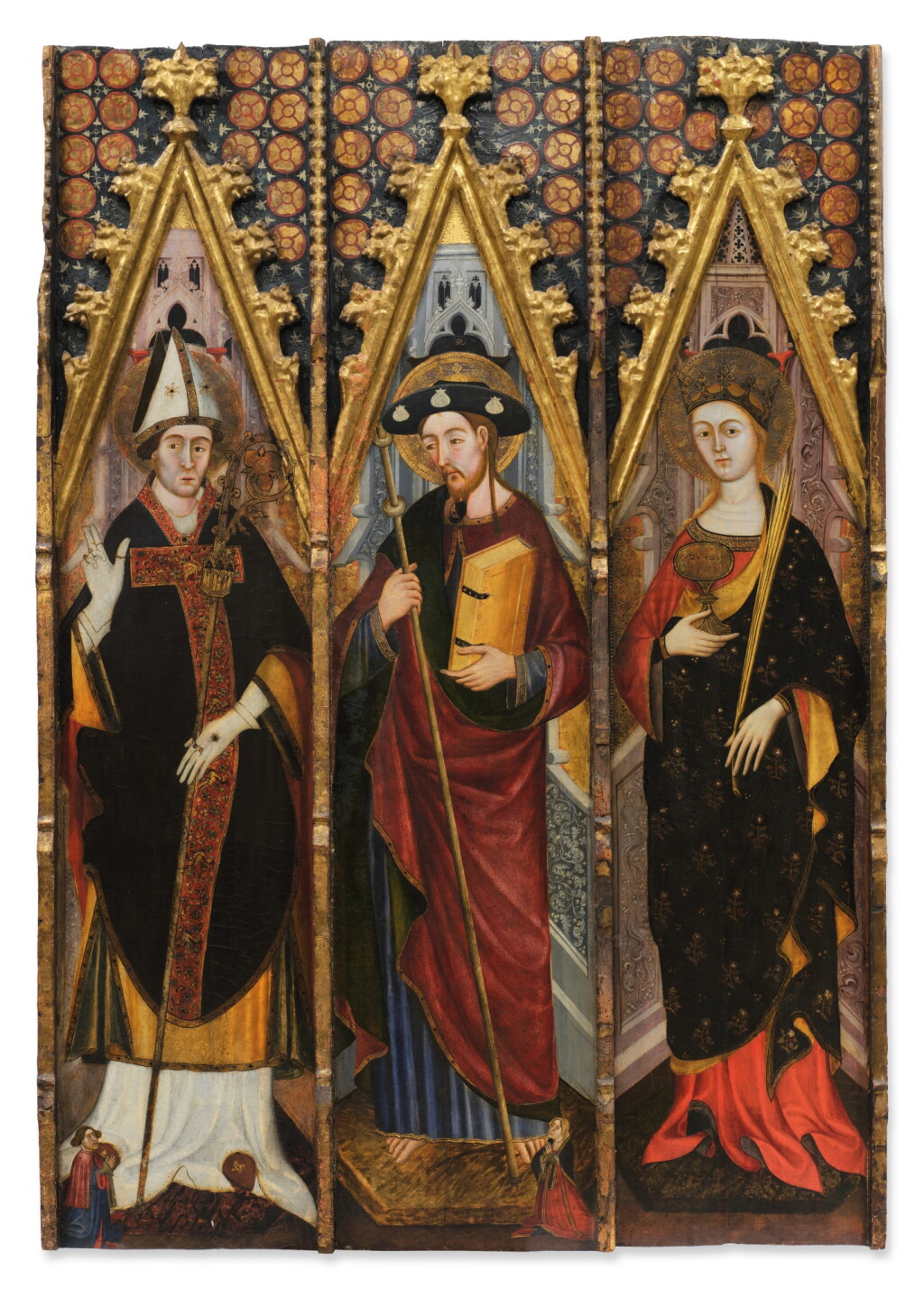
Bishop Saint, Saint James, and Saint Lucy With Donor Figures
No reserve
Auction Closed
June 2, 05:22 PM GMT
Estimate
40,000 - 60,000 USD
Lot Details
Description
Property from the Estate of George Sarlo, San Francisco, Sold Without Reserve
Guillem Ferrer
active in Barcelona and Morella during the last quarter of the 14th century and the first two decades of the 15th century
Bishop Saint, Saint James, and Saint Lucy With Donor Figures
oil on panel, in an engaged frame
panel: 79 by 55 ½ in.; 200.7 by 141 cm
Z. Véliz, "Wooden Panels and Their Preparation for Paintings from the Middle Ages to the Seventeenth Century in Spain," in The Structural Conservation of Panel Paintings: Proceedings of a Symposium at the J. Paul Getty Museum (Los Angeles 1998), p. 140, reproduced figs. 5 and 6 (recto and verso) (as Maestro de Torá).
Chandler Post was the first to isolate a small number of idiosyncratic panels around a complete retablo of the Virgin and Child with Saints Peter and John the Baptist in the Rusiñol collection, now Museu del Cau Ferrat, Sitges, a group which he attributed to his “Rusiñol Master.”1 He considered the painter to be influenced by the Catalan Serra brothers, but with distinctive facial types, featuring thinly opened eyes and pointed chins. This anonymous figure was augmented by other scholars and was eventually renamed by Juan Ainaud de Lasarte the “Master of Torà” after a dispersed altarpiece which was said to have originated in the town of Torà (Lleida).2 This supposition was recently found to be erroneous; one of the Master’s panels from this group, a Pentecost in the Museu de Terrassa) was found to have a label which noted that it had been removed from the town of Rubielos de Mora. It was Antoni José I Pitarch who first suggested that the Master be identified with Guillem Ferrer, an artist recorded in the late 14th and early 15th Century in Barcelona and Morella.3 Ferrer had personal connections to the Serra family of painters, having acted as agent for Jaume Serra in collecting payment for a commission in 1375, and in documents of 1414-15, noted a debt he owed to Pere Serra.4 Arriving from Barcelona in 1379, Ferrer became one of the leading painters in Morella, an active artistic center in the bishopric of Tortosa.
Based on photographs, Dr. Antoni José I Pitarch, to whom we are grateful, has confirmed the attribution of the present panel to Guillem Ferrer, circa 1380-1390. He notes that it most closely relates to the altarpiece in the Museu del Cau Ferrat, Sitges mentioned above, as well as some scenes from an altarpiece dedicated to the Virgin in the Museu Nacional d’Art de Catalunya, Barcelona (as well as some in private collections). He further suggests that the bishop saint in the present painting is likely either Saint Nicholas or Blaise, and that the panel was likely part of an altarpiece dedicated to one of the saints depicted. The patrons shown kneeling before their name saints would thus have been “Jaumeta” for the female donor, and either Nicolau or Blai for the male.
1 See C.R. Post, History of Spanish Painting, Cambridge MA, vol. II (1930), pp. 303-306; vol. VII (1938), p. 743; vol. VIII, part II (1941) pp. 564-65.
2 See J. Ainaud de Lasarte, Pittura spagnola dal periodo romanico a “El Greco,” Bergamo 1964, p 42
3 See A. José i Pitarch, “Morella, centro de pintura: siglos XIV y XV,” in La memòria daurada: Obradors de Morella Segles XIII-XVI, Castellón 2003, pp. 153-7; and A. José Pitarch, “Retaule de la Mare de Déu, sant Joan Baptista i sant Pere Apòstol de Guillem Ferrer,” in Museu Cau Ferrat. La peça del mes, Sitges, 2005.
4 See J. Gudiol Cunill, El Trescentistes, Barcelona (n.d.) pp. 171, 196 and A. José Pitarch, op. cit., p. 152.