Works from the former Claude et Georges Pompidou Collection
Nicolas de Stäel
Les toits de Paris
Estimate
300,000 - 500,000 EUR
Lot Details
Description
Nicolas de Staël
1914 - 1955
Les toits de Paris
signed and dated 52 (on the reverse)
oil on cardboard
14.6 x 22 cm; 5 ¾ x 8 ⅝ in.
Executed in 1952.
Theodore Schempp, New York
Galerie Berggruen, Paris
Claude and Georges Pompidou, Paris
Alain Pompidou, Paris (by descent from the above)
Thence by descent to the present owner
Tokyo, Idemitsu Museum, André Malraux et le Japon éternel, 1978, no. 734, p. 187, illustrated in colour
Paris, Galerie Artcurial, Hommage au Président Georges Pompidou. Un homme de culture, 31 March – 30 April 1987, pp. 19 and 119, illustrated in colour, image inverted
Paris, Hôtel de Ville, Nicolas de Staël, 15 March - 19 June 1994, p. 81, illustrated in colour
Cajarc, Maison des Arts Georges Pompidou, autour d’une collection : le Président et Madame Georges Pompidou, 1994, n.p., illustrated in colour
Paris, Galerie Nationale du Jeu de Paume, Georges Pompidou et la Modernité, février 1999, p.90, illustrated in colour
Paris, Centre Georges Pompidou, Nicolas de Staël, 12 March - 30 June 2003, no. 91, p. 131, illustrated in colour
Paris, Musée de l'Art moderne de Paris, Nicolas de Staël, 15 September - 21 January 2024, p. 128, illustrated in colour
Jacques Dubourg, Françoise de Staël et al., Nicolas de Staël, Paris 1968, no. 479, p. 215, illustrated
Françoise de Staël, Nicolas de Staël, Catalogue Raisonné de l'Œuvre peint, Neuchâtel 1997, no. 327, p. 320, illustrated in colour and on the cover
Anne de Staël, STAËL Du trait à la couleur, Paris 2001, p. 198, illustrated in colour
Jean-Claude Marcadé, Nicolas de Staël Peintures et Dessins, Paris 2008, fig. 102, p. 170, illustrated in colour
Exh. Cat., Chambord, Domaine national de Chambord, Georges Pompidou, Une aventure du regard et l'art, 18 June - 19 November 2017, p. 18, illustrated in colour
Françoise de Staël, Nicolas de Staël: Catalogue Raisonné of the Paintings, Lausanne 2021, no. 327, p. 272, illustrated in colour
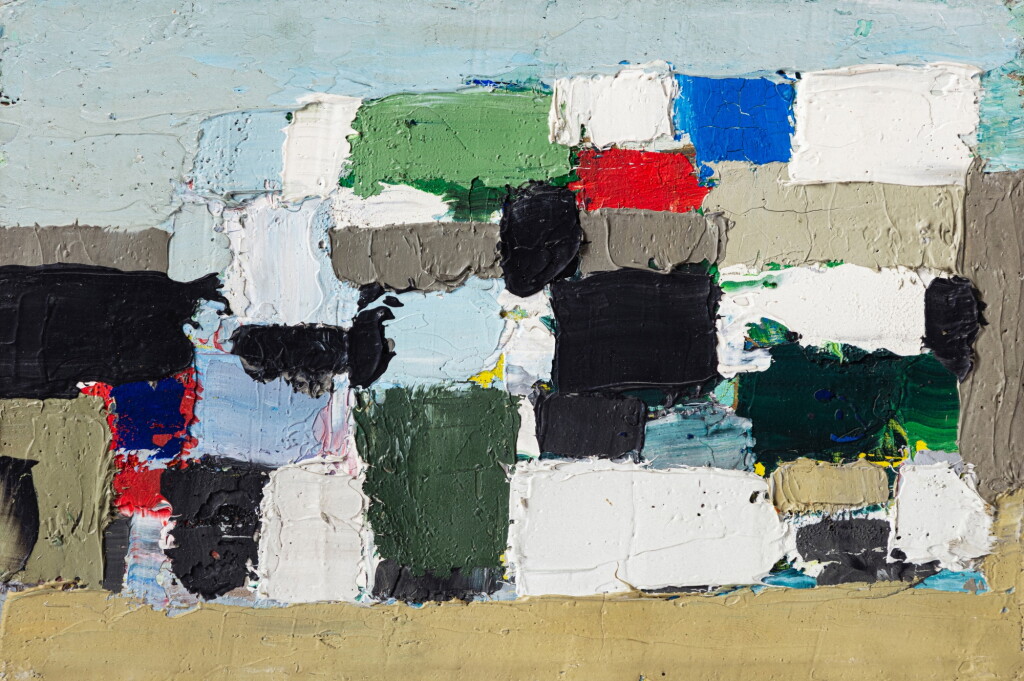
Painted at a pivotal period in the evolution of Nicolas de Staël’s painting, the 1952 oil on cardboard, Les toits de Paris, illustrates the renewal of his art. Defined by its vivid and vibrant colours, this small-format work displays an expressive force characteristic of Staël’s art. Far from merely applying colour, the painter uses it in two ways, both as a visual effect and as a material in its own right, which he condenses into geometric forms. The artist exalts his palette within tesserae which he fills with matter, in a composition that thus becomes frontal, even almost mural. Still marked by his visit to the exhibition of the mosaics of Ravenna, it is through these small geometric forms that the painter found a new way of painting as early as 1951, which he developed the following year in ambitious compositions. In Les toits de Paris, Nicolas de Staël captures the architectural rhythm of the French capital beneath the variations of the spring light. It is this same rhythm, in less vivid colours, that animates his monumental painting Les Toits (1952), which the painter gave to the Musée d’Art moderne de Paris, where it is still preserved.
“I want to achieve a harmony. I use a material which is paint […] Things constantly communicate with the artist while he is painting, that is all I know.” Nicolas de Stael in his response to the MoMA in January 1951.
Resolutely modern, Nicolas de Staël imbues Les toits de Paris with this harmonisation, both visual and chromatic. The superimpositions of pictorial masses, animated by the asymmetrical alternation between the black patches and those of colour, bring a genuine harmony of movement, which only Staël’s painting can bring to life. The French art critic René de Solier very aptly emphasised as early as 1950, in regard to the painter, “Staël escapes classifications.” (René de Solier, Les Cahiers de la Pléiade, 1950, quoted in Cat. Exp., Paris, Musée national d’art moderne, Nicolas de Staël, 2023). Having “painting” as his sole requirement, both material and conception, Nicolas de Staël found no interest in the debate raging in mid-twentieth-century French art, opposing abstraction and figuration. Yet the painter makes his masterpiece Les toits de Paris a powerful image that defies the boundaries between abstract and figurative painting. The link with reality becomes explicit, first through the title—which has few equals in terms of precision within this series—and then through the composition itself, where each tessera now refers to identifiable elements. The shimmering colours gathered in tesserae of varying widths overlap one another, in thick expanses laden with pictorial matter, thereby creating a continuous and permanent movement that tirelessly draws the viewer’s gaze.
“One never paints what one sees or thinks one sees; one paints with a thousand vibrations the blow received, to be received, similar, different.” Nicolas de Stael in a letter to Roger van Gindertael, 14 April 1950.
It is in the landscape that, at the turn of 1952, de Staël found the inspiration for setting painting back into motion. Then in search of an innovative pictorial language, in the spring of that same year the painter left the comfort of his Parisian studio to paint on the motif, directly facing his subjects. It is at the heart of this series, characterised by light materials and small formats, that our work belongs. In a letter to René Char, Nicolas de Staël transcribed the fervour of this renewal in a few words revealing of his genius, “colours filling my hands beneath an open sky” (Nicolas de Staël, quoted in Cat. Exp., Paris, Musée national d’art moderne, Nicolas de Staël, 2023). It is this famous “open sky”, whose clarity of blue gives a particular pictorial power to the coloured tesserae, that frames the composition horizontally, facing the ochre ground in the lower part. Caught between these two broad horizontals, “colours filling my hands”, Nicolas de Staël stages a tonal interplay that unfolds within the tesserae, making each coloured mass, in its relationship to the others, a link in a continuous and perpetual vibration. Faced with the landscape, the artist finds a meticulous balance between observation and abstraction, and condenses within a small format the most significant artistic divide of the twentieth century, of which Les toits de Paris is an emblematic illustration.
It was precisely this modern character that caught the eye of the Pompidou. Les toits de Paris is a highly symbolic work for the collector couple, who kept this small oil on their walls throughout their lives. On 3 July 1958, for her husband’s 47th birthday, Claude Pompidou secretly went to the Jeanne Bucher gallery, where the couple had acquired their first work together eleven years earlier. There, without hesitation, she chose this small oil by one of the most modern painters, Nicolas de Staël, who had died three years earlier. That very day, she hung Les toits de Paris on the wall of their Parisian apartment. When Georges Pompidou discovered his gift, he was immediately fascinated by the pictorial power and radical modernity of this masterpiece, to such an extent that he rose from his seat ten times during dinner to contemplate this new acquisition. This gift, one of the finest pieces in the Pompidou couple’s collection, never left them, and their son, Alain Pompidou, did likewise, preserving until his passing this work that was particularly dear to his parents.
You May Also Like