
Thomas Eakins
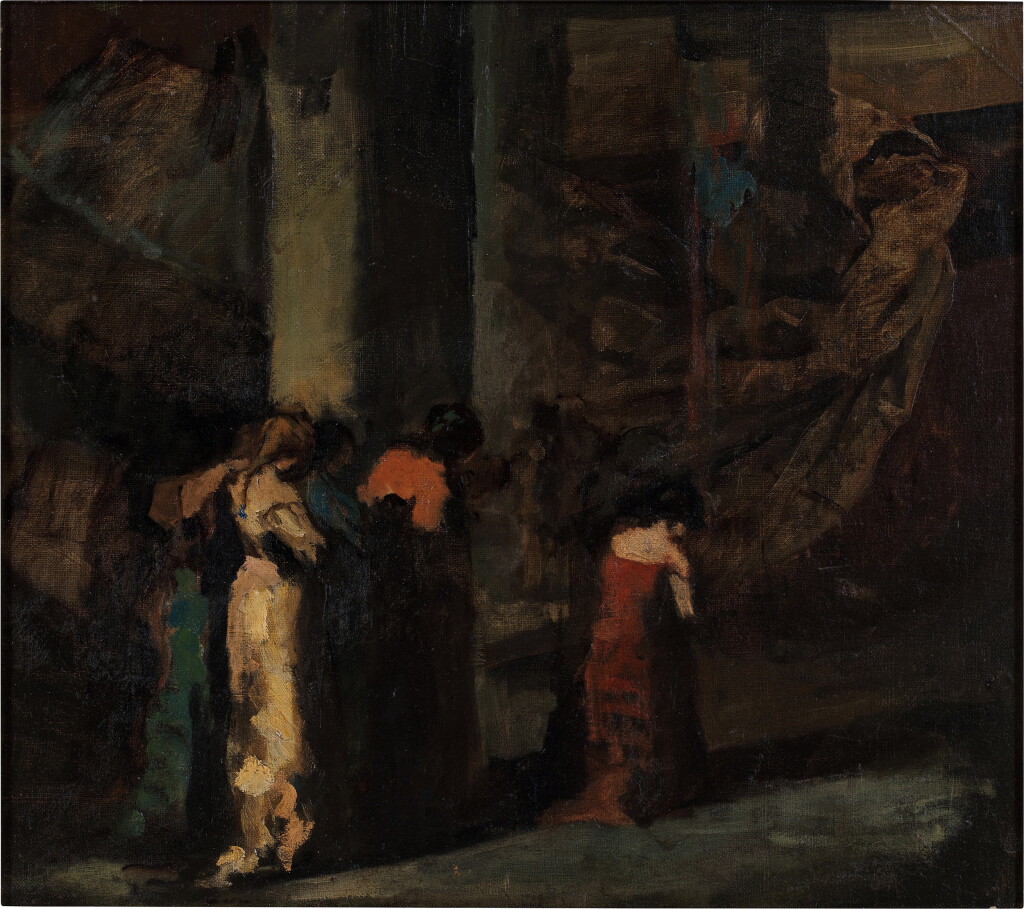
Scene in a Cathedral (Study)
Lot closes
October 9, 03:54 PM GMT
Estimate
10,000 - 15,000 USD
Starting Bid
7,000 USD
We may charge or debit your saved payment method subject to the terms set out in our Conditions of Business for Buyers.
Read more.Lot Details
Description
Thomas Eakins
1844 - 1916
Scene in a Cathedral (Study)
oil on canvas laid down on panel
16 by 18 in.
40.6 by 45.7 cm.
Executed in Spain in 1869-70.
Estate of the artist
Susan M. Eakins, Philadelphia (the artist’s wife)
Charles Bregler, Philadelphia (acquired as a gift from the above)
Harry Felix, Philadelphia (probably acquired from the above)
Joseph Katz, Baltimore
M. Knoedler & Company, New York (acquired from the above in 1961)
Joseph H. Hirshhorn, New York (acquired from the above in 1966)
Hirshhorn Museum and Sculpture Garden, Washington, D.C. (acquired as a gift from the above in 1966)
Christie’s, New York, 1 December 2010, lot 150 (consigned by the above)
Acquired at the above sale by the present owner
Washington, D.C., Hirshhorn Museum and Sculpture Garden, The Thomas Eakins Collection of the Hirshhorn Museum and Sculpture Garden, 1977, no. 14, pp. 12 and 44, illustrated
Lloyd Goodrich, Thomas Eakins: His Life and Work, New York, 1933, no. 31, p. 162
Gordon Hendricks, The Life and Work of Thomas Eakins, New York, 1974, p. 60, fig. 46, illustrated (titled Sketch of the Interior of the Cathedral of Seville)
Alan C. Braddock, Displacing Orientalism: Thomas Eakins and Ethnographic Modernity, Doctoral dissertation, University of Delaware, Newark, 2002, pp. xii, 155-60 and 554, fig. 39, illustrated (titled Cathedral of Seville)
Mary Elizabeth Boone, Vistas de España: American Views of Art and Life in Spain, 1860-1914, New Haven and London, 2007, p. 73, fig. 3,7, illustrated (titled Cathedral of Seville)
Kristin Schwain, Signs of Grace: Religion and American Art in the Gilded Age, Ithaca and London, 2008, p. 16, fig. 1, illustrated; p. 18 (titled Cathedral of Seville)
Thomas Eakins, the Philadelphia painter who would become one of the foremost American realists of the nineteenth century, arrived in Spain at the end of 1869 after three years of academic training in Paris under Jean-Léon Gérôme. Worn down by the Parisian winter and poor health, he stopped first in Madrid, where the Spanish masters at the Prado struck him as “so good so strong so reasonable so free from every affection” (quoted in Mary Elizabeth Boone, Vistas de España: American Views of Art and Life in Spain, 1860-1914, New Haven and London, 2007, p. 65). He continued south to Seville, living there from December until the following June alongside fellow painters Harry Humphrey Moore and William Sartain. On one of Eakins’s first outings there, he entered the city’s great Gothic cathedral, where he “saw many genuflections & riches” (ibid., p. 67). Raised by a Quaker mother and rarely a churchgoer at home, Eakins approached the Catholic ritual as an outsider, and the present work, Scene in a Cathedral (Study), preserves that vantage point.
Five women gather beside a massive column, four standing with bowed heads closely together, while a fifth kneels apart, closest to the unseen altar. Eakins leaves out the altar, crucifix, and any devotional imagery entirely; his subject is the act of prayer itself, observed from a respectful distance. Loosely brushed in earthy browns, ochres, creams, and pops of darkened turquoise, the figures are lit from behind, as if by daylight spilling through the cathedral doors. Painted over an abandoned study of fabric, the canvas’s earlier life shows through: a spectral swirl of drapery rises above the kneeling woman at upper right, almost like a prayer ascending into the vaults. Eakins admitted to his father from Seville, “these pictures may be failures…I cannot make a picture fast yet” (quoted in Phyllis D. Rosenzweig, The Thomas Eakins Collection of the Hirshhorn Museum and Sculpture Garden, Washington D.C., 1977, p. 44) Yet, Scene in a Cathedral (Study) shows a rare pivotal moment: the young painter, fresh from the Prado, testing lessons of the Spanish masters against the life unfolding before him. Here, Eakins discovered the quiet, unflinching attention to human presence that would define his greatest work.
You May Also Like


