Property from the Collection of Erich & Senta Goeritz
Erich Heckel
Männerbildnis
Auction Closed
March 5, 05:50 PM GMT
Estimate
20,000 - 30,000 GBP
Lot Details
Description
Erich Heckel
1883 - 1970
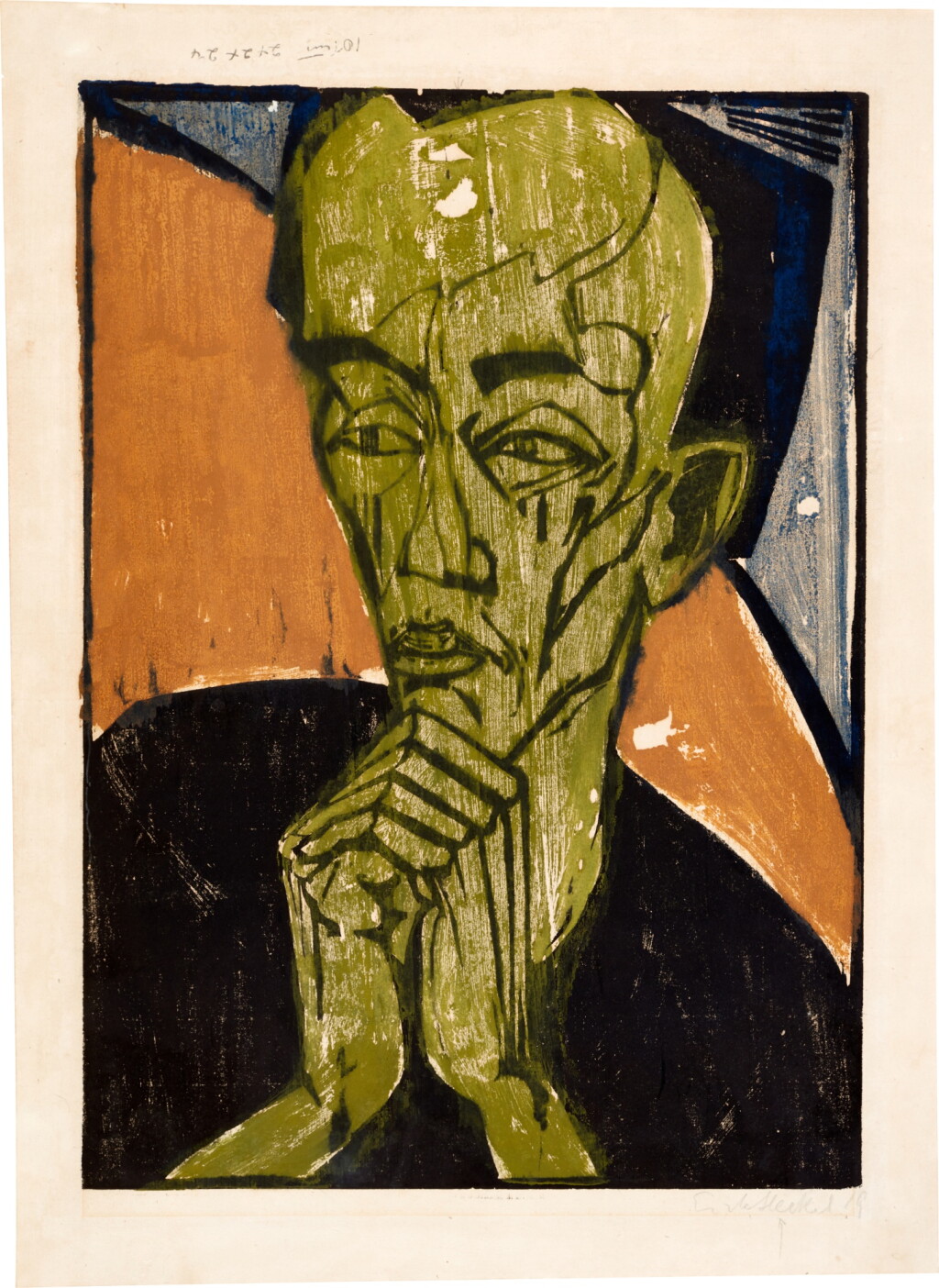
Männerbildnis
signed in pencil and dated
woodcut printed in black, blue, ochre and green, the colours applied in the manner of a monotype, on cream laid paper
image: 46 by 32.5 cm. 18⅛ by 12¾ in.
sheet: 53.5 by 38.5 cm. 21⅛ by 15¼ in.
framed: 73 by 55 cm. 28¾ by 22 in.
Executed in 1918-19, this work is a fine, early impression of the rare second state (of three), before the edition of the final state printed by Fritz Voigt and published by J.B. Neumann, Berlin.
Erich and Senta Goeritz, Berlin and London (acquired from the artist)
Thence by descent to the present owner
Annemarie and Wolf-Dieter Dube, Erich Heckel, Das graphische Werk, New York and Berlin, 1964, no. H.318.II, p. 28.
Renate Ebner and Andreas Gabelmann, Erich Heckel: Werkverzeichnis der Druckgraphik, Munich, 2021, no. 739 H II.b, pp. 104-105.
Lauded as a defining work of German Expressionism, Erich Heckel’s Männerbildnis (Portrait of a Man) vividly conveys the grief and disillusionment that swept across Europe after World War I. A pioneer of Die Brücke, Heckel created this emotionally charged self-portrait upon returning to Berlin from Flanders, where he served in an ambulance unit under the direction of art historian Walter Kaesbach. Kaesbach deliberately assembled a platoon of artists, including Otto Herbig, Max Kaus and Anton Kerschbaumer, and encouraged them to continue their artistic practice.
From May 1915 until the war’s end in November 1918, Heckel was stationed at the emergency hospital in Ostend, housed in a railway station that evolved into a vibrant artistic community. Whenever possible, the orderlies painted, produced woodcuts, and engaged in discussions of literature and poetry; they decorated the building with murals and window designs and created special works for holiday celebrations. During this period, Heckel met James Ensor, who welcomed him into his home and studio.
Despite his wartime duties, Heckel remained actively connected to the German art world, cultivating relationships with collectors and preparing for exhibitions. He further honed his skills as a draughtsman, sketching the people and places he encountered. This dedication proved fruitful, as upon returning to Berlin, he created the complex and masterful Männerbildnis.
The present impression is an exceptional example of this celebrated work, printed by the artist with a highly painterly finish. Unconventionally, the ink was applied with a brush rather than a roller, producing a distinct texture over the grainy woodblock. The green hue seems to reflect Heckel’s own emotional state following the war, lending the work a poignancy that resonates with the period's turmoil. Emerging from such a cataclysmic moment, the portrait captures an historically specific atmosphere and collective mood. As Deborah Wye observes: “Portrait of a Man, a gaunt self-portrait created in the difficult months just after the war ended, manifests a psychic weariness that may be interpreted as broadly symbolic of the German people at that time.”1
[1] Deborah Wye, Artists and Prints: Masterworks from The Museum of Modern Art, New York, The Museum of Modern Art, 2004, p. 56