Stuart Davis
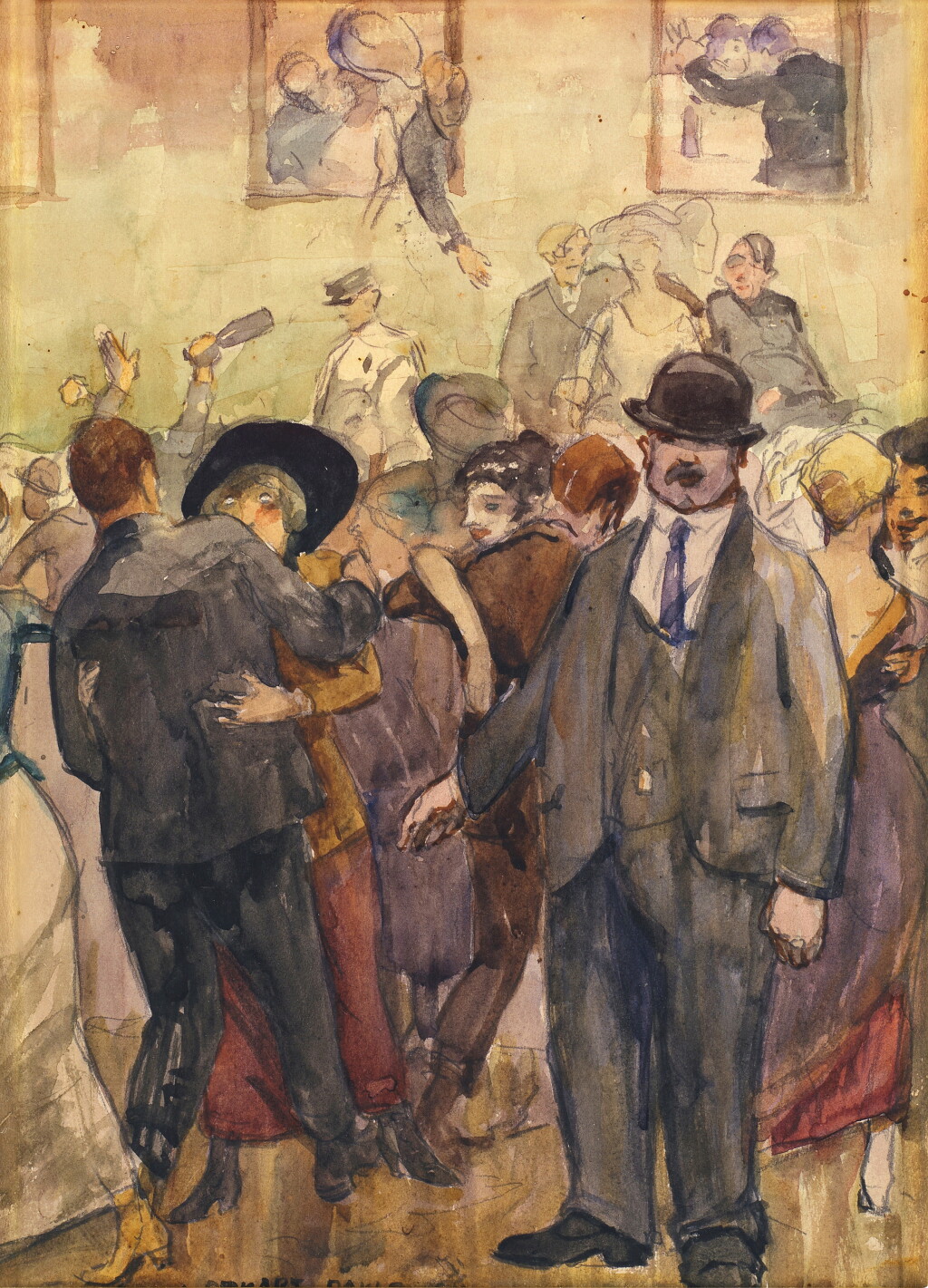
Dance
Session begins in
November 19, 04:00 PM GMT
Estimate
25,000 - 35,000 USD
Bid
20,000 USD
Lot Details
Description
Stuart Davis
1892 - 1964
Dance
signed ·Stuart Davis· and dated 1912· (lower center)
watercolor and pencil on paper
15 by 10 ⅞ in.
38.1 by 27.6 cm.
Executed in 1912.
Estate of the artist
Grace Borgenicht Gallery, New York
Private Collection, Wahwah, New Jersey (acquired from the above in October 1980)
Sotheby’s, New York, 4 October 2022, lot 993 (consigned by the above)
Acquired at the above sale by the present owner
New York, Armory of the Sixty-Ninth Infantry, International Exhibition of Modern Art, 1913, no. 814, p. 56
(probably) New York, Sheridan Square Gallery, Watercolors and Drawings by Stuart Davis, 1917 (titled The Garbage Contractors Ball)
Utica, New York, Munson-Williams-Proctor Institute and New York, Armory of the Sixty-Ninth Regiment, 1913 Armory Show: 50th Anniversary Exhibition, 1963, no. 814, p. 117, illustrated; p. 187, illustrated (titled Dance)
Roslyn Harbor, New York, Nassau County Museum of Fine Art, The Shock of Modernism in America: The Eight and Artists of the Armory Show, 1984, no. 113, p. 73, illustrated (titled The Dance)
(probably) W.H. Bowdoin, “Modern Work of Stuart Davis at Village Show,” New York Evening World, 13 December 1917, n.p. (titled Garbage Collector’s Ball)
“A Glorious Affair,” Time, vol. LXXXI, no. 14, 5 April 1963, p. 59, illustrated in color
Milton W. Brown, The Story of the Armory Show, New York, 1988, no. 814, p. 260
Ani Boyajian and Mark Rutkoski, Stuart Davis: A Catalogue Raisonné, vol. 2, New Haven and London, 2007, no. 987, p. 476, illustrated in color
Stuart Davis’s Dance was notably included in the 1913 Armory Show - an exhibition which permanently altered the trajectory of modern art in the United States. The show opened in New York’s 69th Regiment Armory in February 1913, giving many Americans their first major exposure to European avant-garde artists like Matisse, Picasso, and Duchamp. The exhibition was, as Time magazine later put it, “not so much a handshake as a collision,” pitting European modernism against an American academic establishment that saw it as a threat to tradition and to the marketplace (“A Glorious Affair,” Time, 5 April 1963, p. 59). Upon reflection for the 50th anniversary of the 1913 exhibit, Davis said the encounter was “an experience of Freedom,” and fifty years later he still held up the show as “the correct coordinate for redirection” of modern art as we know it today (Exh. Cat., Munson-Williams-Proctor Institute, 1913 Armory Show: 50th Anniversary Exhibition, 1963, p. 51).
You May Also Like