
Property from a Private French Collection
André Masson
Poursuite
Lot Closed
July 7, 12:43 PM GMT
Estimate
80,000 - 120,000 EUR
We may charge or debit your saved payment method subject to the terms set out in our Conditions of Business for Buyers.
Read more.Lot Details
Description
Property from a Private French Collection
André Masson
1896-1987
Poursuite
signed André Masson (lower left)
oil on canvas
81,4 x 116,3 cm; 31,9 x 45,7 in.
Executed in 1933.
Galerie Simon, Paris (ph. no. 10832)
Galerie Wildenstein, Paris (no. 922)
Private collection, Paris
Hôtel Drouot, Paris, 1 April 1990, lot 52 (consigned by the above)
Private collection, France (acquired at the above sale)
Galerie Thessa Herold, Paris
Galerie Philippe Samuel, Paris
Hôtel Drouot, Paris, 21 March 2004, lot 59
Galerie Jean-François Cazeau, Paris
Acquired from the above by the present owner in 2011
Barcelona, Olimpíada Cultural, Fundació Caixa de Catalunya, Les avant-gardes a Catalunya, 1906-1939, 1992, no. 280, p. 131,illustrated in colour p. 353
Paris, Galerie Artcurial, Consonances peinture – sculpture : choix pour une Collection, 1993
Rome, Fondazione Cassa di Risparmio di Roma - Museo del Corso, Max Ernst e i suoi amici surrealisti, 2002, illustrated in colour p. 97
Pascale Le Thorel-Daviot, Petit dictionnaire des artistes modernes, Paris, 1999, illustrated in colour p. 180
Guite Masson, Martin Masson and Catherine Loewer, André Masson, Catalogue raisonné de l'œuvre peint, 1919-1941, Volume II, 1930-1941, Paris, 2010, no. 1933*13, illustrated in colour p. 165
André Masson occupies a singular position in twentieth-century art. Closely associated with Surrealism while maintaining a profound independence, he developed during the 1930s an artistic language shaped by the exploration of instinctive forces, eroticism and violence. His rapprochement with Georges Bataille led him to investigate the deepest impulses of human nature, pursuing a path that diverged from the oneiric universe favoured by André Breton and the orthodox Surrealist movement.
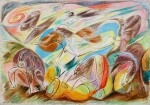
Between 1931 and 1933, scenes of combat and massacre became one of the central themes of his œuvre. In these works, Masson depicts a world governed by primordial tensions in which humans and animals appear subject to the same vital energy. Executed at the heart of this period, Poursuite belongs to this important group of paintings in which bodies intertwine within a complex choreography where the boundaries between struggle, desire and destruction remain deliberately ambiguous.
The composition is distinguished by an extraordinary sense of dynamism. Sinuous lines and fragmented forms animate the surface of the canvas, while vivid touches of colour heighten the impression of movement. Faithful to a creative method founded on spontaneity, Masson allowed forms to emerge during the very act of painting, privileging the energy of execution over any preconceived structure.
The work also reflects the artist’s fascination with the irrational forces that govern existence. Marked by his experience of the First World War and deeply sensitive to the anxieties that permeated Europe during the 1930s, Masson made violence not only a subject but also a formal principle. Bodies merge, contours dissolve and space itself seems charged with a permanent tension, conveying a vision of the world in which instinct and desire occupy a central place.
Through Poursuite, Masson produced one of the most compelling expressions of his artistic investigations during the 1930s. Suspended between vital impulse and destructive force, the work reveals the complexity of an imagination in which man, animal and nature participate in a single process of perpetual transformation.