Lyonel Feininger
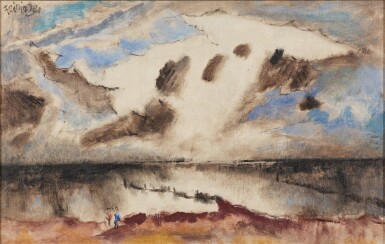
The Big Cloud
Lot Closed
June 2, 12:10 PM GMT
Estimate
120,000 - 180,000 EUR
We may charge or debit your saved payment method subject to the terms set out in our Conditions of Business for Buyers.
Read more.Lot Details
Description
Lyonel Feininger
1871–1956
The Big Cloud
signed (upper left)
oil on canvas
46 by 71.5 cm.
18⅛ by 28⅛ in.
Executed in 1941.
Achim Moeller, Managing Principal of The Lyonel Feininger Project LLC, New York – Berlin has confirmed the authenticity of this work, which is registered under no. 1106-11-01-11. A certificate of authenticity accompanies the work.
Estate of the artist
Sotheby's London, 28 June 1972, lot 79
Acquired directly at the above sale by the present owner
Berlin, Nationalgalerie, Lyonel Feininger. Von Gelmeroda nach Manhattan, 3 July - 11 October 1998, no. 116, p. 197, illustrated;
Munich, Haus der Kunst, Lyonel Feininger, 1 November 1998 - 24 January 1999;
Halle (Salle), Kunstmuseum Moritzburg, Lyonel Feininger: Zurück in Amerika. 1937-1956, 16 May - 23 August 2009, no. 14, p. 87, illustrated;
Apolda, Kunsthaus Apolda Avantgarde, Feininger und das Bauhaus. Weimar- Dessau-New York, 12 September - 19 December 2009
Hans Hess, Lyonel Feininger, Stuttgart, 1961, no. 416, p. 288, illustrated
Jean-Hubert Martin, Carlo Severi and Julien Bonhomme, "Jean-Hubert Martin and Visual Thinking", Gradhiva, issue 13, 18 May 2011, p. 140, illustrated
"The most beautiful landscape cannot hold my attention as much as nature by the seaside and everything connected to water." — Lyonel Feininger (Cited in June L. Ness (ed.), Lyonel Feininger, New York: Praeger Publishers, 1974.)
This reflection, written late in Lyonel Feininger’s life, feels almost like a key to understanding The Big Cloud, 1941. Few motifs remained as constant throughout his career as the meeting of sea, sky and horizon. From the Baltic coastlines he returned to throughout the 1920s and early 1930s to the unfamiliar American landscapes he encountered after leaving Germany in 1937, water became both his subject and anchor, a space where his sharp, crystalline visual language could unfold with clarity and freedom. Painted in 1941, The Big Cloud belongs to this later period, when Feininger, already seventy and living in exile in America, was balancing the disciplined geometry of his Bauhaus years with a softer, more atmospheric sensibility.
The composition is remarkably restrained. A thin horizon line cuts across the canvas, leaving only a narrow strip of land and sea beneath an immense sky dominated by a single monumental cloud. Rather than modelling the form through smooth tonal transitions, Feininger builds the cloud through translucent geometric planes that interlock almost like stained glass. Thin washes of paint allow the texture of the canvas to remain visible underneath, giving the work a luminosity that recalls Cubism, though here it feels quieter and more meditative. Pale ochres, cool greys and washed indigos are organised with careful control, while the faint architectural form on the horizon, perhaps a mast or distant village, grounds the otherwise almost metaphysical vastness of the sky.
An interesting comparison can be made with Bird Cloud (Vogelwolke / Wolke nach dem Sturm) from 1926, now in the Harvard Art Museum’s collection. Both works share the same elongated format, low horizon and singular cloud formation stretching across a calm sea. Yet the earlier painting, created during the height of Feininger’s Bauhaus period, reduces the landscape into the sharp fractured geometry of what he called his prism ism. In The Big Cloud, those crystalline edges dissolve into something softer and more reflective. The fifteen years between the two paintings encompass exile, displacement and return, and that shift from structural certainty to atmospheric introspection defines much of Feininger’s late work.
The painting belongs to a decisive late phase in which Feininger began reconstructing the world through light and atmosphere. Its exhibition history, including presentations at the Addison Gallery of American Art and later retrospectives in Berlin, Munich, Halle and Apolda, reflects its importance within his later oeuvre. The Big Cloud captures something central to Feininger’s practice: the idea that even the most fleeting forms, clouds, light and atmosphere, can attain a sense of permanence when rendered with tender sensibility.
You May Also Like