Property of a Lady
Ivon Hitchens
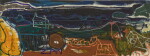
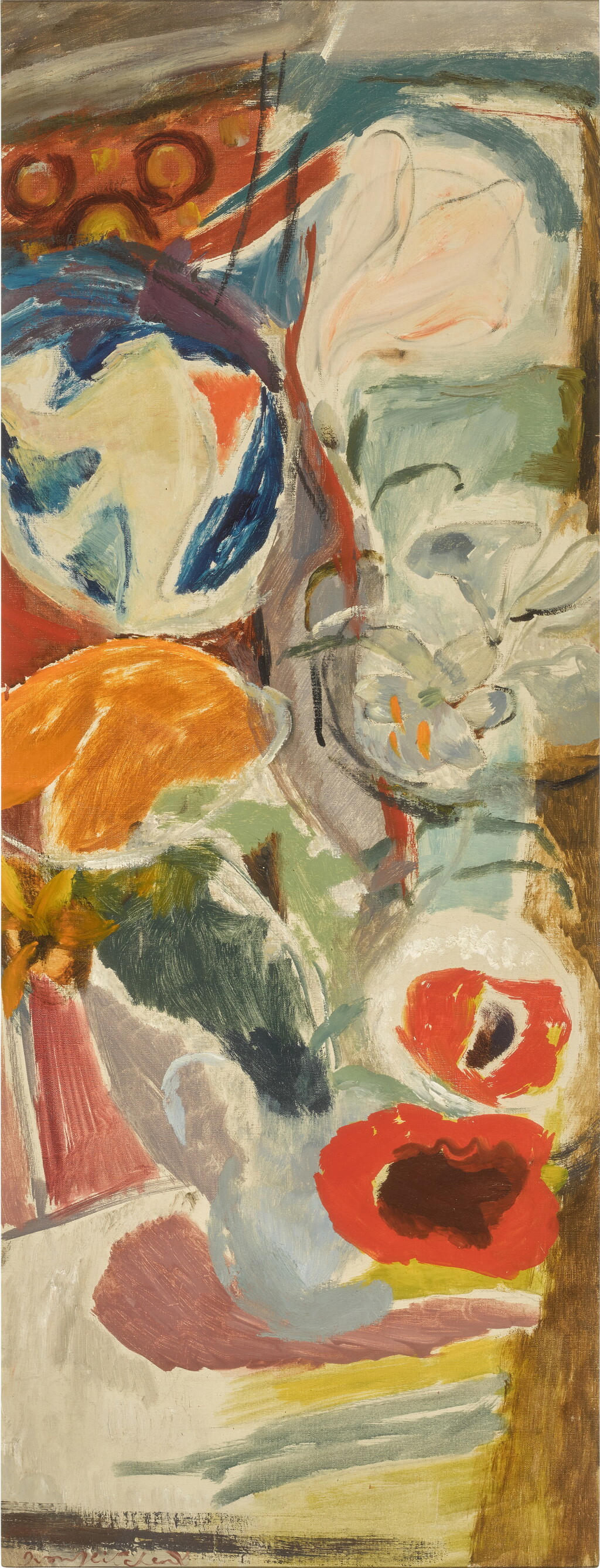
Ivon Hitchens, Poppies Under
Estimate
50,000 - 80,000 GBP
Lot Details
Description
Ivon Hitchens
1893 - 1979
Poppies Under
signed Ivon Hitchens (lower left); also signed Ivon Hitchens, titled and inscribed (on a label attached to the stretcher bar)
oil and pencil on canvas
unframed: 109 by 42 cm. 43 by 16½ in.
framed: 138 by 71 cm. 54¼ by 28 in.
We are grateful to Peter Khoroche for his kind assistance with the cataloguing for the present work.
The Leicester Galleries, London, where acquired by the Hon. Michael Astor (1916-1980) in April 1956 and thence by descent to the present owner
Poppies Under is a vibrant testament to Ivon Hitchens’ enduring dedication to the still life genre. He created a singular and distinctive style which is a seamless blend of abstraction and figuration, and the present work demonstrates this wonderfully in a joyful flourish of colour and form.
After exhibiting with the London Group and leading the formation of the Seven & Five Society in 1919 - a loosely constructed exhibiting body of artists including Henry Moore, Barbara Hepworth, John Piper, and later, Ben Nicholson – Hitchens’ work became increasingly unanchored from figurative representation. The group’s freedom from current artistic convention positioned them as the avant-garde force within British art, a role further reinforced by their engagement with developments in continental Europe. Throughout the 1920s and 30s, Hitchens and his contemporaries regarded Paul Cézanne as a modern master who revitalised still life and landscape genres, paving the way for the later innovations of Matisse and the Cubism of Picasso and Braque.
Like Cézanne, Hitchens sought new ways to represent form, conveying its underlying structure and visceral essence in a wholly unique manner. As Patrick Heron was to note:
‘His spatial grammar – the fact that he conceives of forms in space in terms of a system of flat screens of colour lying one behind another – this is purely Cubist in origin.’
(Patrick Heron, ‘Perspectives’ Pallant House Gallery, https://pallant.org.uk/ivon-hitchens-artistic-influences/, accessed 12 June 2025)
Although taking inspiration from continental Europe, Hitchens was also inspired by rural Britain. He created a visual language that was deeply rooted in the woodlands of Sussex and also inspired by the farmlands of Banks Head, Cumbria, where he spent the summers with Ben and Winifred Nicholson and their artist friends. It was in Banks Head that Hitchens began depicting still lifes in a manner not dissimilar to those of his panoramic landscapes. Instead of treating the still-life as a static or self-contained genre, Hitchens saw it as a stage on which experimentation and new modes of representation could be trialled. The unusual, elongated format of the canvas, allows a free flowing compositional arrangement, encouraging the viewer’s eye to experience more immersively the painterly application and assured swathes of colour.
Hitchens wrote beautifully about his own painting practice, and his work took on a lyrical resonance as his understanding of colour entwined with what he described as ‘the musical appearance of things’ (Ivon Hitchens, Space Through Colour, Pallant House Gallery, 2019, p. 63) At this time, Hitchens regarded the elements of composition – line, form, shape, and colour – as ‘the instruments of a painter’s orchestra’ (ibid., p. 63). In Poppies Under, we see a beautiful culmination of his fluid and expressive approach to painting.
You May Also Like