Sir Terry Frost, R.A.
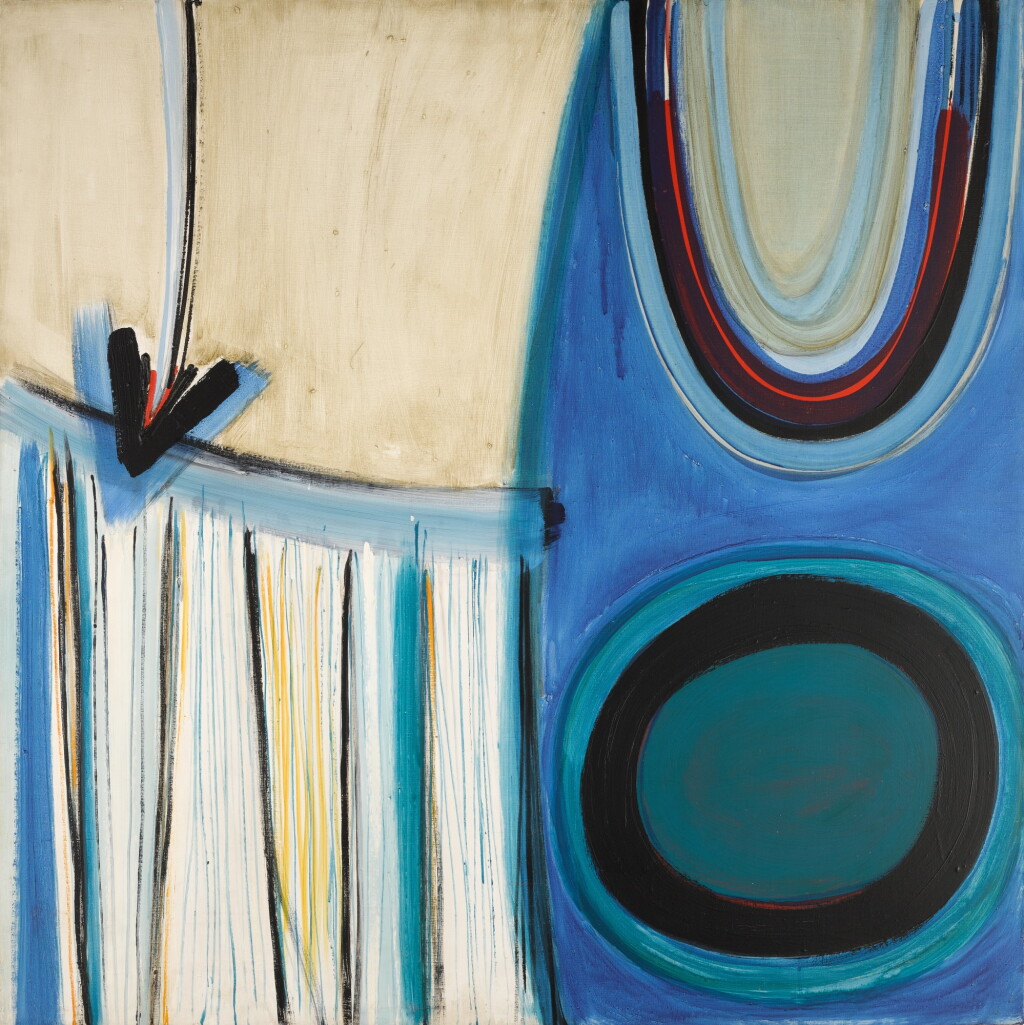
Blue Black Arrow
Estimate
50,000 - 70,000 GBP
Lot Details
Description
Terry Frost
1915 - 2003
Blue Black Arrow
signed Frost, titled, dated March May 62 and inscribed (on the reverse)
oil on canvas
unframed: 122 by 122 cm. 48 by 48 in.
framed: 143 by 143 cm. 56¼ by 56¼ in.
Executed in 1962.
Waddington Galleries, London
Peter Stuyvesant Foundation Collection (acquired from the above in April 1965)
Sale, Sotheby's, London, 11 November 1987, lot 264
Belgrave Gallery, London
Private Collection, UK
Acquired from the above by the present owner in 2001
Zurich, Galerie Charles Lienhard, Terry Frost, 1963
Raleigh, North Carolina Museum of Art, Young British Painters, 18 October - 15 November 1964 (as March, May 1962, Black Arrow)
Bolton Art Gallery, 1966-7 (on loan)
London, Tate Gallery, Recent British Painting: Peter Stuyvesant Collection, 15 November - 22 December 1967, no. 22, with tour to Art Gallery of South Australia, Adelaide, and Auckland City Art Gallery, New Zealand
London, Gillian Jason Gallery, Terry Frost: paintings 1948-1988, 25 May - 1 July 1988, no. 11
Alan Bowness, Recent British Painting: Peter Stuyvesant Foundation Collection, Lund Humphries, London, 1968, no. 22, illustrated p. 60
Terry Frost’s work is characterised by brilliant colour, geometric forms and an interest in light, movement and rhythm. Through colour, Frost believed that painting could invoke deep emotion, and the present work Blue Black Arrow is an example of this embrace to its fullest extent. During the 1960s, when the present work was painted, Frost developed a distinctive visual language based on circles, arcs and stripes combined with a use of pure colour, aiming to induce a joyful sensory response from the viewer through its abstract form.
In the 1950s, Frost had spent time in St Ives, Cornwall, where the British modernists first started experimenting with a new visual language- inspired by the sea, sky and sunlight of the surrounding natural environment. In the 1960s, Frost had moved to Oxfordshire with his wife, and was teaching part time at Coventry Art College and Reading University, and these experiences fully formed the artistic expression we see in Blue Black Arrow.
This celebration of abstract art was a movement happening in both Britain and the United States. After visiting the first British exhibition of American Abstract Expressionism at the Tate Gallery in 1956, Frost first went to America in 1960 and through Clement Greenberg, one of the leading art critics of the time, met some of the Abstract Expressionist painters, including Mark Rothko, Barnett Newman and Willem de Kooning.
The contrast of the strong compositional structure with a freer, more animated application of paint may reflect Frost’s response to his time in the United States: ‘The change of style seems to show Frost wishing to signal his delight in all sorts of visual stimuli … It also marks a move towards a greater commitment to a decorative abstraction, completely detached from any specific literal meaning’. (Chris Stephens, Terry Frost, St Ives Artists, Tate Publishing, London 2000, p.57.)
You May Also Like