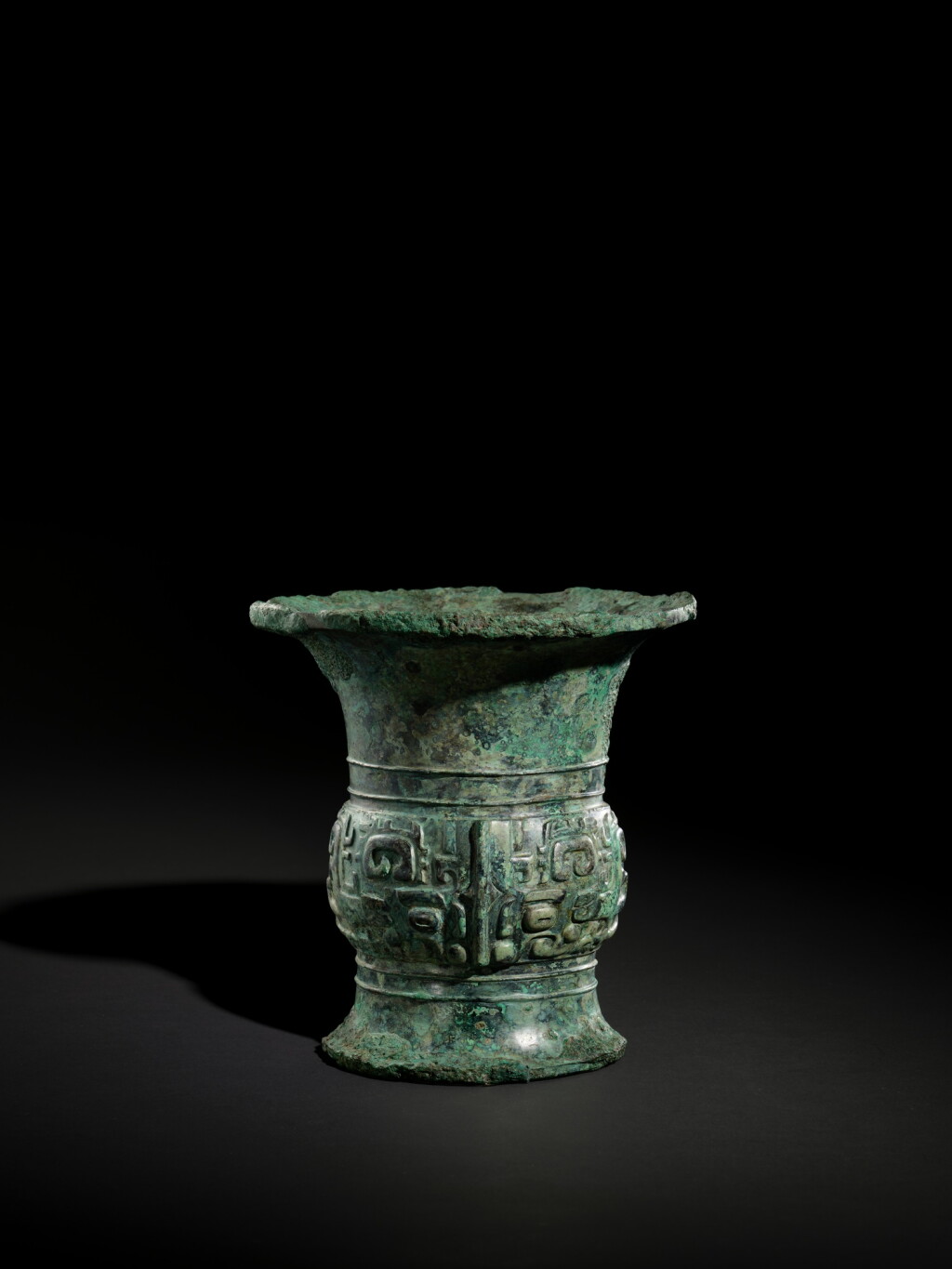
Tian Fu Ding Zun, an inscribed archaic bronze ritual wine vessel, Early Western Zhou dynasty | 西周初 天父丁尊
Auction Closed
May 5, 10:20 AM GMT
Estimate
100,000 - 200,000 HKD
Lot Details
Description
the interior base cast with three characters reading Tian Fu Ding ([made for] Heavenly Father Ding), wood stand and double Japanese wood box
18 cm
Osaka Art Club, Osaka.
Bronze zun were ritual wine vessels used in ceremonies to offer millet wine to ancestors and spirits, acting as a physical bridge between the living elite and the spirit world. They embody the kin‑based ritual obligations inscribed in bronze texts themselves, obligations that formed the backbone of early Chinese societies built on tightly knit lineages and clans; these bronzes were cast for posterity and ancestral memory, to be used by the clan’s descendants in generations to come. Zun were often part of a larger set and were usually cast in matching sets with wine containers you, appearing together in elite ritual assemblages.
In bronze inscriptions, the anthropomorphic character 天 (tian) pictured a standing person with an emphasised head, suggesting the highest part of the human figure, which later extended to mean “heaven” or “sky”. By the Zhou period, it had become the favoured term for the supreme cosmic power, often invoked in the concept of the “Mandate of Heaven”, linking the king’s legitimacy to an overarching, celestial order that watched over kinship and ritual.
A related bronze cauldron (ding) inscribed Tian Fu Ding, attributed to the late Shang to early Western Zhou period, is recorded in Xue Shanggong 薛尚功, Lidai zhongding yiqikuanzhi fatie 歷代鐘鼎彝器款識法帖, 1144, no. 9.2. Another bronze pouring vessel (guang) inscribed Tian Fu Ding, attributed to the early Western Zhou period, is recorded in Lü Dalin 呂大臨, Xu kaogutu 續考古圖, 1162, no. 2.8.
來源
大阪美術俱樂部,大阪
You May Also Like