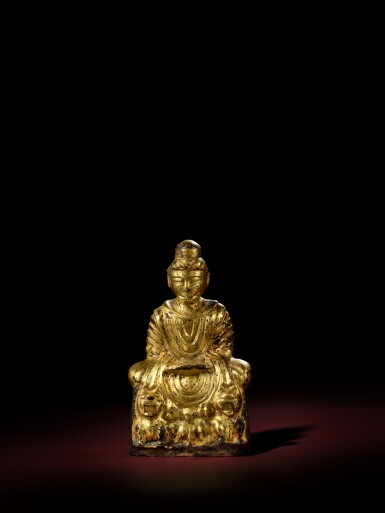
A small gilt-bronze seated figure of Shakyamuni Buddha, Sixteen Kingdoms | 五胡十六國 鎏金銅釋迦牟尼佛坐像
Auction Closed
May 5, 10:20 AM GMT
Estimate
300,000 - 600,000 HKD
Lot Details
Description
wood stand and Japanese wood box
13.2 cm
This gilt-bronze sculpture depicts the Buddha seated in meditation atop a rectangular pedestal, with hands placed in the dhyana mudra and legs crossed beneath a billowy robe. The robe, evenly draped over the Buddha’s shoulders and forming concentric U-shaped folds in front of the chest, retains an evident influence of the Hellenistic Gandharan style. The artful realism is further echoed in the Buddha’s neatly combed hair above his squarish forehead, topped by a rounded chignon.
The pedestal appears to have been cast together with the figure, and its front is flanked by a pair of robust lions, each baring teeth and extending paws. While details of the hair and robe attest to a Gandharan prototype, the lions are Chinese elements, indicating the origin of this sculpture: the Sixteen Kingdoms, a milestone period when West Asian influences and Chinese localisation started to crystallise in Buddhist art.
Compare a renowned gilt-bronze Buddha in the Avery Brundage Collection of the Asian Art Museum, San Francisco, no. B60B1034; the Brundage Buddha is inscribed and dated to AD 338, securing its attribution to the Later Zhao (AD 319-351), a kingdom founded in Hebei by a nomadic people who eventually controlled most of northern China. It was in this kingdom that Buddhism became a state-sponsored, widespread religion after being a minority religion for centuries. The figure’s sitting posture, brushed hair strands, drapery over the shoulders, and U-shaped robe pleats are all similar; the pedestal, also rectangular in form and cast together, features three symmetrically positioned holes, possibly once bearing flanking lions too.
Another gilt-bronze Buddha, also bearing a notable resemblance, is in the Winthrop Collection of the Arthur M. Sackler Museum, Harvard Art Museums, Cambridge, Massachusetts, acc. no. 1943.53.80.A. In addition to the similarities shared by the Brundage Buddha, the dhyana mudra and the lions on the pedestal of the Winthrop Buddha find direct parallels in the present sculpture. It is generally assumed that the Brundage gilt-bronze is the earliest dated Chinese image of Buddha. Some Harvard curators argue, however, that the undated Winthrop Buddha predates the Brundage Buddha, probably due to its retention of a moustache, a trait characteristic of West Asian prototypes.
A further museum example attributed to the Sixteen Kingdoms is now in the Asian Gallery, Tokyo National Museum, acc. no. TC-640; though its pedestal is plain without lions, the correspondences are equally apparent. See also two contemporaneous figures from the art market: one sold at Christie’s New York, 20th March 2014, lot 1601; the other from the Sakamoto Gorō Collection, sold in these rooms, 5th October 2016, lot 3201. While all components are similar, the gilding on the present sculpture remains less affected by time, recalling the Buddha in its original glory.
此尊鎏金銅佛結跏趺坐於長方形台座上,施禪定印,兩腿交盤,袈裟寬綽,披覆雙肩,於胸前形成U形衣紋,層層疊疊,顯見希臘式犍陀羅制式遺風。佛陀額髮茂密,梳束齊整,於頭頂結渾圓肉髻。
台座與佛身一體鑄造,正面兩側各有一獅子,齒牙外露,前爪伸展,雄健威儀。佛陀髮式與衣紋處理可溯至犍陀羅原型,雙獅在側則為漢地元素,種種細節令此像斷代明朗,即十六國時期;此時期內,西域影響與漢地本土化於佛教藝術中凝結成型,為風格融合之關鍵階段。
比一金銅佛名品,布倫戴奇寶蓄,藏舊金山亞洲藝術博物館,館藏編號:B60B1034。該像帶銘文,紀年為公元338年,即屬後趙(公元319–351年)。後趙為北方游牧民族所建,起於河北,後控北方大部。此政權下,佛教由小眾信仰躍升為舉國供養、廣宣流布之宗教。佛陀作禪定坐姿、梳攏髮式,佛衣過雙肩,衣紋呈U形,本像與之一一相類。此外,台座亦為長方形一體鑄造,正面對稱分佈三孔,或曾安置兩側獅子。
再比較金銅佛一尊,為溫思羅普舊藏,藏哈佛大學亞瑟.M.賽克勒博物館,館藏編號:1943.53.80.A。除與前例共有之相似處外,此例之禪定手印與台座獅子更與本像直接對應。學界普遍認定布倫戴奇銅佛為最早紀年之漢地佛像,然部分哈佛策展學者主張,無紀年之溫思羅普銅佛年代更早,或因該像保留髭鬚,更貼近此前之西域原型。
另比一斷代十六國時期之博物館例,現藏東京國立博物館東洋館,館藏編號:TC-640。除台座素面無獅外,其餘特徵均顯著對應。市場中亦見二例,斷代相同,其一售於紐約佳士得2014年3月20日,編號1601;其二出自坂本五郎舊藏,售於香港蘇富比2016年10月5日,編號3201。較之此二例,本像鎏金保存尤善,佛陀妙相宛如往昔。
You May Also Like