
Jacob van der Ulft
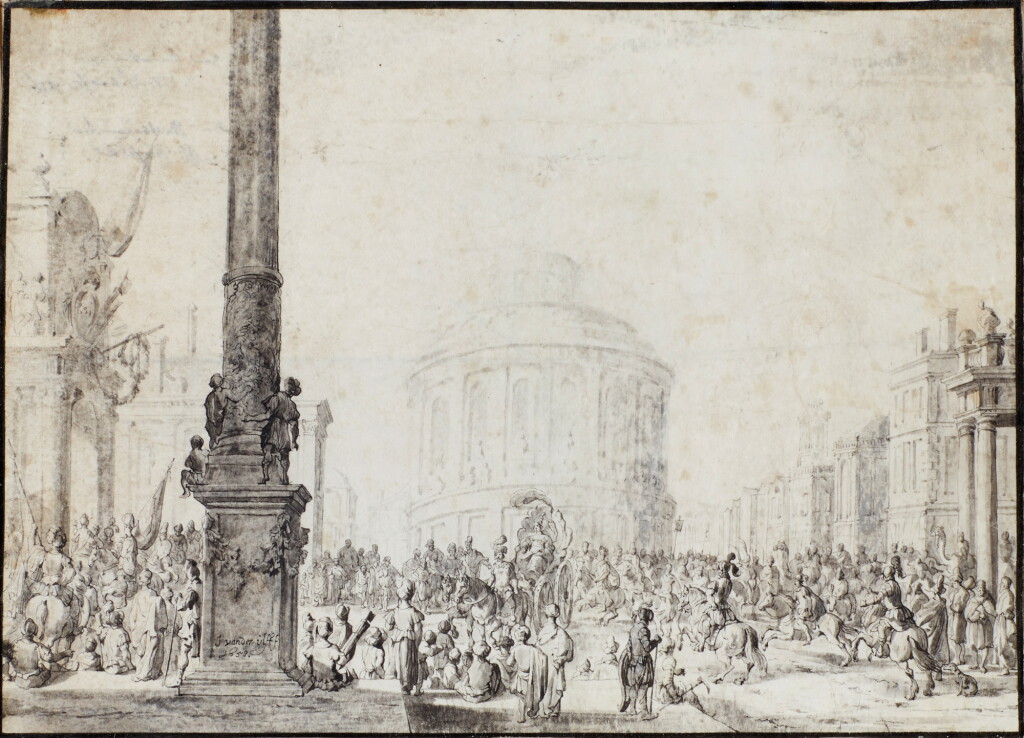
A Procession Before a Circular Temple
No reserve
Auction Closed
February 4, 08:08 PM GMT
Estimate
5,000 - 7,000 USD
Lot Details
Description
Jacob van der Ulft
(Gorinchem 1627 - 1689 Noordwijk)
A Procession Before a Circular Temple
Pen and black and gray ink and wash, on vellum laid down on paper;
signed and dated in black ink, at the base of the column near the lower left: J vander Ulft f / 1658;
bears illegible inscription, verso (drawing is laid down)
152 by 210 mm; 6 by 8¼ in.
Purchased from C.G. Boerner, Leipzig, in 1920 by Dr. Curt Otto, Leipzig (L.611c),
his posthumous sale, Leipzig, C.G. Boerner, 7 November 1929, lot 140;
sale Paris, Aguttes, 19 December 2017, lot 29
Although Van der Ulft made numerous very specific views of Rome, it is unclear whether he ever actually visited Italy. The contemporary biographer Arnold Houbraken states definitively that he did not go to Italy, and further claims that his Roman views were based on the work of other artists. Certainly, Van der Ulft was profoundly influenced by the work of another amateur artist, his contemporary Jan de Bisschop (1628-1671), whose drawings approach his own in both style and handling. (It is likely, however, that De Bisschop himself never travelled to Italy). A number of copies by Van der Ulft of drawings by De Bisschop are known, which suggests that the former may have had access to his studio. An album of forty-three landscape drawings by both Jacob van der Ulft and Jan de Bisschop, mostly views in or around Rome, is in the collection of the Dukes of Devonshire at Chatsworth. Another album of Roman views by Van der Ulft is in the Fondation Custodia in Paris.
An especially refined example of Van der Ulft’s draughtsmanship, this highly finished drawing - prominently signed and dated - was almost certainly intended as an autonomous work of art for sale. As Michiel Plomp has noted, ‘Jacob van der Ulft produced many drawings and paintings of festive processions in imaginary ancient cities...It is not always clear whether Van der Ulft meant to depict actual historical facts.’1 Other drawings by the artist that are similarly crowded with figures are in Paris, Haarlem, Berlin and New York.2
Van der Ulft was clearly an artist who appreciated the smooth surfaces offered by vellum, on which he made many of his typical, finished gouaches. A monochrome drawing by the artist on this support is, though, something of a rarity.
1.Michiel C. Plomp, The Dutch Drawings in the Teyler Museum. Vol.II: Artists Born Between 1575 and 1630, Haarlem/Ghent/Doornspijk 1997, p. 399, under no. 464.
2.Paris, Musée du Louvre, Inv. 23236; Haarlem, Teylers Museum, Inv. Q71, Plomp, loc. cit.; Berlin, Kupferstichkabinett, Inv. 4338; New York, Morgan Library & Museum, Inv. 1985.16
You May Also Like


