
Property from a Noble European collection
Abraham Bloemaert
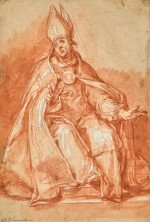
Recto: A Seated Bishop (Saint Willibrordus?) | Verso: Studies of arms and shoulders
Auction Closed
July 1, 11:00 AM GMT
Estimate
6,000 - 8,000 GBP
Lot Details
Description
Property from a Noble European collection
Abraham Bloemaert
(Gorinchem 1566 - 1651 Utrecht)
Recto: A Seated Bishop (Saint Willibrordus?)
Verso: Studies of arms and shoulders
Red chalk and red wash, heightened with white, indented for transfer (recto);
red chalk and wash (verso);
the sheet blackened on the reverse for transfer;
bears signature in black ink, recto, lower left: A: Bloemaert:-
246 by 164 mm
James, 16th Lord Forbes (1724-1804),
by descent to his grandson Charles Forbes René, Comte de Montalembert (1810-1870),
by family descent to the present owner
Rotterdam, Kunsthal, European Master Drawings Unveiled, 2002, cat. 49 (recto only described and illustrated)
Double-sided sheets of studies by Bloemaert executed in this distinctive and appealing combination of red chalk and red wash, with carefully applied white highlights, are not rare. What is, however, unusual in such double-sided sheets is to find that the drawing on one side has had its outlines indented for transfer, and that the other side of the sheet has been lightly blackened - despite the fact that it bears several fine studies by the artist - to allow the transfer of the design on the recto to an engraver's plate, or possibly another sheet of paper.
Although the seated bishop on the recto is lacking any specific attributes to aid in his identification, it seems likely that he is Saint Willibrord, the patron saint of the Netherlands and first Bishop of Utrecht. Active circa 700 AD, Willibrord is credited with introducing Christianity to the present-day Netherlands and Belgium. A drawing by Bloemaert, now in Chicago, shows an almost identical bishop-saint, posed in exactly the same way, but there holding in his hand a small cathedral, symbolising his pioneering efforts to establish a monastery and a cathedral in the city of Utrecht.1 This drawing, which was not known to Jaap Bolten, can reasonably be considered an initial thought for the image that Bloemaert developed further in the Chicago drawing, but it remains unclear whether the indenting of the outlines in our drawing signifies that Bloemaert physically transferred the design from this drawing onto the sheet used for the Chicago drawing, or that it was used in the preparation of an unidentified engraving. Although prints of Saint Willibrord after designs by Bloemaert do exist, they show the saint standing rather than seated, and no print corresponding to the present drawing has yet been identified.
The studies on the verso are different in nature and function: four separate studies of the left shoulder and/or hands of a figure in prayer. Here we see the type of drawing that Bloemaert, the greatest drawing teacher of his time, would have made not only to help with the preparation of his own compositions but also to teach and inspire younger artists. Indeed, when making drawings of this type Bloemaert seems to have had in mind the plan to engrave and publish them as a pattern-book for artists in training, a project that was only brought to fruition after his death by his son Frederik, in the celebrated Tekenboek, a compendium of prints after his father's drawings intended to be used as a drawing manual and a repertoire of figures and poses.
1.Art Institute of Chicago, inv. 2013.896: https://www.artic.edu/artworks/204307/saint-willibrord; J. Bolten, Abraham Bloemaert, The Drawings, 2 vols., Leiden 2007, cat. 312


